Why Celebrity Weddings Have Become The Internet’s Biggest Obsession
From Taylor Swift and Travis Kelce’s global spectacle to Aamir Khan’s intimate Bandra ceremony, celebrity weddings reveal why fans crave a front-row seat to lives they can never fully enter

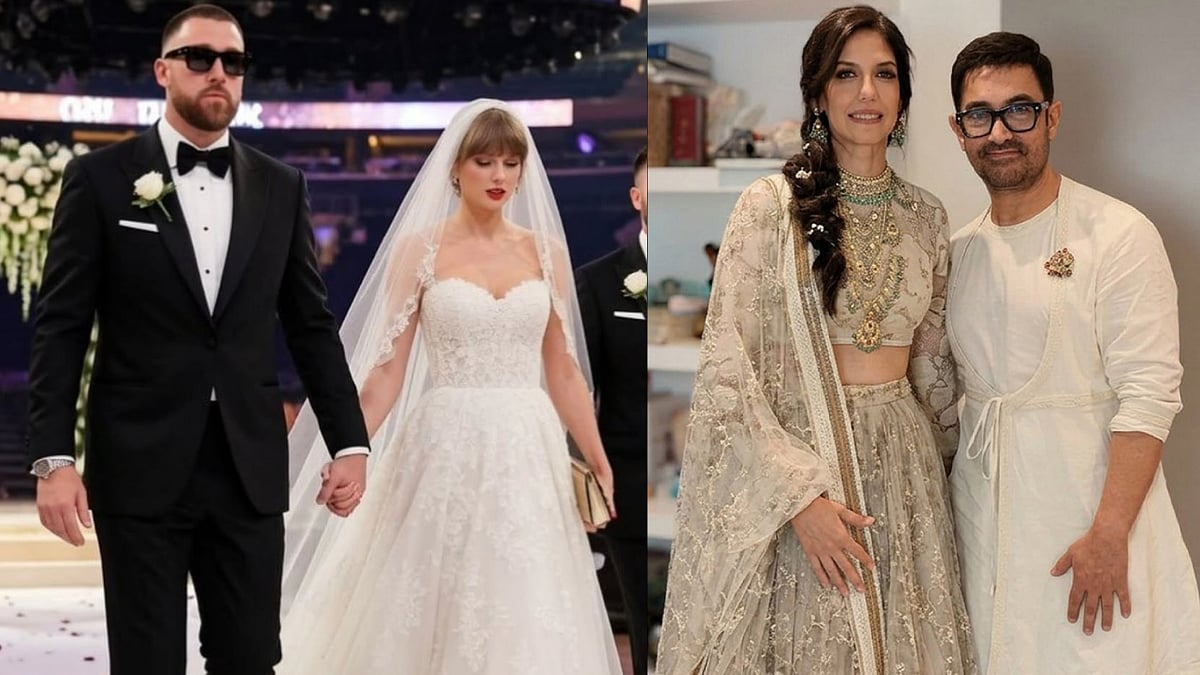
The internet broke twice this summer. First on July 3, when Madison Square Garden turned into a wedding venue for Taylor Swift and Travis Kelce, its billboards lighting up purple with the words "JUST MARRIED" for anyone standing on West 31st Street to see. Then, two days later, halfway across the world in a quieter corner of Bandra's Pali Hill, Aamir Khan signed his own marriage register in an eggshell angrakha kurta, surrounded by a hundred and fifty people who mattered more to him than the thousands who wanted to be there.
Two weddings. Two continents. Two completely different scales of spectacle. And yet, both had the same effect: they stopped the scroll.
Anatomy of an obsession
There is something almost involuntary about the way people consume celebrity weddings now — not just the photographs, but the permits, the guest lists, the florist leaks, the security details. Swift and Kelce's wedding generated news coverage that read less like entertainment journalism and more like an investigative dossier: a street-closure permit filed by an events company, a mayoral aside at a press briefing, a hotel lobby full of unmarked SUVs two full days before the ceremony. Meanwhile, Khan's wedding, deliberately small and private, still made headlines simply because he tried to keep it small.
“People don't just want to know who got married. They want to feel like they were almost invited,” says Ankit Choudhary, a Mumbai-based enthusiast who has spent the better part of the last decade tracking celebrity weddings as a hobby that occasionally feels like a full-time job. “Every leaked detail — the venue, the outfit, the guest list — gives you a small hit of proximity to a life you'll never actually be part of. That's the addiction.”
It is a fair diagnosis. Celebrity weddings today are consumed the way sporting events once were: live-blogged, fact-checked in real time, argued over by strangers who have never met either party. The difference is that a wedding, unlike a match, promises intimacy rather than competition — and it is that promise, however manufactured, that keeps people watching.
Consider the sheer volume of detail that surfaced around the Swift-Kelce wedding alone: the officiant, the dress code, the reported eight-figure charity donation, even which designer might have made the bride's gown, guessed from a friend's rehearsal-dinner outfit. None of it was officially confirmed by the couple. All of it was consumed anyway, stitched together by fans and outlets into a narrative nearly as detailed as an authorised account would have been.
Why it feels personal
There is a clinical name for what's happening in our heads, and it predates Instagram by decades. Sociologists Donald Horton and Richard Wohl coined the term "parasocial relationship" back in 1956, describing the one-sided bond television viewers formed with the personalities who appeared on their screens night after night. Psychologist Karen Dill-Shackleford has traced the impulse even further back, noting that something resembling celebrity fixation existed as far back as ancient Rome, aimed at famous actors and orators long before broadcast media existed. The format keeps changing — stage, screen, feed — but the underlying wiring, it turns out, does not.
What has changed is the intensity. Melanie Maimon, an assistant professor of psychology at Bryant University, points out that social media has sharpened these one-sided bonds considerably, giving fans a constant, intimate drip of access that television never could. A wedding, in that context, isn't gossip so much as a milestone in a relationship that feels, to the fan, entirely mutual — even though only one side knows the other exists. Clinicians broadly agree the attachment is harmless on its own; it tends to become a concern only when it starts replacing real relationships rather than sitting alongside them.
Ground zero of the frenzy
Nobody understands the mechanics of that frenzy quite like the people working inside it. Faizal Khan, who has spent this wedding season interning with an event management outfit in Mumbai that occasionally brushes up against high-profile bookings, describes the run-up to a big celebrity wedding as controlled chaos.
“The client wants privacy, but privacy has become the hardest thing to sell,” he says. “The more a couple tries to keep something under wraps, the more resources go into guessing what's behind the wraps. It's strange — sometimes the secrecy generates more coverage than an open guest list would have.”
That paradox played out almost perfectly with both weddings this month. Khan and Spratt's preference for intimacy became its own headline. Swift and Kelce's guarded planning became a running live-blog. Either way, the public got its story. As Faizal puts it, “in this business, you learn quickly that ‘no comment’ is not the same as ‘no coverage.’ The absence of information just gets filled in by speculation, and speculation is often more interesting to read than the truth would have been.”
Reading the cultural moment
“Weddings are one of the last life events that still feel universally legible, no matter who you are,” says Shilpi Gupta, who has spent years studying how audiences engage with celebrity narratives. “A film release can be niche. A business deal can be abstract. But everyone understands what a wedding means — commitment, family, a new chapter. When a celebrity gets married, audiences aren't just watching gossip. They're watching a story they already know how to feel something about.”
Kartik Agarwal, who writes on pop culture and fandom behaviour, points to something else: the collapsing distance between fans and celebrities in the social media era. “A decade ago, you'd find out a star got married from a magazine cover, days or weeks later. Now you're watching billboards light up in real time from your phone. The wedding isn't just reported — it's experienced, almost simultaneously, by millions of strangers. That immediacy changes the emotional stakes entirely.”
Perhaps that is the real story hiding inside both weddings this July — not Aamir Khan's third marriage, or Taylor Swift's most photographed one yet, but the audience itself. Two very different couples, two very different approaches to privacy, and one identical outcome: the world, uninvited, showed up anyway.
RECENT STORIES
-
-
-
-
-