The Surgeon Who Waited 2,600 Years: Maharishi Sushruta Finally Gets His Place In Global Medicine
A bronze statue of India's Maharishi Sushruta now stands inside one of the world's oldest surgical institution in Scotland

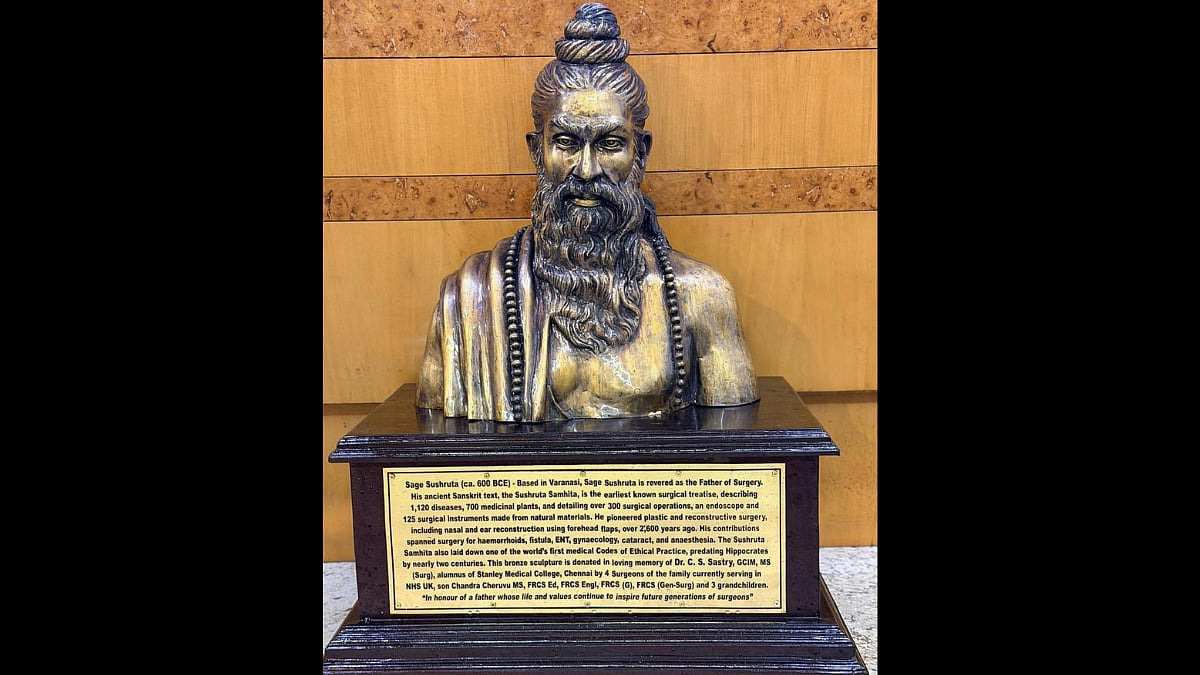
Recently, a 90-kilogram bronze statue of Maharishi Sushruta—widely regarded as the Father of Surgery—was unveiled at the Royal College of Surgeons of Edinburgh, the world's oldest surgical institution, founded in 1505 and home to over 33,000 members across more than 140 countries. The sculpture, crafted using the traditional lost-wax method by artisans in Thiruvannamalai in Tamil Nadu, was donated by the Cheruvu Family Foundation and transported to Edinburgh after clearing customs in both countries.
The statue stands near the staircase leading to the college's Playfair Hall, where surgical fellows receiving their degrees will pass it—a deliberate symbolic gesture connecting Sushruta's foundational work to the living practice of modern surgery. Alongside the unveiling, the college announced the establishment of an annual Sushruta Lectureship, made possible through a donation from Professor Vadrevu K. Raju, cementing the recognition.
The Man Behind the Samhita
Sushruta is believed to have lived around 600 BCE in the ancient city of Varanasi. His defining work, the Sushruta Samhita, is an ancient Sanskrit text documenting surgical procedures, instruments, and techniques—including early methods of nose reconstruction (rhinoplasty) that are among the earliest recorded examples of plastic surgery. He is credited with performing over 300 types of surgeries and inventing 124 distinct surgical instruments.
For Rajiv Vasudevan, CEO of Apollo AyurVAID, this moment points to something larger. "The unveiling of Acharya Sushruta's statue is a global recognition of India's civilizational contribution to medicine," he says. "Sushruta's contributions to surgery, complemented by the medical tradition articulated in Charaka Samhita, laid the foundations of a comprehensive healthcare system that has stood the test of time and can rightfully lay claim to be the mother system of medicine of the world."
Vasudevan draws a precise division of labour between the two ancient scholars. "While Sushruta advanced surgical science, anatomy, and trauma care, Charaka elaborated physiology, pathogenesis, diagnosis, prevention, individualized therapeutics, and the restoration of health — addressing root causes of disease beyond germs and external factors to inappropriate diet, lifestyle, mental factors, and co-morbidities."
Dr Gagan Tiwari, Medical Superintendent at Kailash Ayurveda in Noida, echoes the point about recognition. "International recognition of his contributions is not just a matter of cultural pride," he says. "It is an acknowledgement of India's longstanding role in the evolution of medical science."
Dr Sughran Banerjee, London based MD (res) and Fellow of the European Board of Orthopaedics and Trauma, is more direct, saying "this was long due. The Royal Australasian College of Surgeons had done this in 2018. Documented texts of the Samhita are definite proof of Sushruta as a seminal plastic surgeon."
Between Ancient Wisdom and the ICU
The statue has sharpened a question that Indian medical practitioners have long debated - not just who Sushruta was, but what Ayurveda is for, now.
Notably, in November 2020, the Central Council of Indian Medicine (CCIM), a statutory body of the Ministry of Ayush, issued an amendment to the Indian Medicine Central Council (PG Ayurveda Education) Regulations, listing 58 surgical procedures that postgraduate students in Ayurvedic surgery are to be formally trained in and can practice independently afterward
Dr Kartikeya Chaturvedi, cardiologist and professor at Hangzhou University, draws a distinction he considers clinically important. "When it comes to really acute conditions, I don't think there's a lot of medication in Ayurveda which can deal with, say, an acute myocardial infarction—a heart attack. Not a lot of medications which can deal with appendicitis, or any acute condition."
But he does not dismiss the system. "It has been in existence for the past 5,000 years, so we cannot negate it. Ayurveda is more holistic medicine rather than acute medicine. If you can incorporate Ayurveda, you'll definitely live a healthier life."
Vasudevan argues that the framing of either-or is itself the problem. "The world does not need to choose between Ayurveda and Allopathy," he says. "It needs a healthcare system where both work together to deliver better outcomes, longer and healthy life spans, and more humane care." He points to persistent systemic gaps that Ayurveda can address, the gulf between life expectancy and health-adjusted life expectancy, which globally remains stuck at twelve to fourteen years; the rise of multimorbidity and chronic metabolic disease; antimicrobial resistance; and the affordability crisis in healthcare. "It is worthwhile to examine the preventive, curative, and promotive healthcare that Ayurveda can provide at a whole-person level," he says. Apollo AyurVAID and Apollo Homecare, he notes, have already piloted this model in an integrative, step-down care for complex cases, and demonstrated superior clinical outcomes at lower cost.
Dr Banerjee adds a pointed observation about intellectual ownership. "Ayurveda should not be looked at as alternative medicine. Many of its components are already patented by the Americans like Curcumin from turmeric, Nimin from neem, Coenzyme Q10 from Shilajit."
The next horizon, Vasudevan suggests, is ‘Precision Ayurveda’, where “classical Ayurveda principles are studied and understood through contemporary science, biomarkers, genomics, digital health, and clinical evidence", he explains. Sounds like Indian medicine is finally getting its due.
RECENT STORIES
-
-
-
-
-