The Other Paella: Fascinating Story Behind Fideuà
Along Spain’s Mediterranean coast in Valencia, where rice has long held sway over the pan, another dish emerged from the sea: fideuà, a noodle-based cousin with a story as fascinating as its flavour

Pic: Wikimedia Commons
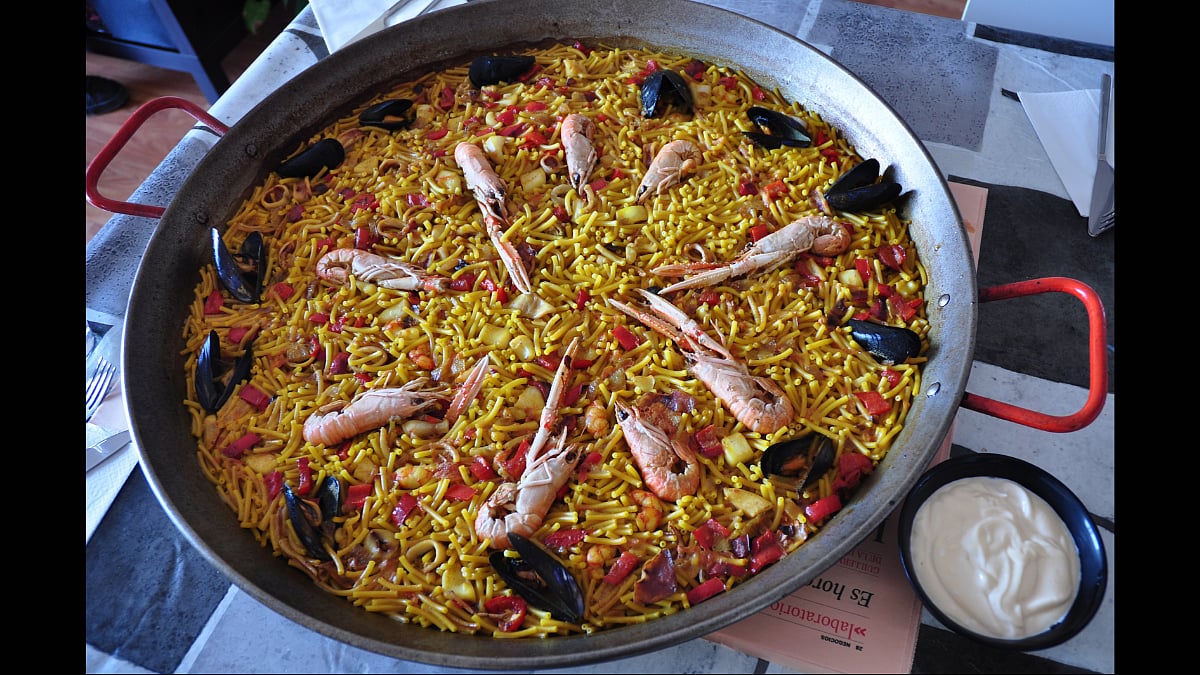
Like most great accidentally created dishes, there is something wonderfully Valencian about one born from necessity. Fideuà takes the architecture of paella—wide pan, intense stock, seafood and a carefully managed fire—and replaces rice with noodles, creating a dish that is unmistakably its own. Its birthplace is generally accepted as the Grau de Gandia, the port district of Gandia in the province of Valencia.
Born at Sea
The most widely told story places fideuà aboard the fishing boat Santa Isabel in the early 20th century. According to Gandia’s gastronomic association, the vessel sailed from the Grau around 1912–14 with six fishermen aboard. When lunchtime came, the cook began preparing what was essentially a seafood paella, using prawns, langoustines, monkfish and a stock made from the day’s fish. Only one problem remained: there was no rice!
Rather than abandon lunch, the cook improvised with what was available—compact pasta, traditionally described as pieces of spaghetti. He broke it into shorter lengths and treated it as he would rice, allowing it to cook in the seafood stock until the liquid was absorbed. The result apparently pleased the crew sufficiently for the invention to survive beyond that boat and eventually become the signature dish of Gandia.
It is a charming origin story, although the precise chronology is not quite as tidy as the legend suggests. Some accounts place the invention around 1930, while the official history of Gandia’s fideuà also gives considerable importance to Emilio López Bonías, a chef who began serving the dish at the Hotel Europa in the Grau in 1960. López reportedly developed the preparation into the recognisable restaurant dish, using thicker noodles with the seafood arrangement of a paella.
That distinction is important. Fideuà may have begun with fishermen, but its journey from improvised boat food to a codified regional speciality involved cooks, restaurants and the culinary culture of Gandia.
A Paella Without Rice
At first glance, fideuà looks like paella’s mischievous sibling. It is cooked in the same broad, shallow paella pan, allowing the noodles to spread rather than pile deeply. But the substitution of pasta changes everything.
The official Gandia version is remarkably specific. It calls for number 4 noodles, monkfish, prawns and langoustines, along with garlic, tomato, sweet paprika, grated onion, saffron, olive oil and fish stock. The stock is fundamental: a proper fumet made from rock fish and crustaceans provides the brine-y, marine depth into which the noodles absorb their flavour.
The technique matters as much as the ingredients. Seafood is first seared in olive oil and removed. The sofrito follows, then the noodles are briefly fried before hot stock is introduced. The monkfish returns during cooking, while the prawns and langoustines finish the dish. The aim is noodles that are loose and succulent rather than wet, with enough surface exposure for the heat to do its work.
And then there is allioli. The garlicky emulsion is not merely decoration. Served alongside fideuà, it cuts through the richness of the seafood and adds a creamy garlic note that makes every forkful taste slightly different.
The noodle itself is another point of fascination. In Gandia, number 4 is regarded as the traditional calibre, though other versions use thinner strands or the distinctive hollow, slightly curved fideos sometimes known as perla. That small hole is surprisingly useful: it allows the noodle to capture more of the surrounding stock.
From Gandia to the Mediterranean
As fideuà travelled, it inevitably changed. Along the Valencian coast, cooks adapted it according to local seafood and household practice. Further north, it found particularly enthusiastic followers in Catalonia, where cooking with noodles and fish already had deep roots.
This is where culinary terminology becomes delightfully complicated. Catalonia has its own family of fisherman’s noodle dishes, especially fideus rossejats. These are generally made with fine noodles that are toasted before being cooked in fish stock, often with allioli on the side. They resemble fideuà but are not quite the same dish.
There are also versions known as fideuà negra, in which squid or cuttlefish ink turns the noodles almost black and gives the dish a deeper, briny character. In Barcelona and along the Catalan coast, seafood fideuàs may include cuttlefish, prawns, mussels or other local catches, depending on the cook.
That proliferation of versions explains why ordering fideuà in different parts of Spain can produce markedly different plates. One may arrive with thick noodles and langoustines; another with fine, toasted strands and a dark seafood base. Some are relatively dry, while others retain more stock. The common thread is the marriage of pasta, seafood and the shallow-pan technique.
Yet Gandia remains protective of its original identity. Its International Fideuà Competition, first held in the 1970s and now an international event, has helped establish the city’s recipe as the benchmark for Fideuà de Gandia. The 2026 competition was its 51st edition, demonstrating how a dish that began as a solution to an empty rice sack has become a serious part of the region’s gastronomic heritage.
Perhaps that is fideuà’s greatest charm. It is not simply “paella with noodles”. It is a lesson in Mediterranean ingenuity: take the pan, respect the sea, build a good stock and adapt when the pantry refuses to cooperate. Somewhere off Gandia, a missing ingredient changed lunch—and, in doing so, created one of Spain’s most distinctive dishes.
(The writer is a food and travel columnist and editor)
RECENT STORIES
-
-
-
-
-