The Diwali Ank Isn't Dead. But Who Is Still Reading It?
Once an essential part of festive shopping, regional-language magazines’ Diwali special issues are confronting shrinking readerships and changing reading habits

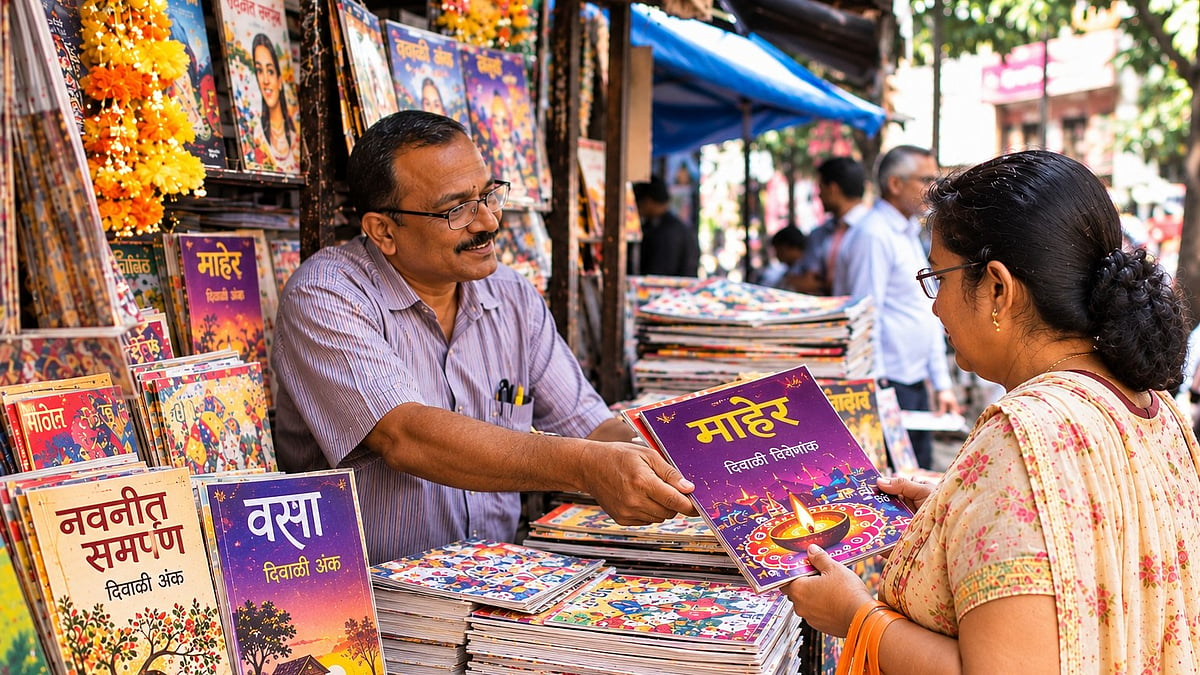
Representative Image
Diwali of my childhood had everything: rangoli, diyas, the bustle of guests, that familiar silver tray of dry fruits on the centre table and an assortment of traditional festive snacks. But alongside all this was another Diwali essential. A corner table stacked with magazines. Not just any magazines. These were the much-awaited Diwali Ank, Diwali special festive editions of regional-language magazines that brought together some of the finest names in literature, poetry, theatre and art.
There were glossy covers, specially commissioned photographs and illustrations, and the excitement of discovering what one’s favourite writers had contributed that year. Although newspaper vendors delivered these issues to our doorstep, visiting a bookstore to buy them was a Diwali ritual in itself. Rows of colourful covers, the pleasure of leafing through pages, the difficult business of choosing which ones to take home. It was festive shopping of a different kind.
I particularly remember the thick Diwali special of Gujarat, published by the Gujarat government’s information department. Its sections included plays, which I would read aloud, performing every character myself, complete with dramatic flourishes.
But when was the last time you saw six or seven Diwali special issues lying on someone’s centre table, waiting to be read? Yet, with almost everything we read now arriving on a screen, what has happened to this once-cherished literary ritual?
For Deepak Doshi, editor of Bharatiya Vidya Bhavan’s Gujarati magazine Navneet Samarpan for nearly four decades, preparing a Diwali special has always been an elaborate editorial exercise. "We would invite established authors and poets to contribute. The entire issue would, often, revolve around a particular theme," he recalls.
Given Bharatiya Vidya Bhavan’s educational and cultural orientation, literature, life and education remained central to its publications. Some editions explored unusual subjects, including iconography.
Change in approach
What troubles Doshi today is not simply declining sales, but a deeper change in how people approach reading. "There was a time when reading was considered essential. Today, that habit has been marginalised," he observes.
Smartphones, streaming platforms and digital entertainment have altered reading habits. Many readers now prefer receiving magazines as PDFs rather than buying printed copies. But Doshi believes the greater loss is that of sustained engagement with a subject.
"People feel they have knowledge at their fingertips. But getting information and understanding something in depth are two different things."
In an age of instant delivery, he argues, even knowledge is being treated as something that must be available immediately. Information is abundant, but the patience required to absorb and reflect upon it is becoming scarce.
There are practical challenges, too. Printing and paper costs have risen, editorial resources have shrunk, and even essential roles such as proofreading are becoming difficult to sustain.
Reader's memories
Writer and academician Avaneesh Bhatt remembers his family eagerly purchasing seven or eight Gujarati Diwali specials in the 1980s and 1990s. Gujarat, Chitralekha and Abhiyan were favourites. Short stories were the main attraction, with the occasional complete novella an added delight.
"My mother often remarked, 'The Gujarat Diwali issue is so heavy that holding it for too long gives you an ache in the arm,'" he recalls.
The children took turns with the magazines, sometimes quarrelling because they suspected a sibling had deliberately hidden an issue to finish reading it before school reopened.
Bhatt sees their diminished appeal as part of print magazines' wider decline. His family once bought English and Gujarati weeklies regularly; today, he no longer rushes to pick up special editions. "The once-voluminous Diwali issues have grown slimmer, and the excitement that once accompanied their arrival has dimmed," he says.
He points to a contrast in West Bengal, where Pujabarshiki, annual literary special editions published around Durga Puja, continue to hold cultural and commercial significance. For Bhatt, their endurance throws the waning excitement around Gujarati Diwali issues into sharper relief.
Difference in literary language
Yet the story of the Diwali Ank is not entirely one of decline.
Sandhya Nare-Pawar, an independent journalist, writer and editor associated with the Marathi magazine Vasa for 25 years, offers a more hopeful perspective. "Diwali issues are still being published. Yes, their sales and readership have declined. But something interesting is happening within their pages," she says.
A younger generation is bringing new forms of expression to these publications. Their poetry, prose and storytelling do not necessarily follow the literary conventions familiar to older readers.
What particularly excites Nare-Pawar is the changing background of contributors.
"Earlier, many contributors came from urban backgrounds. Even stories about rural life were often written by urban authors. Today, writers from smaller towns and villages are bringing their own experiences, dialects and perspectives into these publications."
As young writers increasingly write in the dialects they grew up speaking, Diwali Ank are also becoming spaces where regional expressions are documented and preserved through literature.
"The contributor’s age has also changed. Today, we have writers in their twenties and thirties. Their language, their experiences and their ways of looking at the world are different." She is particularly appreciative of the non-linear forms of expression emerging in contemporary writing. For an editor, this willingness to experiment makes putting together a literary issue exciting.
Readers share the excitement too. “It is particularly heartening to see youngsters write. Especially in Marathi Diwali Ank,” says 60-year-old Savitri Gadkar. “They give people like me a different and fresh perspective of things.”
Nare-Pawar acknowledges the difficulties. Some magazines have discontinued their Diwali editions, others face declining sales, and digital platforms are competing for readers. But she is reluctant to declare the tradition’s future bleak. "We need to wait and watch rather than simply conclude that it will not survive. A new generation is reaching readers with different kinds of writing. And what better platform for that than a Diwali Ank?"
Gadkar adds to this observation. “While some old favourites in Marathi have shut shop, there are some new in the market and new genres like thrillers and erotica too.”
Beyond shopping list
Perhaps the real question is not whether the Diwali Ank can reclaim its old place on the centre table, but whether it can find a meaningful place in the lives of a new generation of readers. The glossy covers may compete with glowing screens. The familiar names may share space with unfamiliar voices. The tradition is changing, certainly. But so is the literature it carries.
And perhaps, somewhere this Diwali, a young reader is still turning the pages of a special issue, discovering a writer for the first time, and finding a story worth lingering over.
RECENT STORIES
-
-
-
-
-