Residents Captured Red Auroras In Ladakh; Is It A Warning Sign? | Here's The Truth
Who doesn't love watching Auroras? It's just a matter of chance, isn't it? On Monday, January 19, 2026, red aurora scattered in the sky lit up the night sky over Hanle in Ladakh, creating one of the most breathtaking astronomical sights ever seen from India.

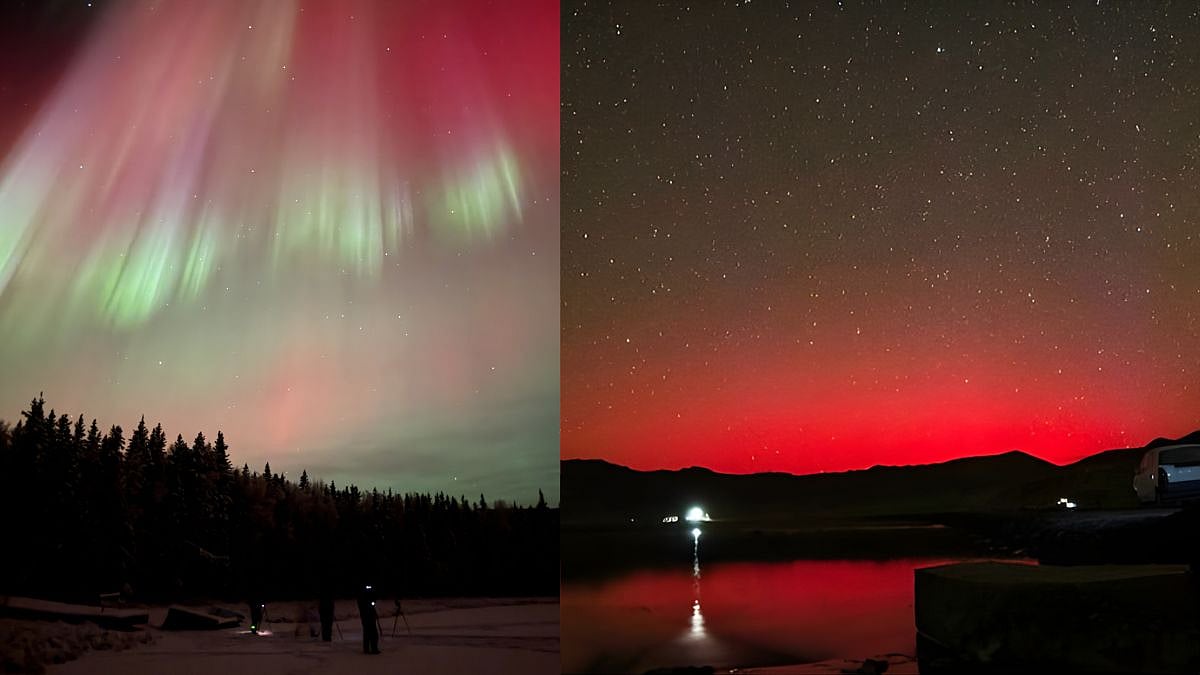
Residents Captured Red Auroras | X/ @NewsIADN
Auroras Borealis is a rare celestial spectacle that is often seen in high-latitude regions around the Arctic and Antarctic, specifically within the "auroral oval", a band that typically lies between 60° and 75° north and south of the equator. Alaska, Canada, Greenland, Iceland, Norway, Finland, Russia, and other regions where the Aurora Borealis is commonly seen.
However, on Monday, January 19, 2026, deep red auroras lit up the night sky over Hanle in Lakakh. Did you know the rare-blood auroras served as a sign of solar flare activity? Keep on reading to know more about the celestial event that occurred in India and how it served as a significant warning sign?
Red aurora Borealis in Ladakh
Who doesn't love watching Auroras? It's just a matter of chance, isn't it? On Monday, January 19, 2026, red aurora scattered in the sky lit up the night sky over Hanle in Ladakh, creating one of the most breathtaking astronomical sights ever seen from India. Hanle, also spelt Anle, is a large historic village in the Leh district. It is located in the Hanle River valley on an old branch of the ancient Ladakh–Tibet trade route at an altitude of about 4,500 metres. The Hanle Dark Sky Reserve offered ideal conditions to witness this once-in-a-generation phenomenon.
Red aurora borealis : A warning sign?
The rare blood-red auroras in Ladakh served as a significant warning sign of intense solar activity. It was caused by high-speed solar particles from a Coronal Mass Ejection (CME) that hit Earth's magnetosphere. These Solar flares are so powerful that their eruption can impact electric power grids, navigation signals, radio communication, and more. The red auroras over Hanle were the result of an intense S4-level solar radiation storm.
Reason behind the spectacle
According to scientists, the geometric storm occurs when energised particles from Coronal Mass Ejection (CMEs), a vast eruption of plasma and magnetic fields from the sun's outer atmosphere, are directed towards the Earth.
Best atmosphere for an aurora display
The best atmosphere for an aurora display is a cold, clear, and dark night sky. In Ladakh, the Hanle Drk Sky Reserve is a perfect and unique vantage point for observing the rare celestial event.
ALSO READ
What is the reason behind red Auroras?
Mostly green auroras are formed, but the distinct red hue emerged when energetic particles interacted with low-density oxygen atoms at high altitudes, a phenomenon generally unseen at lower latitudes such as India. The northern and southern lights (Aurora Borealis and Aurora Australis) are formed by the solar wind, a stream of charged particles continually flowing from the sun.
When these energised particles enter the polar regions of the Earth, they collide with atoms and molecules in the upper atmosphere. When the charged particles come in contact with oxygen gases present in the atmosphere, they produce green lights that scatter in the sky. Blue and purple colours are caused by collisions with nitrogen.
RECENT STORIES
-
-
-
-
-