Looking Back At Legend Raghu Rai's Life, Craft & Lasting Legacy: A Tribute By Senior Photojournalist Pradeep Chandra
From early days at The Statesman to iconic images that shaped Indian photojournalism, a look back at the legend’s life, craft and lasting legacy

In early seventies, when I shifted my base to Delhi, my elder brother Shiva Chandra, who was working with MCM advertising took me to meet Raghu Rai at The Statesman where he was working as the chief photographer. I was introduced to this very tall, dark, handsome man who was wearing a very long coat like attire. His colleague, Raghu Singh was also present in his room. I saw pictures taken by him for the first time that day. I was impressed by his personality and his work equally. I still remember the first conversation I had with him. He asked me, “Munna, how are you? Delhi main kya karoge?”
I met him for the second time many years later. Again, at his office. Pakistan’s President Bhutto had just visited India and Raghu Rai had photographed his daughter Benazir. His portraits of Benazir were stunning. If I am not mistaken, during those days, he was also working on his first photo book - ‘A life in the day of Indra Gandhi’. I started following his work and used to look at The Statesman for his pictures. He introduced a half page photograph on the back page of The Statesman every Sunday.
My friend Sondeep Shankar was very close to him and often I would meet them while shooting at various places in Delhi. Raghu Rai was mostly with his wide-angle lens. He captured things while shooting which I couldn’t even see. My friend Mayank Chhaya later told me that whenever Raghu Rai got the perfect shot, he called it his ‘Aha moment’.
Once, at one of his exhibitions in Mumbai, he signed and gifted me one of his brochure which was no less than a book. When Narsimha Rao was the Prime Minister of India, I got a chance to be with him for longer time. Both of us were covering the Congress Convention at Tirupati. What I noticed about his shooting was he was shooting at a very fast speed with his 200 mm lens. He never believed in cropping his pictures. He shot full frame of what he thought was the perfect frame.
Raghu Rai was a star photographer, and his personality attracted people big or small, stars or politicians. I think, his best work was Delhi, Punjab, and Taj Mahal. The book was the ultimate. He was also lucky to have got the opportunity to work with MJ Akbar in Sunday magazine when he travelled a lot and did interesting photo features. Later, at India Today, he used to get huge space like 8/12 pages of photo features. He was also invited to Magnum by Henri Carte Bresson. Some of his best works were images of Mother Teressa, Bhopal Gas Tragedy and that iconic image of Amitabh Bachchan that he shot for India Today’s cover in 1984.
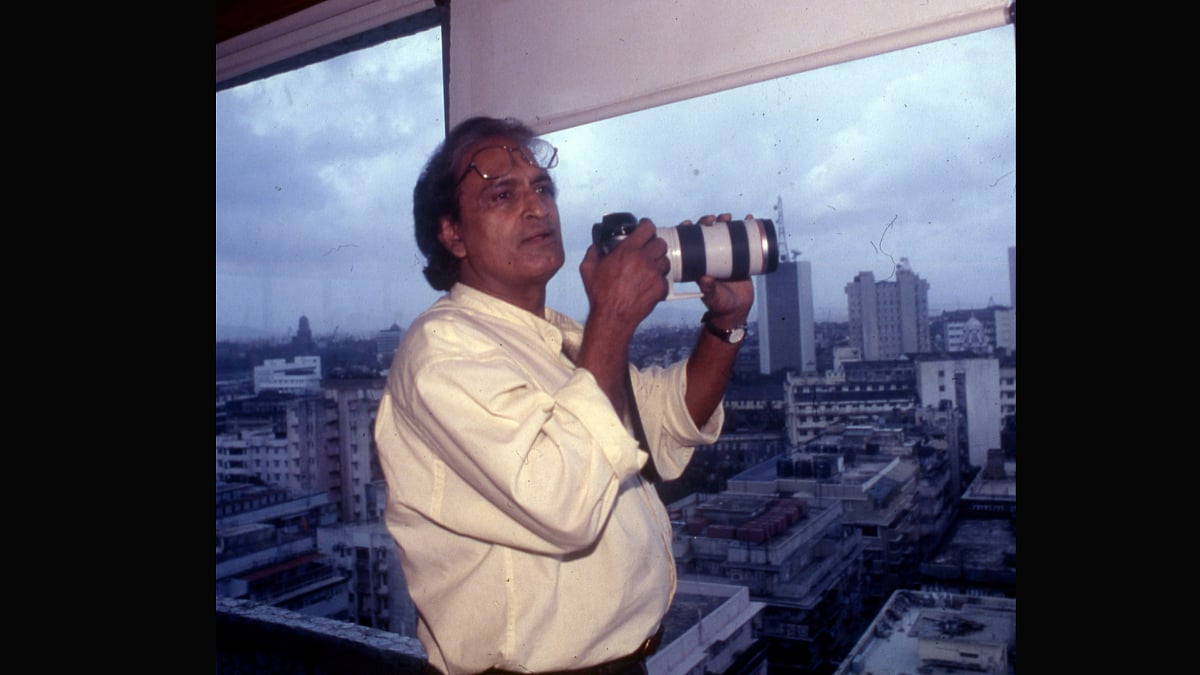
I met him last at Museo Camera when the director of the museum, Aditya Arya, had invited 70 photographers to show our work and Raghu Rai’s work was there too. We had a long chat, and he mingled with all guests. When I reminded him about the pictures of him that I had shot at Ambassador hotel in Mumbai, he asked me if I could mail him the high-rise images, which I did.
He was very organised and knew the value of his photographs unlike most of us, especially me.
Good bye Raghu Jee, your pictures will live forever and see you in the other world someday.
Pradeep Chandra is a senior photojournalist
RECENT STORIES
-
-
-
-
-