'I Love Comics Right From My Childhood': Cartoonist And Illustrator Savio Mascarenhas On Creating Tinkle’s Iconic Characters
From childhood doodles to shaping beloved characters like Suppandi and Shikari Shambu, Savio Mascarenhas reflects on his 35-year journey of storytelling, imagination, and keeping the magic of comics alive for generations

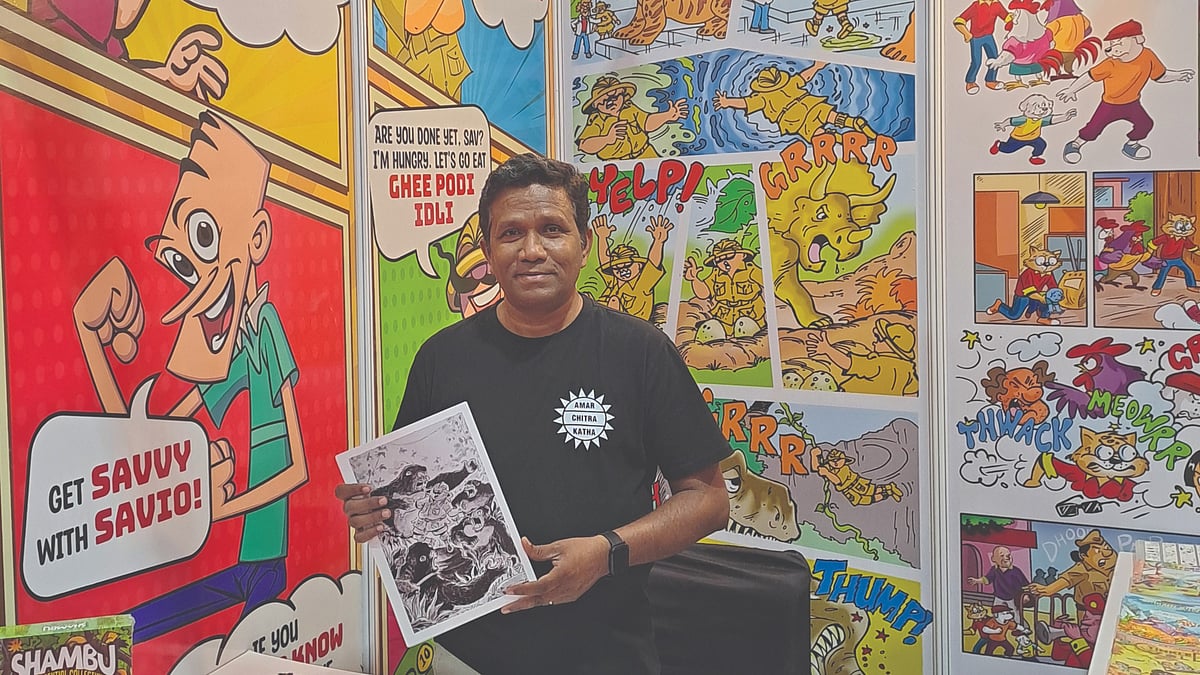
Photographs: Courtesy of Savio Mascarenhas
For generations of Indian readers, characters like Suppandi and Shikari Shambu have been a cherished part of growing up, bringing laughter, adventure, and timeless storytelling to the pages of Tinkle.
Behind the visual charm and enduring appeal of these beloved comic icons is Mumbai based cartoonist and illustrator Savio Mascarenhas. Through his distinctive artwork and creative vision, Savio has helped bring some of India's most recognizable comic characters to life, captivating young readers while preserving the legacy of one of the country's most iconic children's publications.
Once asked by Tinkle’s Uncle Pai, whether he was happy working as a copywriter in an ad agency or as a comic book artist, Mascarenhas’ reply of a comic book artist paved the way for him completing over 35 years with Tinkle.
With absolutely no formal training in art, the 56 year old used to look at comics and draw from them. He did draw funny cartoons for his friends and at home on the doors of his bedroom.
In an interaction with The Free Press Journal, Savio speaks about his artistic journey, creating memorable comic characters, and the magic behind the world of Tinkle.
Excerpts from the interview:
What inspired you to start designing comic characters for children?
It was my love for comics right from my childhood when I was 10. I grew up in the world of Amar Chitra Katha and Tinkle, Children’s World, Target. Our favourite pastime would be reading and exchanging comics, visiting libraries and spending hours on books and drawings. The newspaper came with the cartoons by RK Laxman and Mario Miranda and I vividly remember being fascinated with these comical illustrations in my text books. It was Mario’s style that got me intrigued into drawing funny cartoons. These two gentlemen were my first inspiration to take up a pencil and start drawing. There is also Sergio Aragones from Mad Magazine, Bill Waterson’s Calvin and Hobbes. I feel my style of art leans towards these stalwarts works.
Which childhood comics or cartoon characters first made you want to become an illustrator?
Reading was a habit at home and with most of my friends in my colony. I remember getting Tinkle comics from our newspaper vendor every month. Suppandi, Shambu, Kalia the Crow were my favourite characters. My first cartoon characters would definitely be Suppandi, Shambu from Tinkle comics and Detective Moochwala from Target Magazine.
Do you recall your first design you created?
It was the drawing of Bageera, the panther (of The Jungle Book) I did for my Scouts Team while I was in Class 8. We proudly pinned it on our shirts. I remember we used to exchange the bottle caps of the soft drink Gold Spot and get The Jungle Book comic. I used to draw all the characters like Bageera, Mowgli, Sher Khan. That was the time I used to draw cartoons on my notebooks and my friends’ books.
Tell us about your journey in Amar Chitra Katha and Tinkle and how the job of drawing Shikari Shambu and Super Suppandi come about?
After completing my studies in Commerce and Advertising & Public Relations, I began my career as a copywriter while pursuing cartooning as a hobby. Encouraged by my boss, I submitted my cartoons to Tinkle, where my first batch of 10 cartoons was accepted by Uncle Pai. What started as freelance work soon became a full-time career when Uncle Pai offered me a staff artist position in 1994. In 1997, following the retirement of artist V.G. Halbe, I was entrusted with drawing Shikari Shambu, a dream come true. Since then, I have spent nearly three decades illustrating Shambu and later Super Suppandi.
When creating a new character, what comes first—the personality, the story, or the visual design?
I have worked with various writers and it is their vision that I try to bring to life. They define the universe that these characters exist in. We go through rounds of discussions before we finalize on the look of the character, the backgrounds, the colour palette. The writers put in all the details for the Artist to create this universe. It is a collaborative effort of this team that makes the characters come alive.
Can you walk us through the process of developing a comic character from the first sketch to the final published version?
Every Tinkle comic begins with a story idea, often contributed by children. The editorial team develops these ideas into detailed scripts, breaking them into panels with descriptions, dialogue, and character notes. Using the script, the artist first creates pencil sketches, which are reviewed by the editorial and art teams for accuracy and consistency. Once approved, the artwork is inked and refined. The pages then move to a colourist, while a lettering artist adds speech balloons, captions, and sound effects. After final checks for artwork, colours, and text, the completed pages are sent to production for printing as part of the finished comic.
What advice would you give aspiring illustrators hoping to build a career in anime and comic art?
Understand the medium and read and practice as much as you can. Evolve and stay relevant. Be ready to experiment and explore new concepts.
What opportunities exist for newcomers in this field? Are there sufficient openings, and can it be a financially viable long-term career?
You can experiment a lot in this field. You can move from print to digital to animation as they are connected.
Goa has given India beaches, feni, and Mario Miranda. Are you hoping to add your name to that list of iconic Goan exports?
Oh yes. Being a Goan to the core, Goa is a constant inspiration for me. Growing up looking at Mario Miranda's work, I have to say that he has had a huge influence on me as an artist. I never met him, though. A neighbour in my native place, Salvador Do Mundo, Goa, worked at the studio in Torda, and used to visit Miranda's place in Loutolim very often. How I wished I had accompanied him on one of his trips. Nevertheless, I will live with the thought that the maestro has and will continue to inspire me.
Are you working on anything new with Tinkle?
We have added a lot of new characters like Mopes and Purr, Defective Detectives, WingStar and Bankhu’s Bhais, alongwith the iconic Suppandi, Shambu and Tantri. I am also working on two projects. One is a comic book on the Musicians of India that features Goan musician Chris Perry, Lata Mangeshkar, Pt. Ravi Shankar, and 15 other prominent Indian musicians on ACK. My second is my personal project of a Goan story that has fascinated me for years. It’s a graphic novel that I am writing and illustrating.
In today’s digital era, do you think children engage differently with comic art compared to earlier generations?
Yes, surely they do. They are exposed to more edge content than what a child was a decade ago. Today they have multiple platforms for entertainment. They do consume a lot more of video content and digital comics also have become a part of their content consumption. We are aware of this and we have adapted our content to address this demand of digital content.
What role do comics and illustrated characters play in shaping a child’s imagination and reading habits?
Comics go a long way in the mental development of a child. Visuals help children learn and grasp ideas much faster. Reading by itself is a good habit, and reading comics is that first step in developing children to become good readers. They develop that love for reading by starting on simple reading of comics. Reading comics open them to novel ideas, they become visually more active and develop a wholesome thought processes. When we give a child a book to read, we open windows of imagination for them to explore and learn. And the day we take this away from them it is like shutting that window for them.
Behind all the colour and fun, how much serious storytelling goes into creating a memorable comic character?
The effort we put in from a team of writers, artists and designers. We also are highly active on social media and our school outreach programme.
In a world filled with screens and animation, what still makes printed comic characters magical for kids?
It is our faithful fan following we have that keeps us going. We are a family brand, and we have built that trust in our content over the years. So we have that share in the space of children’s content and that is a huge segment of people.
With over 35 years with Amar Chitra Katha, what is the best part of your job?
Telling stories with all the love and dedication and having a huge fan following across the country.
How do you ensure your characters connect with young readers across different age groups?
Amar Chitra Katha and Tinkle have remained relevant for 60 and 45 years respectively because they have evolved with changing times. While retaining their core values, they have introduced new characters, adapted storytelling and art styles, and addressed issues that resonate with today's children, attracting multiple generations of readers.
ALSO READ
Which is tougher—making children laugh or keeping their attention from the first drawing to the last?
It is both in equal dose. We see to it that our storytelling is as strong as our visuals.
How important is humour and visual expression when designing characters for kids?
Especially important, it is the crux of our content. Children look to our magazine for that relief they need from studies and need to take a break and humour themselves. We have been in this business of visual storytelling for decades now and our readers look up to us with a lot of expectation.
Which character that you’ve created do you feel most emotionally connected to, and why?
My favourite would be Mopes and Purr created by writer Ms Reena Puri. This series is about a cat and dog detective duo who fight crimes against animals and birds. Reena is passionate about animals and is a huge advocate of their rights and well being. And most of it has rubbed off on me too. She wrote brilliant stories and I got my chance to create these characters because of her vision. I love this series because of the messaging in it. These are my first character creations for Tinkle.
What kind of reactions from young readers make you feel you’ve truly done your job as an artist?
When they come up to me and say thank you for making their childhood or say that it is because of me that they have become artists today. At Comic Cons across the country, I meet readers of all ages who share cherished memories of growing up with Tinkle. Many recall picking up a copy during train journeys or being introduced to it by their parents. Some even ask me to sign posters for their families or speak to their parents.
RECENT STORIES
-
-
-
-
-