Human Laughter Shares Ancient Evolutionary Roots With Great Apes, Study Finds
A new study has found that humans and great apes share a common rhythmic pattern in laughter, suggesting it evolved around 15 million years ago. Researchers say human laughter later became faster and more flexible, offering fresh insights into the evolution of speech, social communication and human behaviour.

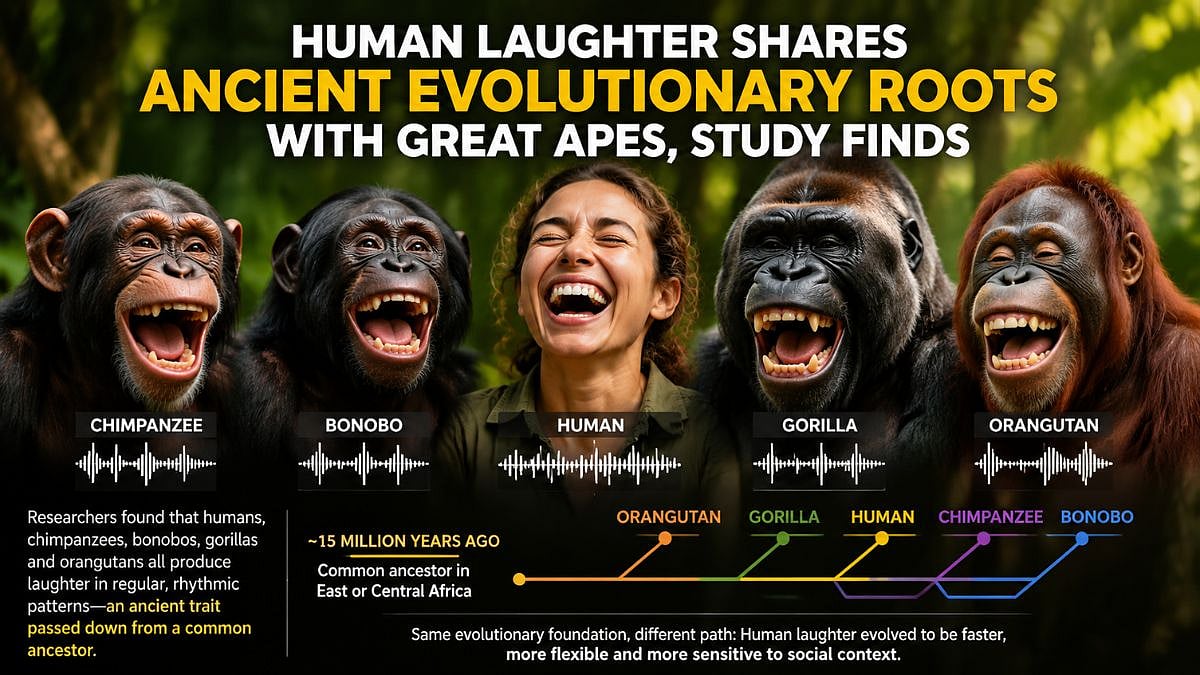
A new study suggests humans and great apes share an ancient rhythmic pattern of laughter dating back around 15 million years | AI Generated Representational Image
London, July 2, 2026: Humans and great apes may laugh differently today, but new research suggests that the roots of laughter go back much further than previously understood.
A study has found that humans, chimpanzees, bonobos, gorillas and orangutans all share a common rhythmic pattern in laughter, indicating that this form of vocal communication likely existed in their last common ancestor around 15 million years ago in East or Central Africa.
Researchers compared laughter across the five species and found that all of them produce sounds at regular, evenly spaced intervals. The shared pattern suggests that laughter is an ancient trait that has survived through millions of years of evolution. However, the study also found that human laughter has become faster, more flexible and better adapted to different social situations over time.
Shared Evolutionary Origins
According to lead author Chiara De Gregorio, a primatologist and research fellow at the University of Warwick in England, human laughter and great ape laughter share the same evolutionary foundation but have developed differently over time.
“Human laughter is faster, more variable and more sensitive to social context than the laughter of other great apes. Chimpanzees and bonobos are indeed our closest relatives, and their laughter is generally more similar to ours than that of gorillas or orangutans. However, human laughter still stands out in its degree of rhythmic complexity and flexibility,” she said.
The study noted that the human evolutionary lineage split from the lineage leading to chimpanzees and bonobos around seven million years ago. Despite that separation, the similarities in laughter remain evident.
Researchers analysed recordings from four chimpanzees, three bonobos, two gorillas, four orangutans and four humans, examining the timing between each burst of sound across 140 laughter sequences.
The ape recordings were collected while the animals were playing or being gently tickled by familiar caretakers in zoos in Germany and Malaysia. The researchers observed that humans changed the speed of their laughter depending on the situation, while great apes showed little variation in their laughter rhythm, Reuters reported.
Clues To Human Speech
The findings also offer fresh insight into how human speech may have evolved. De Gregorio said the gradual increase in rhythmic flexibility seen in human laughter suggests that our ancestors may already have had better vocal control than modern apes, an ability that could have laid the foundation for language.
“By studying laughter in our closest relatives, we can better understand not only where language came from, but also the social and emotional foundations that make us human,” she said.
She added that although researchers still do not know exactly how early human ancestors communicated, the study provides a clearer understanding of how they may have laughed.
Laughter Beyond Humans
De Gregorio described laughter as a rhythmic vocalisation linked to positive social interactions such as play among non-human animals. She said it likely evolved as a social signal to strengthen bonds and indicate that play was friendly rather than aggressive. In humans, laughter has since taken on many additional social roles, although its origins probably lie in play.
Also Watch:
ALSO READ
The study also pointed out that laughter-like behaviour is not limited to great apes. Dogs, for instance, produce a distinctive panting sound during play and display a characteristic “play face”, while similar play-related vocalisations have also been observed in several other mammals, highlighting that playful communication may be more widespread in the animal kingdom than once thought.
To get details on exclusive and budget-friendly property deals in Mumbai & surrounding regions, do visit: https://budgetproperties.in/
RECENT STORIES
-
-
-
-
-