Ganga Aarti Goes To Thames: Can A River Ritual Transcend Geography?
On the Thames, Ganga Aarti enters a new landscape with the cultural memories of India’s riverfronts

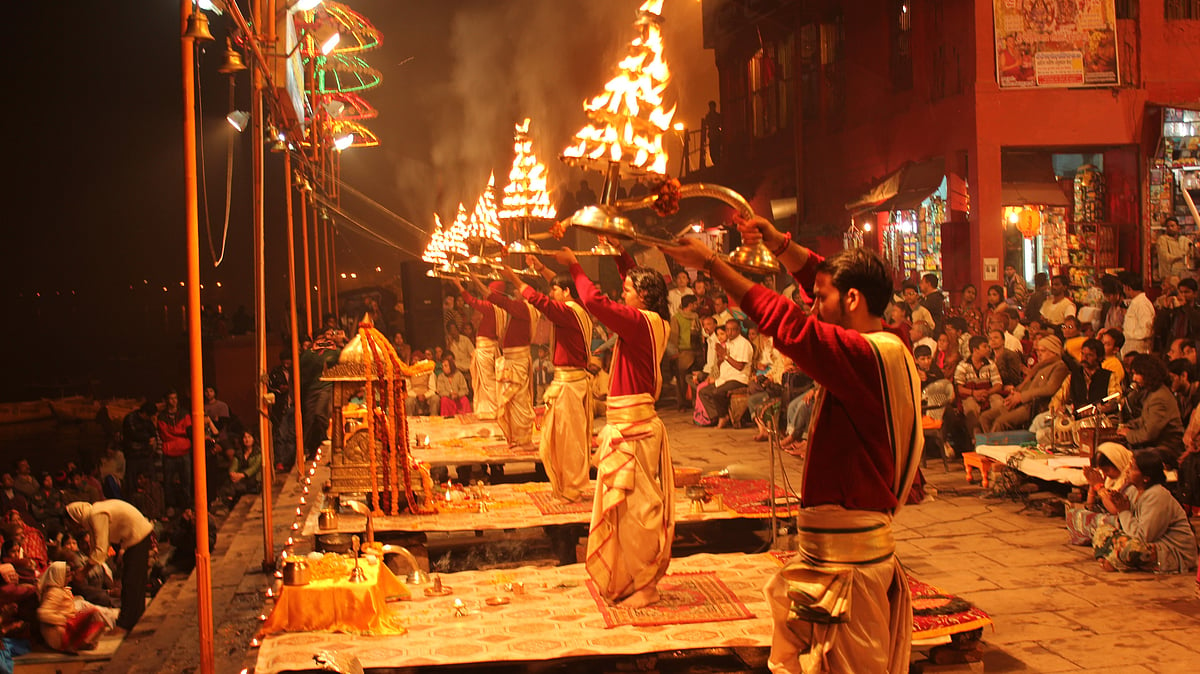
On September 13, one of India’s most recognisable riverside traditions will find an unexpected setting: the banks of the River Thames in London. The sold-out Ganga Aarti on the Thames—A Ceremony of Light, organised by Chinmaya Mission UK, will bring Indian music, dance, food and community to the Old Royal Naval College in Greenwich, before culminating in the evening aarti at 7:15 pm.
It is the setting that makes the event particularly intriguing. Here, the familiar ghats of Varanasi and Haridwar give way to the historic waterfront of Greenwich; the Ganga to the Thames; and the sounds, sights and atmosphere of an Indian riverfront to one of Britain’s most recognisable waterways.
So, what happens to a cultural tradition when it travels far beyond the landscape that has shaped it?
When the River Changes
Ganga Aarti is most strongly associated with the riverfronts of Varanasi and Haridwar, where the ceremony has become inseparable from the visual and cultural identity of the cities. But the Ganga is not the only Indian river around which communities have developed their own traditions of aarti. The Narmada, too, has its own established riverfront ceremonies.
Since news of the sold-out Ganga Aarti on the Thames began circulating, social media has been filled with variations of the same question: “How does one have a Ganga Aarti without the Ganga?” For some, the very name suggests that the ceremony is inseparable from the river that gives it its identity. For others, its appearance on the Thames is an example of how cultural practices evolve when communities carry them beyond their original geography.
“The Ganga has a very particular place in India’s cultural imagination, shaped by centuries of stories and associations with the river,” says Dr Meera Joshi, a spiritual guide and cultural researcher. “But other rivers have their own histories and identities. The practice of aarti can become a broader cultural expression of our relationship with rivers without diminishing the individuality of the Ganga.”
On the other hand, can the energy and intention of a ritual transcend geography? From an astrological perspective, there is an argument to be made for it. “Place carries its own energy. In Vedic thought, rivers, mountains, temples and pilgrimage sites are believed to develop distinct spiritual and cultural vibrations through their natural qualities, mythology, centuries of association and collective consciousness. This is why certain places are considered tirtha - spaces where the earthly and spiritual are understood to intersect,” says Silky Kukreja, celebrity astrologer, spiritual guide and spiritual psychotherapist.
That distinction becomes particularly interesting on the Thames. “The question isn't whether the Thames can become the Ganga - it cannot,” says Dr Joshi. “It is about why communities carry familiar cultural practices with them when they move. For the diaspora, the ceremony can become a way of carrying memory and a connection to home into a new landscape.” Yet the essence of aarti is not limited to geography. “Fire represents divine light and consciousness, while the water offering represents gratitude, purification and surrender. When performed with genuine shraddha and sankalpa, the ritual becomes an expression of intention connecting the individual with the Divine,” adds Kukreja.
On its website, the Chinmaya Mission has explained the logic behind the celebration, saying that two ancient rivers have shaped civilisations and carried prayers of countless generations. “For thousands of years, Ganga Mata (Mother Ganges) has received the prayers of those who stand at her banks at dusk, offering fire and song in the Vedic tradition of aarti. Now, this living ritual comes to the Thames — two ancient rivers, each having shaped civilisations and carried the prayers of countless generations, meeting in a single act of offering,” the website reads.
“I wouldn't see the emergence of aarti around other rivers as diminishing the cultural importance of the Ganga,” she adds. “When a tradition travels with a community, it carries memory with it. Performing Ganga Aarti on the Thames can therefore be understood as bringing an element of Indian cultural memory into a new landscape, rather than trying to suggest that the Thames is the Ganga.”
For the ones away from home
For Indian communities living abroad, recreating familiar traditions can be a way of maintaining a relationship with the country. The ceremony is taking place in London, but for many Indians in the city, it may evoke something much closer to home. “For the first generation, these traditions can feel like a connection to something they already know," says Rohit Mehta*, an Indian-origin London resident. "For younger people, they can become a way of discovering something that might otherwise remain distant or abstract.”
It is a sentiment that captures the peculiar position of diaspora culture. “I have seen images of Ganga Aarti in India, but I never imagined I'd see something like it beside the Thames,” says Priya Kapoor*, a second-generation British Indian. “I think London is particularly interesting because so many cultures are visible here.” That idea of belonging to more than one place is particularly relevant in a city such as London, where communities from across the world have created their own cultural ecosystems.
For Indians living away from home, that sense of recognition can become especially valuable. “For someone born in Britain, the Thames may be the river they know intimately. Experiencing an Indian cultural tradition beside it allows the two parts of their identity to exist in the same physical space,” Mehta adds.
However, there is an important distinction between carrying a cultural or spiritual tradition to another place and suggesting that another river is equivalent to the Ganga. “The Thames has its own geographical, historical and cultural identity. Performing a Ganga-inspired ritual there can create a spiritual connection, but it does not erase the unique sacred identity of Maa Ganga or the spiritual significance of Varanasi and Haridwar,” Kukreja highlights. “In fact, such rituals can broaden our understanding of rivers as living symbols of consciousness, life and purification. But this expansion should come with awareness, not appropriation or mere spectacle.”
The Ganga and the Thames will remain two very different rivers, shaped by two very different histories. But for one evening in Greenwich, the banks of the Thames will become the setting for an Indian cultural tradition thousands of kilometres from its most familiar home.
RECENT STORIES
-
-
-
-
-