Did Muslim Shepherd Buta Malik Discover Amarnath Cave? Here’s What Legend Says
According to popular Kashmiri folklore, Buta Malik was a 15th-century Muslim shepherd from the village of Batakot who was tending to his flock in the mountains when he met a mysterious saint. The saint is said to have handed him a bag filled with coal. Disappointed but respectful, Malik took the bag home. Upon opening it, he discovered that the coal had miraculously turned into gold.

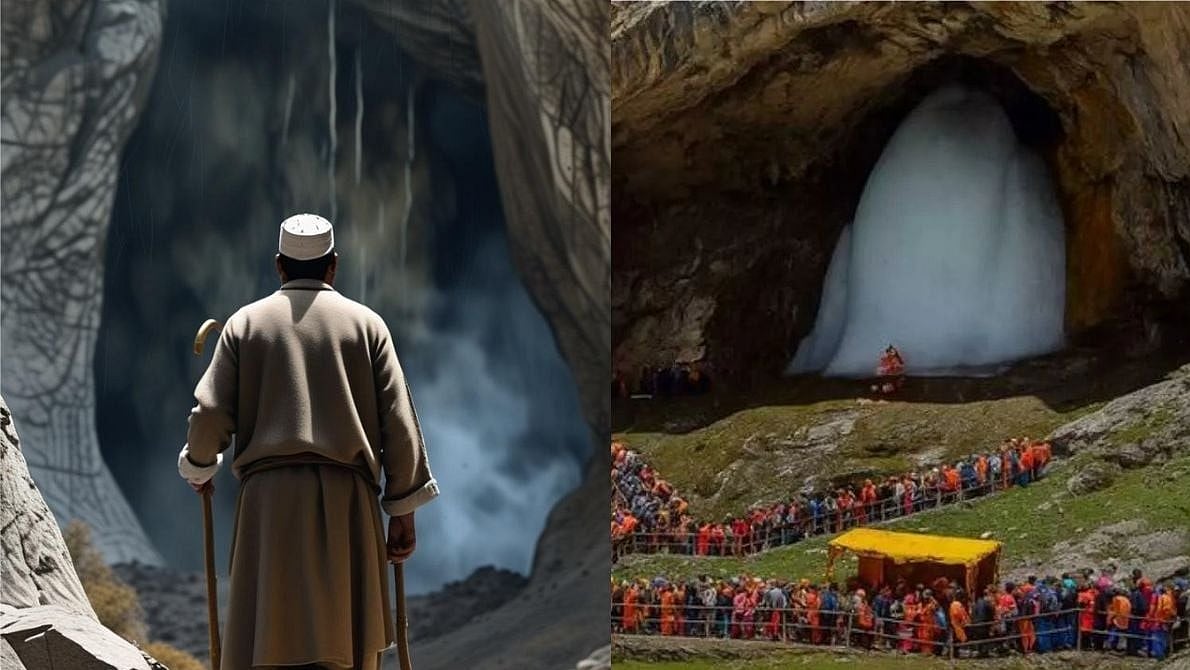
Did Muslim Shepherd Buta Malik Discover Amarnath Cave? |
The Amarnath Cave in Jammu and Kashmir is one of Hinduism's most revered pilgrimage sites, drawing lakhs of devotees every year during the annual Amarnath Yatra. While the cave is deeply associated with Lord Shiva and the sacred ice Shivling, one of its most intriguing legends revolves around a Muslim shepherd named Buta Malik, who is believed to have rediscovered the holy shrine centuries ago.
Buta Malik legend
According to popular Kashmiri folklore, Buta Malik was a 15th-century Muslim shepherd from the village of Batakot who was tending to his flock in the mountains when he met a mysterious saint. The saint is said to have handed him a bag filled with coal. Disappointed but respectful, Malik took the bag home. Upon opening it, he discovered that the coal had miraculously turned into gold.
Overcome with gratitude, he rushed back to thank sadhu, only to find that the sadhu had vanished. In his place was the entrance to a cave, inside which gleamed the eternal ice lingam of Lord Shiva. Thus, the Amarnath Cave was “discovered,” and ever since, the Malik family is said to have shared joint custodianship of the shrine along with Hindu mahants.
Rediscovery not discovery
Although this story is widely narrated and cherished by devotees and locals alike, historians note that it belongs to folklore rather than verified historical records. References to the Amarnath Cave are found in ancient texts such as the Rajatarangini, and also mentioned in ancient Hindu scriptures like the Nilamata Purana, suggesting that the shrine was known long before the period associated with Buta Malik. Thus, the legend is generally understood as the rediscovery of the cave rather than its original discovery.
Amarnath mythology
Unlike man-made Shivlings found in temples, the Amarnath Shivling is believed to be Swayambhu, meaning self-manifested. Inside the cave, water droplets continuously fall from the rocky ceiling. As temperatures remain extremely low, these droplets freeze layer by layer on the cave floor, gradually forming a towering ice stalagmite. This upward-growing ice formation is worshipped as a manifestation of Lord Shiva.
RECENT STORIES
-
-
-
-
-