Did Mount Everest Once Lie Underwater? Fossils Reveal Ancient Ocean
Recently, photos of marine fossils on the world’s tallest mountain, Mount Everest, took the internet by storm. Fossils of marine creatures, including corals and shells, have been found at high altitudes on the mountain, confirming that this iconic peak was once submerged under a prehistoric ocean over 500 million years ago.

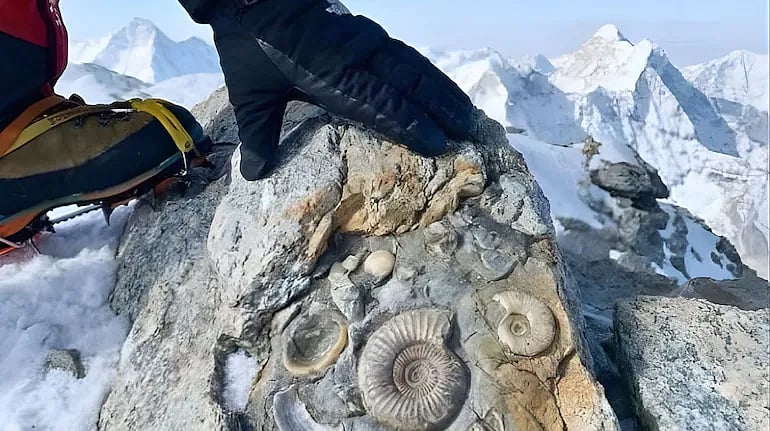
Did Mount Everest Once Lie Underwater? | X/ @MAstronomers
When you believe you've encountered all there is to see, that's precisely when the world reveals its surprises! Keep in mind that the world is full of wonders; the more you seek to understand, the more you will realise how little you truly know. Images of marine fossils on Mount Everest have recently amazed millions of viewers online. Scientists have long been fascinated by the geological history of Mount Everest, the world’s tallest peak, and recent fossil discoveries are shedding new light on its ancient origins.
Marine fossils on Everest
Recently, photos of marine fossils on the world’s tallest mountain, Mount Everest, took the internet by storm. Fossils of marine creatures, including corals and shells, have been found at high altitudes on the mountain, confirming that this iconic peak was once submerged under a prehistoric ocean over 500 million years ago.
Formation of mountains from ocean
Scientists confirm that the mountain was once formed beneath an ancient ocean. According to researchers, these fossils are roughly 450 million years old. These fossils were preserved in the limestone and shale layers that make up much of Everest’s geology. Researchers explain that the region that now forms the Himalayas was part of the Tethys Sea. It was a vast, tropical body of water existing roughly 250 to 50 million years ago and separated the supercontinents of Gondwana (south) and Laurasia (north) during the Mesozoic Era.
Over millions of years, the collision of the Indian and Eurasian tectonic plates pushed the seabed upward, forming the towering mountains we see today. When the prehistoric ocean separated Asia from the drifting Indian continent, marine organisms that were living there died within the shallow ocean water, and their shells and skeletons slowly settled into the accumulating seabed sediments.
Discovery of marine fossils in high altitude region is extremely rare
Scientists and climbers have found fossils of ancient animals above 8,000 meters above sea level. These fossils include remains of trilobites, crinoids, and brachiopods. These fossils not only provide evidence of Everest’s underwater past but also highlight the dynamic history of Earth’s surface over hundreds of millions of years.
RECENT STORIES
-
-
-
-
-