A Song From Earth, Bound For The Stars: Kesarbai Kerkar's Voice On NASA's Voyager 1
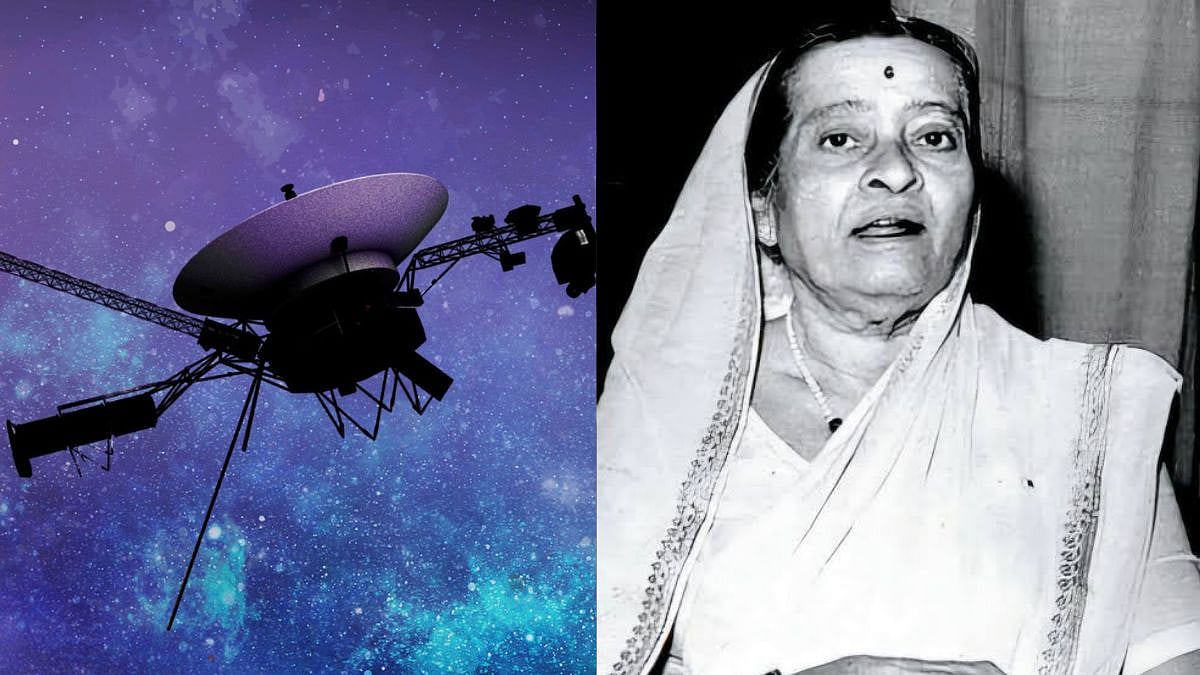
As Voyager 1 travels one light-day from Earth, it carries the voice of Goan classical vocalist Kesarbai Kerkar into deep space. Her rendition of Jaat Kahan Ho in raga Bhairavi features on the spacecraft's Golden Record. Through insights from classical musicians, the story explores Kerkar's musical legacy and the extraordinary journey of her voice beyond Earth

A Song From Earth, Bound For The Stars: Kesarbai Kerkar's Voice On NASA's Voyager 1 |
Eight minutes is all it takes for sunlight to reach Earth. But a voice recorded decades ago is now travelling billions of kilometres away from our planet, carrying a piece of India's musical heritage into the vastness of space.
As NASA's Voyager 1 approaches the historic milestone of reaching a distance of one light-day from Earth, approximately 25.9 billion kilometres away, it carries a recording by legendary Hindustani classical vocalist Kesarbai Kerkar. Her rendition of Jaat Kahan Ho, performed in raga Bhairavi, is among the musical selections preserved on the spacecraft's Golden Record.
The 12-inch, gold-plated copper disc was created as a message for potential extraterrestrial life. It contains 115 images, natural sounds, greetings in 55 languages and 27 musical recordings representing different cultures. India's contribution includes Kerkar's three-minute-and-30-second performance, making her voice part of an extraordinary journey beyond Earth.
For Ketaki Gharpure, a classical singer and learner, the selection reflects the recognition Kerkar received during her lifetime and the lasting influence of her music.
Why Kesarbai Kerkar's Voice Made It To Space
The Golden Record's music selection was curated to represent the diversity of musical traditions on Earth. Among the recordings chosen was Kerkar's performance, a decision that continues to draw attention to her place in India's classical music history.
"American ethnomusicologist Robert Brown suggested Kesarbai Kerkar's music to NASA because he thought it was one of the finest recorded examples of Indian classical music. Her recordings became very popular during her time, which is why she was a well-known classical singer. Her song being selected for Voyager is not surprising, she was iconic," says Gharpure.
Kerkar's influence also extended to women entering the world of classical music at a time when pursuing it professionally came with social barriers.
"She was the only female singer of her time, and she paved the path for other female vocalists in the future. Honestly, I even credit the iconic Kesarbai Kerkar for inspiring generations of women to choose classical music as a career," she says.
Kerkar also performed at mehfils, participating in private gatherings as well as community performances.
The Gharana That Shaped Her Musical Identity
Born on July 13, 1892, in Keri village in Goa, Kerkar went on to become a celebrated exponent of the Jaipur-Atrauli gharana.
Her musical journey involved training under several respected names. According to Gharpure, she initially learnt from Ustad Abdul Karim Khan, followed by Ramkrishnabuwa Vaze, before spending a significant period training under Ustad Alladiya Khan, founder of the Jaipur-Atrauli gharana. She also learnt bhajans and kirtans, broadening her musical understanding.
"The reason her musical style is so rich and timeless is because she learnt from the Jaipur-Atrauli gharana, one of the most skilled gharanas. Her gurus were also highly skilled and are remembered as some of the greatest classical vocalists to have been born. As a result, Kesarbai formed her own style of singing," Gharpure explains.
Classical music, she adds, relies on the connection between a composition's words and its melodic expression, allowing the performer to communicate beyond the notes themselves.
"Emotions are very important in classical music. In a bandish, we mould the notes of the raga. That word and the note are together. The emotions of the raga should definitely reach the listener," she says.
A Question That Travels Across The Universe
The title Jaat Kahan Ho translates to 'Where are you going?' and takes on a striking significance when considered alongside Voyager 1's journey into deep space.
Milap Rane, a PhD student and classical vocalist, believes the recording represents much more than a musical performance. He describes Indian classical music as deeply connected to spirituality, where words such as riyaz and sadhana signify an inner journey beyond technical practice.
"This recording captures many of the finest elements of that tradition as expressed by a master artist, and it now carries them into the universe," Rane says.
He believes the title feels almost prophetic in the context of Voyager's journey, becoming an open question posed by a human voice that conveys longing, wonder and the uncertainty of an unknown destination. It can also feel like an invitation — "where are you going, come here instead."
Kerkar died on September 16, 1977, just 11 days after Voyager 1 was launched. Nearly five decades later, her voice remains preserved aboard a spacecraft travelling farther from Earth than any other human-made object.
Whether another civilisation will ever discover the record remains unknown. But a composition asking where a traveller is headed has become part of humanity's message to the universe, ensuring that a fragment of India's musical heritage continues its journey beyond our planet.
RECENT STORIES
-
-
-
-
-