EU-India FTA: From Trade Numbers To Strategic Corridors, A Blueprint For Action
As the "mother of all deals" moves into final legal and political phases, a new strategic report released at the European Parliament urges governments and businesses to look beyond tariffs. The report, produced by Water & Shark and EICBI, has been formally presented to senior Indian and EU parliamentarians.

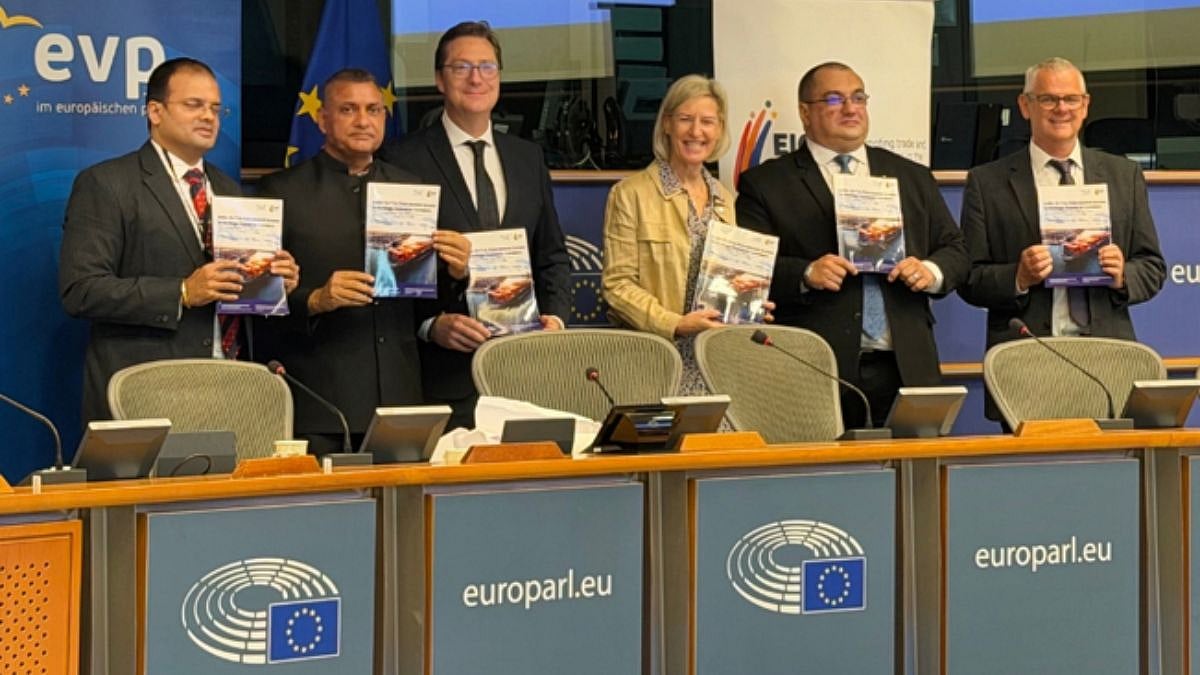
European and Indian leaders discuss the future of trade cooperation as a new report outlines opportunities and challenges under the India-EU FTA | File Photo
BRUSSELS / NEW DELHI – The India-European Union Free Trade Agreement has been widely hailed as the most ambitious trade pact ever negotiated by either side, but with ratification still months away, policymakers and business leaders are increasingly turning their attention from trade diplomacy to trade implementation. A comprehensive strategic intelligence report released at the European Parliament on 9 June, during the 7th EU India Leaders Conference, frames the agreement as a fundamental re‑architecting of the economic relationship.
The report, titled India–EU FTA: From Market Access to Strategic Economic Corridors, was developed jointly by the Europe India Centre for Business and Industry (EICBI) and Water & Shark, a multinational cross‑border advisory firm founded by Advocate CA Harsh Girish Patel. While the detailed 15‑chapter document focuses on market access, regulatory compliance and sectoral pathways, the headline political message is unmistakable: the FTA is not merely a tariff‑cutting exercise but a long‑term strategic corridor that will redefine how two of the world's largest economies trade, invest and collaborate.
"The agreement has been described as 'the mother of all deals'," said Mr Sujit S. Nair, Chairman of EICBI and a Senior Partner at Water & Shark. "But a deal is only as good as its implementation. The report provides a comprehensive assessment of policy challenges, strategic market access considerations, business opportunities, and sectoral pathways for companies seeking to leverage the growing opportunities emerging across the EU–India corridor following the conclusion of the Free Trade Agreement."
A deal of historic proportions, still awaiting final ratification
The FTA, concluded on 27 January 2026 during the 16th India-EU Summit in New Delhi, brings together a combined market of nearly 2 billion people and accounts for approximately a quarter of global GDP. Bilateral goods trade between India and the EU stood at USD 136.54 billion in 2024-25, with services trade reaching USD 83.10 billion in 2024, according to a factsheet issued by the Ministry of Commerce & Industry. The agreement delivers preferential market access for more than 99% of India's export value, with 70.4% of tariff lines covering 90.7% of India's exports receiving immediate duty elimination upon entry into force. Key labour‑intensive sectors such as textiles, leather, marine products, chemicals and gems and jewellery – which together represent over USD 33 billion in exports – are poised to gain zero‑duty access.
However, the agreement is not yet in force. Legal verification, translation into all 24 official EU languages, ratification by the European Parliament and approval by the Indian Cabinet are expected to take several more months. The formal text was published on 28 February 2026, and while the European Commission expects the deal to be signed before the end of 2026, a more realistic timeline points to entry into force in early 2027. Crucially, because the FTA falls under EU exclusive competences, it will not require ratification by each individual member state's national parliament, avoiding the protracted delays seen with agreements such as CETA.
Political weight in Brussels
The report was formally released in the presence of senior parliamentarians from both sides, underscoring the political capital invested in the agreement. Ms Angelika Niebler, the German Member of the European Parliament who chairs the European Parliament's Delegation for Relations with India, led the launch. Ms Niebler, who visited New Delhi and Bengaluru in April at the head of an 11‑member delegation, has been a consistent advocate for deepening the partnership. During that visit, she described India as a "trustworthy and reliable partner" and noted that the European Parliament was scrutinising the deal in a "very positive spirit".
She was joined by Mr Vladimir Prebilic, the European Parliament's standing rapporteur on India, who has previously observed that after years of on‑again, off‑again negotiations, "the geopolitical moment is finally aligned". He added that the FTA is not an endpoint but a foundation, with future cooperation required to extend into technology transfer, research collaboration and people‑to‑people exchanges.
Also present was Mr Cristian Terhes, a Romanian Member of the European Parliament and a member of the Parliament's Committee on Foreign Affairs, as well as Mr Sudhakar Singh, an Indian Member of Parliament from Bihar's Buxar constituency who serves on the Parliamentary Committee on Agriculture, Animal Husbandry and Food Processing. Mr Singh, a former state agriculture minister, brought a necessary dose of realism to the proceedings. He has previously warned that inadequately negotiated trade pacts can harm smallholders, and in Brussels he stressed that the agreement's gains must reach rural India while respecting domestic food security concerns.
Private sector backing for government priorities
For Harsh Girish Patel, the founder of Water & Shark, the report is not an academic exercise but a practical tool to support the government's trade ambitions. Patel, whose firm operates at the intersection of accounting, law and diplomatic advisory across 12 countries, has been building strategic intelligence capabilities precisely to help Indian businesses navigate the post‑FTA landscape. The report is the inaugural publication of the Water & Shark Global Research Board, chaired by Dr David Bozward.
"The Indian government has secured an extraordinarily favourable architecture in this FTA," Patel said in a statement following the launch. "Now the private sector must match that ambition with preparation. Our report is a small contribution to that effort – helping Indian exporters move from formal access to usable access."
Beyond tariffs: the real work of implementation
The report devotes considerable attention to the gap between tariff liberalisation and usable market access. While the headline numbers are impressive – the EU will eventually eliminate duties on 99.5% of Indian exports by value – the document argues that regulatory preparedness is the decisive factor. Indian exporters face a complex web of EU compliance requirements, including REACH for chemicals, CBAM for carbon, the EU Deforestation Regulation for agricultural products, the Corporate Sustainability Due Diligence Directive for supply chain transparency, and the rapidly evolving AI Act.
For the Indian government, the FTA is part of a broader strategic pivot. Alongside the trade deal, India and the EU have signed a Security and Defence Partnership and a mobility framework, and are negotiating an investment facilitation treaty. The agreement also establishes a first‑of‑its‑kind EU Gateway Office in India, designed to provide structured migration pathways for Indian professionals in IT, green technology and healthcare. Services commitments cover 144 EU subsectors, including professional services, education and financial services, offering Indian firms greater predictability in the European market.
On the policy front, the government has been actively preparing the ground. Commerce and Industry Minister Piyush Goyal recently held discussions with Ms Niebler's delegation on early implementation of the FTA, and the Ministry of Commerce has expressed hope that the agreement will come into force within the current financial year. However, several MPs have raised concerns in parliamentary consultative committee meetings about the potential impact of CBAM on Indian steel exports, as well as compliance costs that could hit small and medium industries.
A roadmap for Viksit Bharat
The report's subtitle – "From Market Access to Strategic Economic Corridors" – reflects a deliberate shift in framing. The authors argue that the FTA should not be viewed as a standalone trade instrument but as a platform for deeper integration across supply chains, technology transfer and investment flows. For the Indian government, which has articulated a vision of making India a developed nation by 2047 (Viksit Bharat @2047), the FTA with the EU is a critical enabler.
As Ms Niebler noted during her India visit, "the EU-India relationship has moved beyond transactional trade to encompass strategic convergence on digital transformation, defence and multilateral reform." The question now is whether the architecture being built in Brussels and New Delhi can translate into tangible benefits for exporters in Tiruppur, marine product processors in Kerala and small‑scale manufacturers in Gujarat.
That, ultimately, is the work the report is designed to support – and the challenge that will occupy policymakers and business leaders on both sides for years to come. The report, produced by Water & Shark in association with EICBI, is available at https://www.waterandshark.com .
Published on: Saturday, June 13, 2026, 06:36 PM ISTRECENT STORIES
-
-
-
-
-