UP To Roll Out Single-dose IV Iron Therapy For Pregnant Women With Severe Anaemia
UP govt will roll out intravenous Ferric Carboxymaltose (IV-FCM) therapy for pregnant women with severe anaemia, officials said. 3.7 lakh doses have been procured and over 10,000 health workers trained. The initiative under Anaemia Mukt Bharat aims to improve maternal outcomes and reduce anaemia prevalence through faster single-dose IV-FCM treatment and strengthened frontline healthcare delivery.

UP To Roll Out Single-dose IV Iron Therapy For Pregnant Women With Severe Anaemia |
Lucknow: The Uttar Pradesh government is set to roll out Intravenous Ferric Carboxymaltose (IV-FCM) therapy across the state to treat pregnant women suffering from severe anaemia, with officials describing it as a major step to improve maternal health outcomes.
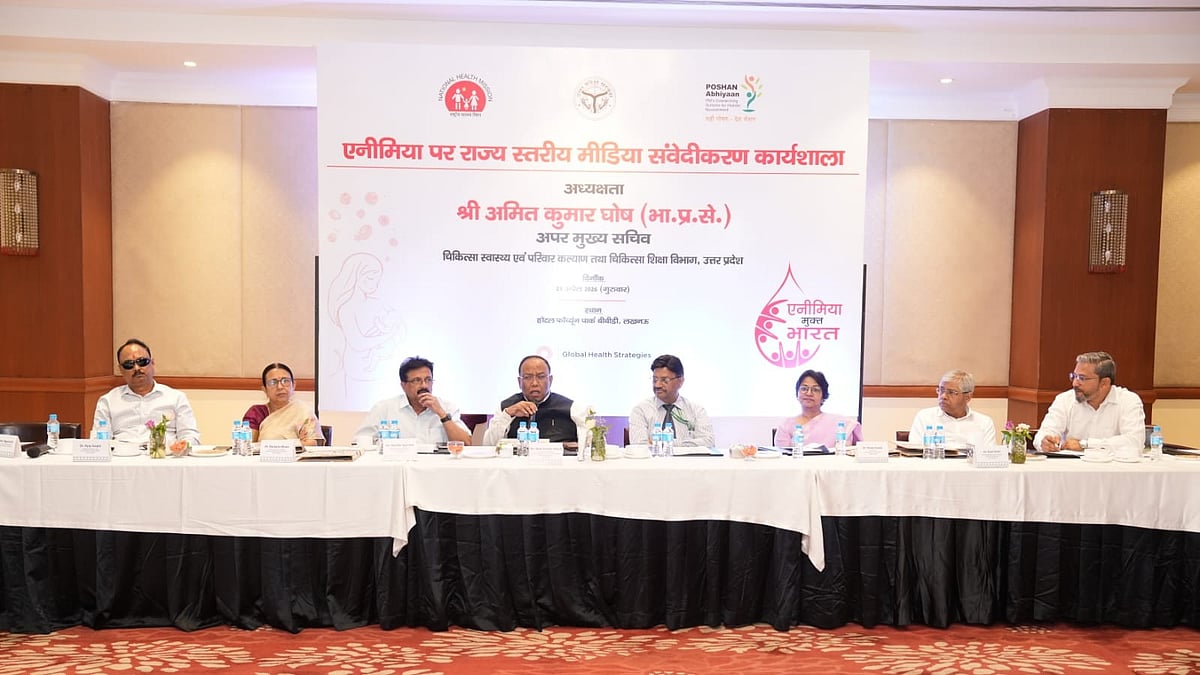
The announcement was made at a state-level media sensitisation workshop organised by the Department of Health in collaboration with Global Health Strategies. The workshop focused on strengthening awareness around anaemia and enhancing the role of media in supporting the Anaemia Mukt Bharat campaign.
Additional Chief Secretary, Medical, Health and Family Welfare and Medical Education, Amit Kumar Ghosh, who chaired the workshop, said the state is committed to reducing the burden of anaemia. “Ek Dose, Do Zindagi ka vardan,” he said, highlighting the benefits of single-dose IV-FCM in treating iron deficiency among pregnant women.
Officials said 3.7 lakh doses of intravenous iron have been procured for distribution across districts. More than 10,000 medical officers and staff nurses have been trained in administering the treatment and managing cases of severe anaemia.
Ghosh said anaemia control has been prioritised under the Anaemia Mukt Bharat initiative, with services such as iron folic acid supplementation, deworming, nutrition counselling and testing being strengthened through frontline workers including ANMs, ASHAs and Anganwadi staff.
Citing National Family Health Survey data, he said 83.4 percent of deliveries in the state now take place in government health institutions, contributing to safer childbirth. He added that alongside iron folic acid tablets, advanced therapies like IV-FCM are being scaled up for faster and more effective treatment.
The programme follows a 6x6x6 strategy covering six beneficiary groups, six interventions and six institutional mechanisms. These groups include children, adolescents, women of reproductive age, pregnant women and lactating mothers. The National Health Mission has implemented the strategy across all 75 districts.
Director General, Family Welfare, Dr Haridas Agrawal, said anaemia prevalence among pregnant women in the state has declined from 52 percent in 2006 to 46 percent in 2021. Among adolescent girls, it dropped from 56.5 percent to 52.9 percent, and among children aged six to 59 months from 73.9 percent to 66.4 percent. He added that iron and folic acid supplementation coverage among pregnant women has reached 95 percent as per the 2024-25 scorecard.
Dr Agrawal said regular health check-ups, counselling and timely supplementation remain critical to improving maternal health indicators.
Director General Training, Dr Ranjana Khare, said continuous capacity building of healthcare workers is key to the programme’s success. She confirmed that over 10,000 personnel have been trained on updated protocols, including IV-FCM use.
Additional Director RCH, Dr Ajay Gupta, said the state has seen improvements in availability and consumption of iron folic acid tablets, expansion of testing services and growing public awareness. He said the focus will now be on last-mile delivery, better treatment adherence and strengthening monitoring systems, especially in high-burden districts.
ALSO READ
Also Watch:
Joint Director, Dr Shalu Gupta, said maternal health remains a top priority, with efforts underway to ensure timely diagnosis, balanced nutrition and uninterrupted supply of supplements.
General Manager, Maternal Health, National Health Mission, Dr Ravi Dixit, said screening and treatment services are being strengthened at primary and community health centres to enable early detection and timely care.
Head of Community Medicine at KGMU, Prof Monica Agrawal, said anaemia often begins in adolescence due to poor nutrition and continues into pregnancy if not addressed. She stressed the need for early screening across age groups to reduce maternal and child mortality.
The workshop was attended by officials from the state health department, KGMU, technical agencies and development partners including UNICEF, Nutrition International and other organisations, along with media representatives.
RECENT STORIES
-
-
-
-
-