The Price Of Proof: One Man's Struggle To Prove He Is Indian
An Assamese Muslim migrant in Lucknow endures repeated police verification drives, document scrutiny, and eviction amid anti-'infiltrator' campaigns. Despite holding valid IDs and voting rights, he is forced to travel to Assam to restore his name on the electoral roll, while his slum is demolished. The story highlights precarious citizenship, labour migration, and identity insecurity in India.

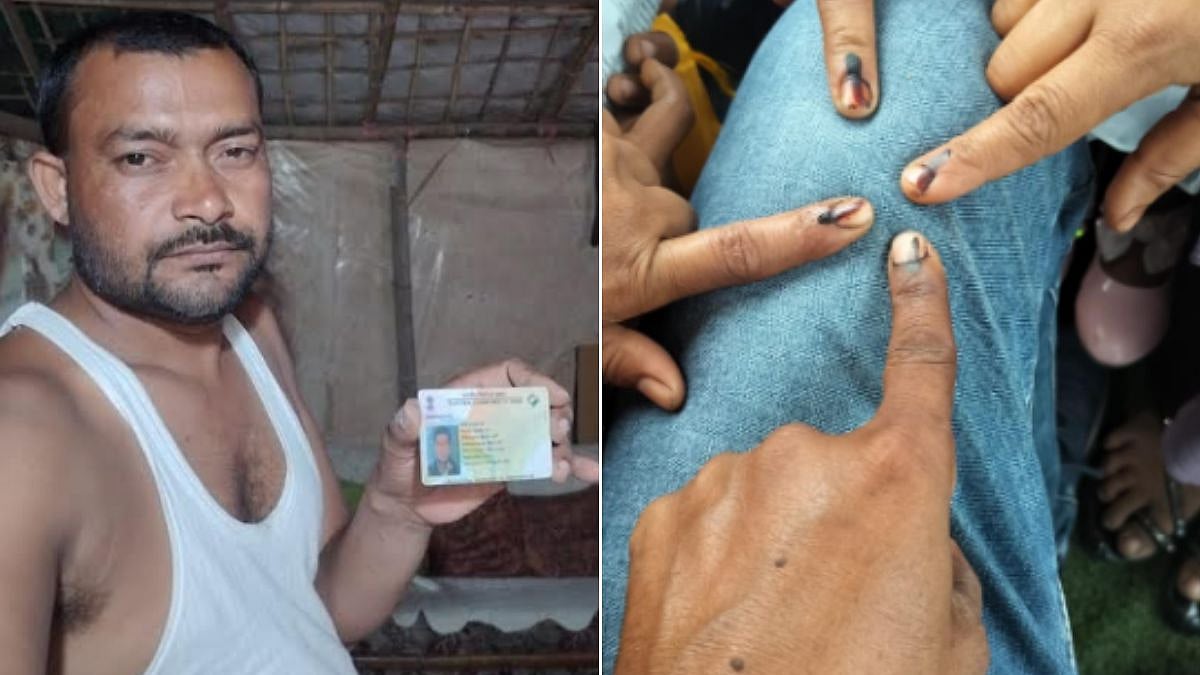
The Price Of Proof: One Man's Struggle To Prove He Is Indian | File photo
Lucknow: In a police station on the outskirts of Lucknow, the constable did not raise his voice. He only pointed to the floor. "Sit there."
It was an early January morning. The chill was in the air. Mohammed Saadiq hesitated for a moment—just a moment—then lowered himself slowly onto the hard cold tile, careful not to crumple the transparent plastic folder pressed against his chest. Inside it were papers he had carried across two states. Birth certificates. Identity cards. A ration card worn soft at the edges from being opened and refolded so many times it had begun to feel like wrinkled skin.
There had been a verification drive in the residential colony where he worked in Lucknow, capital of the north Indian state of Uttar Pradesh. Officials had received complaints—or said they had—about illegal residents in the area. The directive had come from the Chief Minister's office. The target was clear: Bangladeshis and Rohingyas.
The profile of suspicion was familiar: people who spoke Assamese or Bengali, who worked in sanitation or waste collection, who lived in shanties or slums covered with black plastic sheets.
"We are always the first to be called," he said. "Whenever there is a drive, they come to us."
Around him, a line of men and women sat cross-legged against the wall, backs bent, eyes lowered. All of them were from Assam and worked either as sanitation workers or rag pickers. Saadiq's neighbour Sameer, also from Assam, sat on the hard floor with his back against the wall. No one spoke.
Saadiq's wife Romisa Begum sat beside him. She had not said a word since they entered. She said she was scared as it was her first visit to a police station. "I preferred to keep quiet," she told this reporter later. She had learned, over the years, that silence was safer.
"The police made us sit like `chor’," Sameer would say later. "Like thieves."
Saadiq had arrived at the police station that January morning with everything. The plastic folder had been prepared over years—a photocopy of each document made before the original had a chance to fade. Birth certificates. Government identity cards. Papers that had made the journey from Assam to Lucknow in his bag, been shown, returned, refolded, and kept ready again. His wife Romisa carried their children's documents separately, in her own envelope.
They were told to sit. Hours passed without explanation.
After a wait of almost an hour and a half, Saadiq asked the constable sitting at the main desk why they had been summoned. The constable looked at him and then politely answered: "Senior Inspector will come and talk to you. He will check your documents."
Later, when they tried to show their documents, one officer said all their documents were fake.
Fake?
The word was not explained or argued. It was said in an authoritative way, as if it were a fact that needed no questioning.
"How can they be fake?" Saadiq remembered asking. "These are government papers issued by officials in Assam."
The officer did not respond to the logic. He gave a direction instead. "How can we believe these are genuine papers? Get them verified from Assam."
The instruction was cruel but impossible to follow from the outskirts of Lucknow. Saadiq was inside a police station in Uttar Pradesh. The people who could verify his documents were in Assam, an eastern state bordering Bangladesh, almost 1,500 kilometres away. How could he get them verified?
When this reporter went to the Manas Vihar police outpost to enquire about the ordeal of Saadiq and his neighbours, police officer Brij Bhushan Singh said the incident happened on January 9. "I remember the date because that day there was a double murder in that area. The senior inspector had gone there for enquiry. Murder enquiry takes time. Seniors also came. Then there was a forensic team which came to the site. He came late and therefore these people had to wait for a few hours," he said.
The police officer did not specify as what he meant by kuch ghante (few hours) , but Saadiq claims the wait was more than eight hours.
Justifying police verification, Durgesh Dwivedi, a senior police official at Indira Nagar police station under which Manas Vihar falls, said that law enforcement agencies regularly monitor the slum clusters in the area. "We conduct frequent verification drives and raids to identify illegal residents. We are aware that not everyone living in these settlements is from Bangladesh. However, there is always a possibility that infiltrators may blend into such communities because they share similar language, appearance, and cultural practices. That is why continuous vigilance is necessary," Dwivedi said.
Eventually the inspector arrived, reviewed the situation and asked the constable to record details and distribute forms. Each person was called one by one. Names, family members, Aadhaar numbers, all written down slowly.
The process was excruciatingly long. He jotted down the name of the head of the family, number of members, their names and Aadhaar card numbers.
Saadiq completed the formalities. Helped constable to fill all details and then filled the form. Before he reached the door, an officer added: "Do not indulge in anti-national activities. We are keeping an eye on you."
Saadiq did not answer. He looked around and still saw some of his neighbours from the slum in the Chaandan area sitting and waiting for their turn so that they could register their details. He looked at Romisa Begum, asked her to leave, and walked outside the police outpost to realise the evening has already set in.
Lenin Raghuvanshi of the People's Vigilance Committee on Human Rights (PVCHR) said: "This is the machinery of modern citizenship in India, where belonging is a privilege that must be constantly proven, not a right that is guaranteed."
The Verification
The verification drives across Uttar Pradesh began on November 22, 2025, when Chief Minister Yogi Adityanath directed officials to identify Bangladeshis and Rohingyas and act under existing law. All districts were asked to set up temporary detention centres to house suspected infiltrators. Officials said the directive came amid growing concerns over undocumented foreign nationals living in several districts, particularly in border-linked and high-migration zones.
Government records show 572,064 people from Assam had migrated to other states for work. Most are Muslim, most employed in sanitation, construction and informal labour. They left a state still unsettled by the National Register of Citizens exercise, which between 2013 and 2019 excluded 1.9 million people from a final citizenship list that satisfied almost no one. The fear it produced was permanent.
After Chief Minister’s directive, Lucknow Mayor Sushma Kharakwal ordered that Bangladeshis in the city be identified and sent back. "There are around two to three lakh illegal migrants from Bangladesh living in Lucknow. Identify them and send them back," she said.
She did not explain from where she got the number.
Under this exercise, people like Saadiq were summoned to police stations and made to wait for hours. "All immigrants from Assam were asked to report and fill papers," he said. "We were punished only because we are Muslims who speak Assamese."
Saadiq and his family of five—wife and three children—were facing a struggle on two fronts. First, to prove that he is Indian. Second, to vote in the Assam elections on April 9, because failing to vote could mean his name gets struck off from the voters' list.
Tremor Before Elections
Days after the police station ordeal, Saadiq was finishing his morning shift sweeping a residential colony in Bal Vihar when his phone rang. It was mid-January.
His younger brother Razibul Ali was calling from Barpeta in Assam. "Have you checked your name?" he asked.
Saadiq did not need to ask which list.
"Your name is not on the voting list. The government has issued a notice against you. You need to come here," his brother said.
"Notice?" Why?
He was stunned. He had submitted all documents, including the NRC papers. He learned that during the Special Revision in Assam, officials went door to door for verification. His name was cut because he was not in Bangtigram, his village in Barpeta district, when the Booth Level Officer (BLO), the local election official responsible for voter rolls—came for inspection.
In the days that followed, the calls multiplied. Neighbours, cousins, people from the same district, all asking the same questions. What would happen now. What if they branded him Bangladeshi.
Saadiq is thirty-five. He has worked in Lucknow for twenty-one years, sending money home most months. His wife and children live with him, but his mother and one brother remain in Barpeta, in the village where he was born and where his name first appeared on a document.
He had come to Lucknow in 2005 through a village acquaintance he called Chacha, an older man who said there was work and would help find it. Saadiq started as a rag picker and eventually joined the Municipal Corporation as a sweeper. An ordinary life built over two decades, between two places, belonging fully to neither.
From the moment he learned about the notice, he did not sleep well.
Each evening he came home and sat with his phone, trying to understand a voter list revision process administered in Assam, accessible in theory online, impossible in practice for someone in a tarpaulin shanty in Lucknow with an unreliable connection and no local official to call. The instructions came in forms he could not always read. The deadlines were unclear. The consequences of missing them were not.
By early February he had made his decision. He would go to his village and appear before the officers himself.
"We are not eager to vote for any particular leader," he said, the evening before he left. "We are going to get our names on the voting list so that no one can question whether we are Indian."
He packed his bag, left behind his wife and three children, and decided to take a long train journey to prove he was Indian.
The trains leaving for Assam that week were full.
The Train Journey
On the Avadh Assam Express, which runs from Lucknow to Guwahati in roughly 32 hours, the unreserved compartments were standing room only by the time the train cleared the platform. Men pressed into the space between berths. Children sat on laps. The windows let in the cold plains air and the sound of the tracks.
"The unreserved coach was mostly migrant labourers from Assam going to get their names on the voting list," Saadiq said. "All of them were Muslims. The talk was whether we were being persecuted because of our religion."
The Procedure
The government's position, stated through regional officials when pressed, was measured. Voter list revisions are routine, conducted ahead of every election cycle, and necessary to remove duplicate or ineligible entries.
There was confusion over the Election Commission carrying out a "Special Revision" of electoral rolls in Assam instead of a "Special Intensive Revision" as seen in some other Indian states, raising concerns about its implications for voters' citizenship status. Opposition parties and petitioners argued that the distinction has created uncertainty among voters in a state already sensitive to citizenship verification issues. They alleged that the exercise was being used to selectively target certain communities, particularly Muslims, by removing their names from the electoral rolls ahead of the 2026 Assembly elections.
What Assam's document crisis produced, more than any list or category or legal status, was a generation of people who learned to treat their own identity as provisional. Lenin Raghuvanshi said: "The process—which ran for years, consumed enormous state resources, and cost ordinary people their savings, their mental health, and in documented cases their lives—taught a simple lesson: your name can be questioned at any time, by anyone with a form and a table and the authority to sit while you stand."
Saadiq reached Barpeta after two days on the train and found that it was not an end to his woes. There were queues at the local administrative office. Forms to submit, names to confirm, officials to locate. He spent days moving between desks, repeating himself, waiting.
"Submit your papers and return after three days," an official told Saadiq. "Verification needs time," he said when Saadiq told him about his unskilled job in Lucknow.
Realising that the official was local—an Assamese—and hoping to earn sympathy, Saadiq told him about his experience in the police station in Lucknow and how he had been humiliated for being Muslim. "I cannot help it," the official said. "This is a government notice and needs to be verified."
The wait for three days stretched to seven. And by the end of February, he was told that his name had been included on the voters list.
He stood in that office and felt something he could not immediately name. Not relief—relief implies that the danger was unreasonable. What he felt was closer to exhaustion, the kind that comes after a long effort whose necessity you cannot reconcile with the country you thought you lived in.
The Slum Was Gone
While Saadiq was in Barpeta, the municipal authorities demolished the Chaandan slum colony.
The demolition took place on February 20, 2026—a Friday morning, according to three residents who witnessed it and spoke to this reporter. Saadiq's wife, Romisa Begum, was inside when the notice came. There was no written order delivered to their door. A municipal worker came through the lane and told everyone to remove their belongings within the hour. Some families saved mattresses. Some saved cooking vessels. Most saved their documents first.
Romisa Begum saved the children's school papers and a plastic folder that carried citizenship papers for her and the children.
"I grabbed the children's school papers and my paper folder," she told this reporter. "The rest—the stove, the bedding, our clothes—I watched it all disappear under the rubble. But I knew: without those papers, we had nothing."
That night she and her children—a son and two daughters—slept under the open sky as she did not have a place or resources to build a hut.
The demolition had been announced weeks earlier. On February 4, 2026, Lucknow's Mayor told reporters that the city needed to be "rid of Bangladeshi infiltrators" who were "encroaching on government land." She did not name Chaandan specifically. But the message was understood. Between February 15 and February 28, the Lucknow Municipal Corporation demolished an estimated 40 structures in three slum clusters—Chaandan, Transport Nagar, and Ghazipur. The majority of residents were Muslims from Assam and West Bengal. The municipal corporation did not respond to requests for a list of families displaced or alternative housing offered.
This reporter submitted three written requests to the Lucknow Municipal Corporation seeking the demolition order number, the list of affected families, and the legal basis for the evictions. The question was: when they had submitted all details at the police station, why was their slum demolished? There was no response.
Saadiq learned of the demolition from a neighbour's phone call while he was still in Barpeta, waiting for his name to be restored to the voters list. He cut short his visit, but by the time he reached Lucknow, the land had been cleared. He did not say much about this when we spoke. Some losses, he told me, are too large to narrate in a single sentence, so you do not try.
He and Romisa Begum rebuilt their shanty three kilometres away, in Sugamau, on land that a neighbour allowed them to use. The new roof is black tarpaulin. The floor is packed earth. The plastic folder sits under the sleeping mat.
He had solace that his name was on the voters list and he would cast his vote as an Indian in the assembly election.
Voting to Prove Nationality
The election in Assam was on April 9. He told the office-bearers of the Residents Welfare Association (RWA)—the neighbourhood committee that managed the colony where he worked—that he would be going to Assam again to cast his vote. The secretary of the association grew angry and questioned how he could leave when he had been away from work for ten days almost a month earlier.
"I have to go and vote to prove my nationality," Saadiq said. The RWA officials said it was not possible to allow him to take leave so frequently. But Saadiq was adamant. "Just give me leave for seven days, and in the next two years I will not ask for leave," he said.
Just seven days… Saadiq agreed.
On April 4, he undertook the train journey again. This time he was lucky. He got a reservation on the Okha-Guwahati Express—the train that connects the western part of India with the east—and travelled for over 32 hours. Saadiq went with his full family and took gifts for his brother and mother.
This time he was happy. He was going to vote to prove his nationality. He was happy that this election would be the end of his trauma, that the ink on his finger would end all the questions about whether he was Indian or Bangladeshi.
On April 6, he reached Guwahati and by evening he was in his village. On April 9, he voted in the provincial election. Whom he voted for—no one asked. He took a photograph of his inked finger and his family's and posted it on social media to tell the world that he had taken part in the election process and was part of the Indian diaspora.
He met his relatives, some of whom had come from different parts of the country to cast their votes. Some of them he was meeting for the first time in years. This election had given them an opportunity to connect.
In his excitement, he crossed the seven-day warning and returned to work two weeks late.
Job Gone
The colony had hired a replacement within the week. His supervisor was apologetic, not unkind. Work does not wait. Someone else had needed it and taken it.
Saadiq did not argue. He remembered the conversation with the supervisor clearly. It had been brief. The supervisor had looked at the floor, shifted his weight, and said: "We found someone. He's already started. I'm sorry, Saadiq." There was nothing more to say.
What the supervisor did not say—what was understood—was that the replacement was younger, cheaper, and had not just been away for two weeks. Saadiq knew the economics of unskilled labour: there is always someone else waiting.
"I had a feeling people were avoiding me because I was a Muslim from Assam," he said. "There is so much news about Bangladeshi infiltration. People started looking at us differently."
He waited a few days. Then he decided to start something new.
He had lived in the Chaandan neighbourhood for ten years before the demolition. He knew its fish market like the back of his hand. He began selling fish—setting up in the morning, his son and daughter helping him arrange the catch and find customers. Whatever he earns is not always enough to feed a family of five. But it is enough, he said, to pick up the threads.
In between, he found part-time work as a driver for a Municipal Corporation garbage truck. "It's not a regular job," Saadiq said. "But it gives me extra money."
There is one thing he has changed. His friends stopped speaking Assamese or Bengali in public.
"We should speak only in Hindi when we meet at the workplace," Sameer told him. "Speaking Assamese makes us suspects. In the eyes of people. In the eyes of the law."
Saadiq did not agree.
"Assamese and Bengali are languages of India," he said. "Why should I hide them? We should take pride in speaking Bangla and Assamese. It strengthens our Indian identity. We have our papers. We have our citizenship. And we have our own language."
He switched to Bangla and told this reporter: "You take pride in speaking Bangla. I too speak Bangla and Assamese with my friends. Some answer in Hindi. That is their choice. Not mine."
The Afterword
Saadiq's name is still on the voters list in Assam. But he does not know if it will stay there. He knows that the next revision, the next verification drive, the next election will bring new forms and new questions. He knows that the Rs 40,000 he spent on this journey is not enough to protect him.
He is not alone. Across Uttar Pradesh, lakhs of migrant workers from Assam live in similar uncertainty. The demolition of Chaandan displaced an estimated 20 families. The Lucknow Municipal Corporation has not offered any of them alternative housing. The police verification drives continue.
When asked if he would make the journey again—if his name were struck off the list again—Saadiq did not hesitate. "Yes," he said. "What else can I do?"
In the shanty in Sugamau, Saadiq still has his plastic folder. It sits not in a cupboard but under his sleeping mat—not because he expects to be called tomorrow, not because the danger is immediate, but because the time between being asked to prove yourself and being asked again has never been long enough to forget.
The documents are his. Earned and legitimate and worn with use. The country they were issued by is his. The floor of the police station where he sat is also his—the memory of it, the weight of it, the thing it made of an ordinary January morning.
Last week, Saadiq showed this reporter the plastic folder. He pulled it from under the sleeping mat, untied the string that held it closed, and spread the contents on the floor of the shanty. The ration card was there. The birth certificates. A voter ID card from the 2024 general election, its corner softened from humidity. On the back of the ration card, in blue ink, someone—Saadiq does not remember who—had written a phone number that no longer works.
One edge of the ration card was torn.
"It was not torn before the police station," Saadiq said. He looked at it for a moment. Then he said: "If it is too perfect, they will think it is fake. So I do not replace it."
He folded the papers back into the folder, tied the string, and pushed it under the mattress.
He keeps the folder close the way you keep something you are afraid of losing.
When this reporter asked Romisa about the folder, she said: "We have the papers. We have the ink on our fingers. But we still wake up every morning wondering if it will be enough."
Not the papers.
What the papers are supposed to mean.
RECENT STORIES
-
-
-
-
-