Supreme Court Refuses To Halt Release Of Mahaprabhu Jagannath, Says Creativity Cannot Be Curtailed Over Religious Sensitivity
The Supreme Court refused to stop the release of the animated film Mahaprabhu Jagannath, dismissing pleas seeking changes to its earlier order. The Bench said religious sensitivities alone cannot curb artistic expression and noted the CBFC-certified film was intended for children. It added the producer could make voluntary changes if desired.

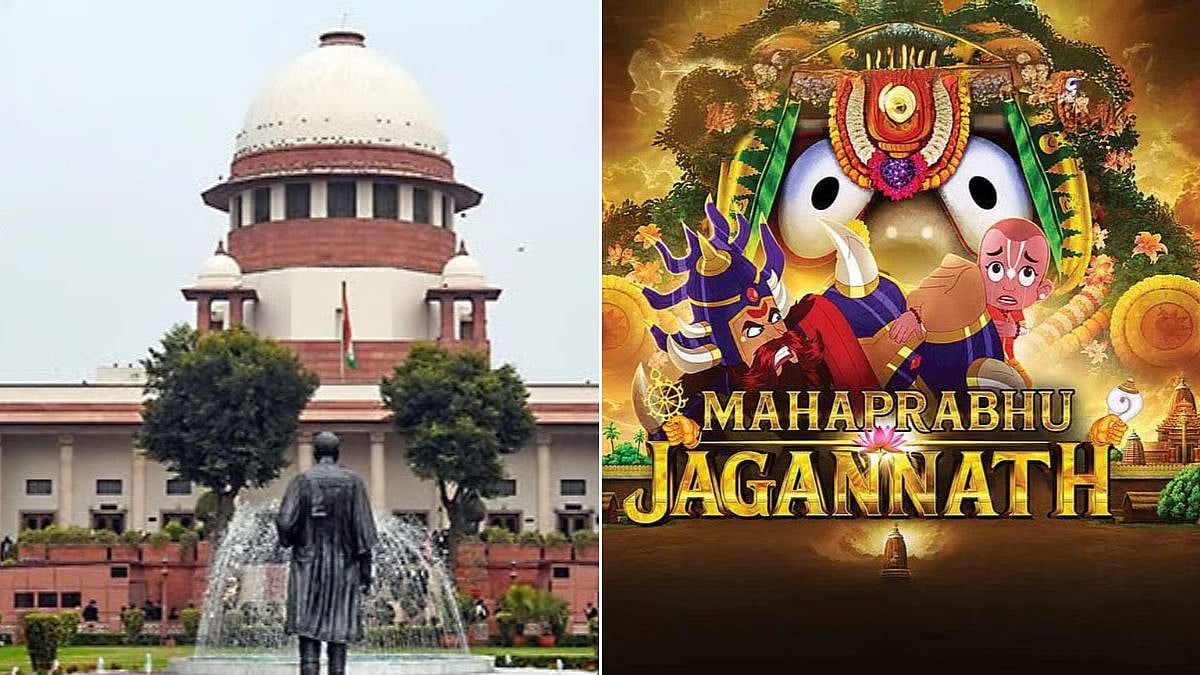
Supreme Court Refuses To Halt Release Of Mahaprabhu Jagannath, Says Creativity Cannot Be Curtailed Over Religious Sensitivity |
The Supreme Court on Wednesday refused to ban the release of the animated film Mahaprabhu Jagannath, dismissing applications seeking to modify its earlier order that had allowed the movie to hit theatres after the conclusion of the Lord Jagannath Rath Yatra in Puri on July 28.
A Bench of Justice BV Nagarathna and Justice R Mahadevan declined to interfere with its July 17 order, observing that objections based on religious sensitivity cannot become a ground to stifle artistic expression. The court also rejected the argument that depicting Lord Jagannath in animated form was inherently offensive, noting that the film was intended for children, Live Law reports.
Court draws a line on artistic freedom
Making strong oral observations during the hearing, Justice Nagarathna questioned the growing tendency to seek judicial intervention against creative works merely because they do not align with the sentiments of a section of people.
"If there is such kind of sensibility, sensitivity, and two-three people file a writ petition, we will pass an order that in respect of Hindu God, Goddess or mythology, let there be no art form in India," she remarked. Referring to the many versions of the Ramayana across the country, she said creativity takes different forms and warned that accepting such arguments would mean no films, television shows, paintings or sculptures on Hindu deities could ever be made.
Justice Mahadevan also pointed out that the film had already been certified by the Central Board of Film Certification (CBFC).
The applications seeking a modification of the July 17 order had been filed by the temple trust and a devotee, who objected to the depiction of Lord Jagannath in cartoon form.
Temple panel cites broken promise, producer denies assurance
Appearing for the Temple Committee, Odisha Advocate General Pritambar Acharya argued that the producer had breached the trust of religious authorities. He submitted that the producer had organised a special screening for religious heads, members of the temple committee and others, where several objections were raised over the animated portrayal of Lord Jagannath.
According to Acharya, the producer had assured those present that the film would be modified in line with their concerns. He also claimed that the deity had been depicted like cartoon characters such as Doraemon and Spider-Man.
Responding to the submissions, Justice Nagarathna reiterated that the court could not allow artistic expression to be curtailed because of the sensitivities of a few people. She observed that animation films are primarily made for children and noted that storytelling has always evolved with changing times. She also said filmmakers undertake research before creating such works to ensure creativity is backed by study.
Senior Advocate Devadatt Kamat, appearing for the producer, denied that any assurance had been given. He submitted that members of the temple committee had themselves walked out of the screening.
After hearing both sides, the Bench said it was not inclined to modify its earlier order and dismissed the applications. It, however, observed that if the producer wished to make any changes voluntarily, he was free to do so according to his own conscience, adding that the court would not sit in judgment over such a decision.
The matter reached the Supreme Court after the Orissa High Court had passed an interim order restraining the release of the film across the country. The producer, Ele Animations Pvt Ltd, challenged that order before the apex court, which on July 17 permitted the release of the film after the Rath Yatra concluded on July 28.
Background
The Orissa High Court had passed the interim order on July 15 while hearing a public interest litigation filed by Mahesh Kumar Sahu.
ALSO READ
The Division Bench of Chief Justice Harish Tandon and Justice Murahari Sri Raman had expressed concern that the film's release before the Rath Yatra, scheduled for July 16, could affect public order. The court observed that while films enjoy the protection of freedom of speech and expression, they can also have an immediate impact on public sentiment and religious beliefs, which could potentially disturb peace.
The controversy began after Ele Animations Pvt Ltd uploaded a teaser of Mahaprabhu Jagannath on its YouTube channel, Jay Jagannath, on June 6, 2026, announcing that the film would be released on July 10, 2026. The teaser sparked widespread objections over the film's content.
Following objections from the Shree Jagannath Temple Administration (SJTA), which manages the 12th-century shrine in Puri, the producer organised a special screening for Puri's Gajapati Maharaja and SJTA members. They objected to what they described as inaccurate stories that were inconsistent with established Jagannath traditions and the spiritual history of the deity. According to the petitioners before the High Court, although the producer had reportedly agreed to make changes, the film was later scheduled for release on July 17 without incorporating those modifications. They therefore sought revocation of the CBFC certificate granted to the film.
RECENT STORIES
-
-
-
-
-