Supreme Court Flags Highway Encroachments, Asks NHAI Why CCTV Cannot Be Installed At Toll Plazas
The Supreme Court flagged highway encroachments and stationary vehicles as major road-safety risks and asked NHAI why CCTV systems and monitoring rooms cannot be installed at toll plazas. The court was hearing a suo motu case linked to a Phalodi accident that killed 15 people and has posted the matter for October 6.

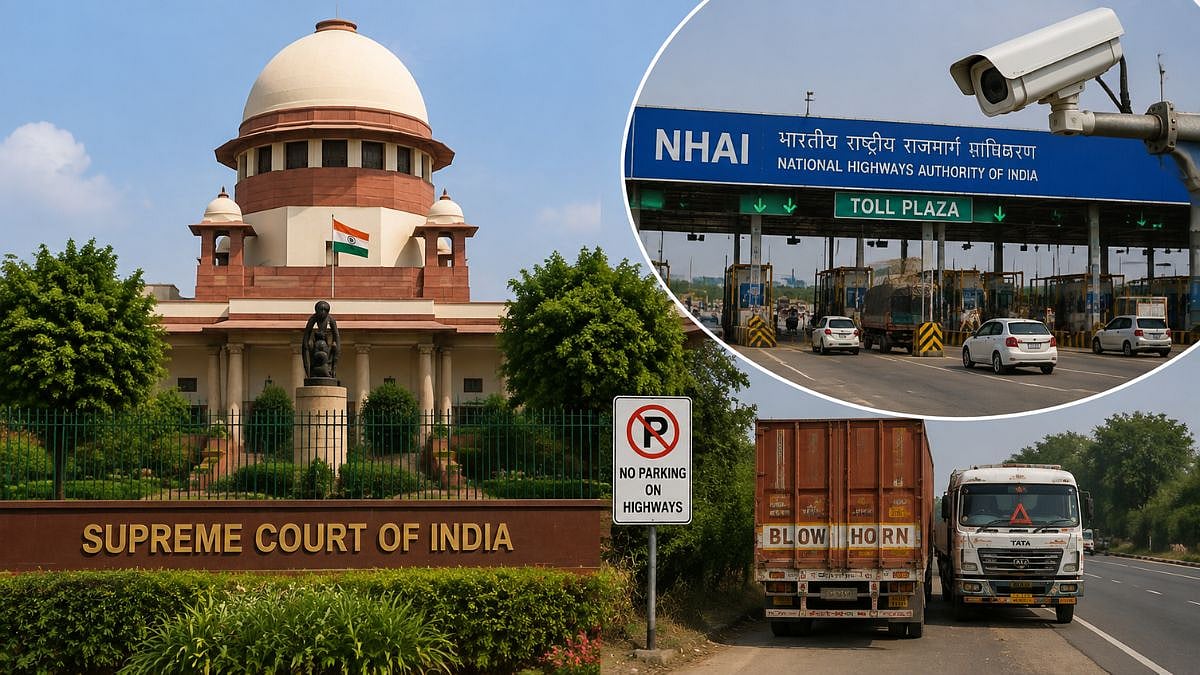
The Supreme Court has sought stronger surveillance and enforcement measures to curb hazards on national highways | AI Generated Representational Image
New Delhi, September 3, 2026: The Supreme Court on Thursday flagged encroachments and stationary vehicles on highways as major road safety concerns and asked the National Highways Authority of India (NHAI) why camera surveillance systems and monitoring rooms cannot be installed at toll plazas.
A bench of Justices Vikram Nath and Sandeep Mehta raised the issue while hearing a suo motu case concerning a road accident in Rajasthan's Phalodi area that claimed 15 lives. The bench identified encroachments and stationary vehicles on highways as two major problems that need attention.
Cameras Could Strengthen Highway Vigil
The court's suggestion to use cameras at toll plazas points to the need for stronger monitoring of highways, particularly when illegally parked vehicles can pose a serious danger to motorists. With toll plazas already serving as key points along national highways, surveillance from these locations could help authorities keep a closer watch on violations.
Counsel appearing for the NHAI said the authority had issued circulars for regular inspections and patrolling to check unauthorised parking on highways, PTI reports.
"Why can't you think of having a camera surveillance system? You can have monitoring rooms at all toll plazas," the bench said.
Senior advocate ANS Nadkarni, who is assisting the Supreme Court as amicus curiae in the matter, said illegal parking of vehicles on highways was one of the major issues leading to road accidents.
Ministries Yet To File Compliance Affidavits
The bench noted that the Ministry of Road Transport and Highways, the Ministry of Home Affairs and the Tamil Nadu government had not yet filed their compliance affidavits in the matter.
It granted the two ministries two weeks to file their affidavits. The court posted the matter for October 6 and directed the Tamil Nadu government to file its affidavit before the next hearing.
The case stems from a November 2 road accident in Phalodi last year, in which a tempo traveller rammed into a stationary trailer truck. The Supreme Court took suo motu cognisance of the accident later that month.
Phalodi Crash Claimed 15 Lives
The accident occurred near Matoda village on the Bharat Mala Highway when the tempo traveller was travelling from the Kolayat temple in Bikaner to Jodhpur.
The tragedy brought into focus the danger posed by stationary vehicles on highways, an issue that has now become central to the Supreme Court's examination of highway safety.
On April 13, the Supreme Court issued a series of interim directions, including an order that no heavy or commercial vehicle should park or stop on the carriageway or paved shoulder of any national highway except at a designated bay, lay-by or wayside amenity.
Court Had Ordered Action Against Highway Hazards
The court also prohibited the construction or operation of any new dhaba, eatery or commercial structure within the right of way of any national highway.
It directed the Ministry of Road Transport and Highways and the NHAI to identify accident blackspots and critical areas and publish a comprehensive list of accident blackspots on national highways.
The court had underlined the seriousness of the problem by noting that national highways constitute approximately 2% of India's total road length but account for nearly 30% of all road fatalities.
"A road, particularly a high-speed expressway, must not become a corridor of peril due to administrative lethargy or infrastructural gaps," the Supreme Court had said.
Also Watch:
ALSO READ
The figures underline why effective enforcement, regular patrolling and better surveillance are crucial. The court's latest intervention puts the focus back on whether existing highway infrastructure can be used more effectively to prevent avoidable accidents.
To get details on exclusive and budget-friendly property deals in Mumbai & surrounding regions, do visit: https://budgetproperties.in/
RECENT STORIES
-
-
-
-
-