Shock In India As Trump Backs Bill Proposing 500% Tariff On Exports To US
India reacted with alarm after US Senator Lindsey Graham said President Donald Trump had approved a Bill proposing a steep 500% tariff on Indian exports. Economists warn the move could severely hurt MSMEs, trigger job losses, and disrupt key export sectors, even as New Delhi weighs limited diplomatic and trade options.

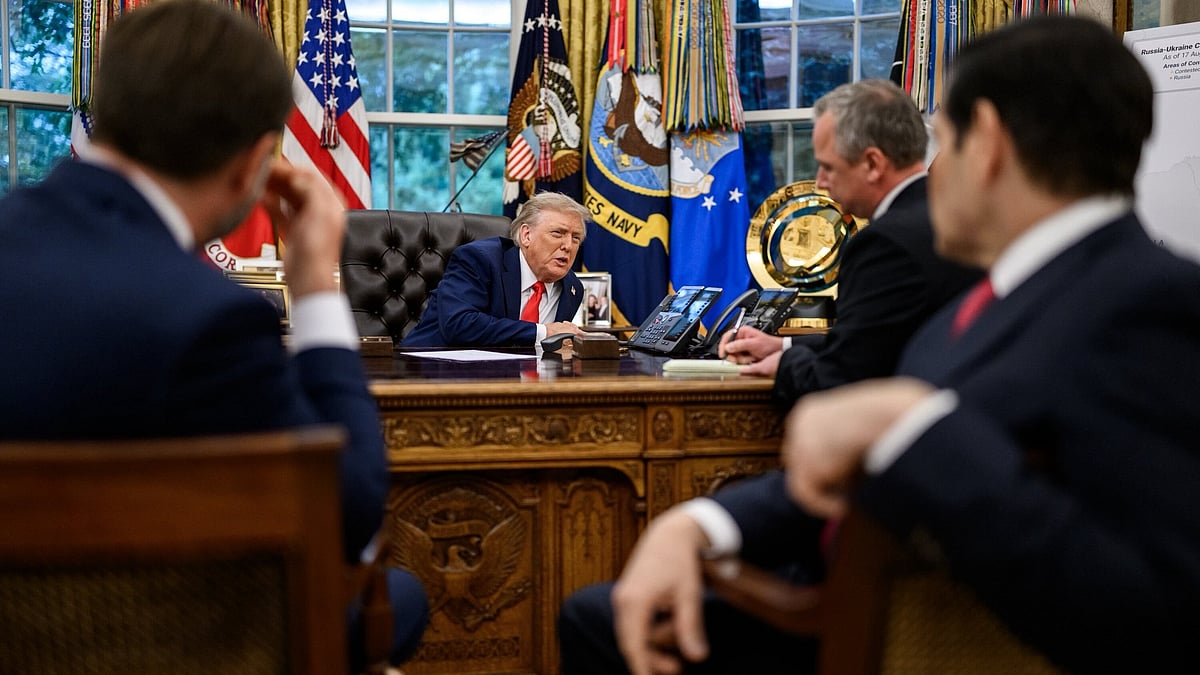
US President Donald Trump | X/White House
Indians reacted with shock as US Senator Lindsey Graham announced that President Trump had green-lighted a bill allowing a 500% tariff levy on Indian exports to the US. Immediate reactions to the news included India’s stock benchmarks falling to their worst day in over four months, while economists warned that India’s MSME sector—already struggling with 50% tariffs—could face huge job losses.
Economists Warn of $7-10 Billion Export Losses
Sankhanath Bandyopadhyay, economist at the credit ratings agency Infomerics Valuation and Ratings, said in a recent interview. “Exports of gems and jewelry, marine products, pharmaceuticals, electronics, and steel, all heavily dependent on the US market, could suffer significant losses. If tariffs are reinstated or raised, Indian exporters could face losses of $7-10 billion.”
The focus now will be on how the Trump administration will structure the tariffs. In August, pharmaceutical exports, along with semiconductors and aluminum products, were exempt as Trump launched an additional 25% tariff in August 2025, taking the total tariff on Indian exports up to 50%. So the structuring of the tariff will be a factor, and only once the fine print is understood can New Delhi take action.
Economists say India’s options include going to the WTO—a fairly useless proposition, as setting up a WTO committee would take over a month—and Trump is not likely to abide by any WTO ruling. The other option is to try and understand what President Trump wants. Suranjali Tandon, Associate Professor at the National Institute of Public Finance and Policy (NIPFP), believes that what the US president wants is for India to buy more US crude.
US Oil Lobby Influences Trump’s Trade Strategy
“I think what is required of India is to sit at the table and ask the US what it is that they want. I think what the US is trying to say is that it wants India to buy its oil.” She adds. “They have done this with the EU. If you look at the composition of the gas and oil purchased, they were not writing long-term contracts with the US, but they were ramping up their imports from there. This placated Trump, and they got out of a situation where they were going back and forth on negotiations.”
India is already buying more US crude. Data from the Ministry of Commerce and Industry showed it imported 178.1 million tonnes of crude between April and November 2025, of which 60 million tonnes came from Russia and 13 million tonnes came from the US. Though the amount of US oil was a 92% year-on-year growth from the same period in 2024, there is a limit to how much US oil India can buy. Energy experts say Indian refineries are catered to Russian and Middle Eastern crude rather than US crude, which is different. Therefore, India can buy US crude but in a limited amount. Shifting over will take time and money.
Time is something Trump is not willing to give. According to Tandon, the US president is invested in the US oil lobby. “We have to remember that US shale oil has been languishing for a long time, and Trump came back on the promise of drilling more.” She adds. “Many of Trump’s advisors (a Guardian report said over 40 of them currently work for oil, gas, or coal companies) are involved in oil. So, there is some strategic thinking on that side.”
Trump’s insistence on oil compliance is a situation that New Delhi will have to handle delicately. However, the options are limited. Trump’s attempt to exert more control over the US Federal Reserve and put pressure on its current chair Jerome Powell has reduced New Delhi’s bid to talk to alternate voices in the finance sector.
Limited Channels for Diplomatic Negotiation
The silence of the Indian diaspora in the US has also not helped. Perceived as a powerful link with the US government, Indian diaspora groups have kept their distance from New Delhi. Suhag Shukla, co-founder of the diaspora group the Hindu American Foundation (HAF), wrote recently in an opinion piece that his group would “prioritize American interests and not serve as extensions of India’s political agenda.”
India therefore has no option but to deal directly with Trump and manage the fallout of the large-scale job losses should the tariff come into place. Subsidies may be one way to implement this, but this will take time to implement. Tandon believes India needs to boost domestic consumption and then reroute supply chains, but this will also take time. There are no quick-fix solutions, and India must decide soon what option is likely to cause the least pain in the short to medium term.
RECENT STORIES
-
-
-
-
-