SC Upholds Delhi HC Order Quashing MEA's CPV Tender For 4 Indian Missions, Orders Fresh Bids Within 3 Months
The Supreme Court refused to interfere with the Delhi High Court's order quashing the MEA's tender process for outsourcing Consular, Passport and Visa (CPV) services at Indian Missions in Abu Dhabi, Kuwait, Singapore and Canberra. It allowed existing service providers to continue temporarily and directed the Centre to complete a fresh tender process within three months.

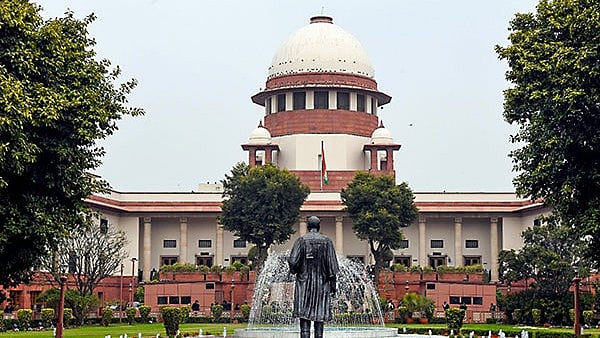
SC Upholds Delhi HC Order Quashing MEA's CPV Tender For 4 Indian Missions, Orders Fresh Bids Within 3 Months | X - ANI
New Delhi: The Supreme Court on Monday refused to interfere with the Delhi High Court's judgment quashing the Ministry of External Affairs' (MEA) tender process for outsourcing Consular, Passport and Visa (CPV) services at Indian Missions in Abu Dhabi, Kuwait, Singapore and Canberra.
A bench led by Chief Justice of India Surya Kant and comprising Justices Joymalya Bagchi and V. Mohana dismissed the Union Government's special leave petitions challenging the July 15 judgment, while modifying the High Court's directions to ensure that consular services remain uninterrupted until a fresh tender process is completed.
ALSO READ
"The SLPs are hereby dismissed", the Court said.
The Court, however, modified paragraph 101 of the High Court's judgment and permitted the Union of India and the MEA to continue the existing service providers at all four missions until fresh Requests for Proposal (RFPs) are issued and the work is reallocated.
Alternatively, the Court said the Centre would be at liberty to temporarily allocate the work to the successful L-1 bidders whose allotments had been set aside by the High Court, making it clear that such an arrangement would be entirely at their own risk. The Court also granted the MEA liberty to evolve any other mechanism to ensure uninterrupted consular services at the four missions.
The Court directed the Union Government to comply with the Delhi High Court's directions and complete the fresh tender exercise within three months.
During the hearing, Solicitor General Tushar Mehta, appearing for the Union Government, argued that the High Court's judgment had disrupted the functioning of Indian missions abroad as embassy officials had been diverted to perform work that was earlier handled by outsourced service providers.
He submitted that, unlike previous tender processes, the Centre had allowed even the existing service providers to participate in an open and competitive bidding process.
ALSO READ
Defending the evaluation process, Mehta argued that the tenders related to four different Indian Missions and that technical assessments could legitimately vary from one mission to another.
"A bidder may get two marks in Abu Dhabi but five marks in Singapore. If the same marking is given everywhere, then something is fishy", the SGI argued.
He further submitted that each evaluation committee had independently assessed bidders based on competence after considering the requirements of the respective mission.
"I had a word with the concerned Secretary in the Ministry of External Affairs. We have taken each bidder on competence and given them marks", be added.
The Solicitor General also contended that if one bidder secured full marks under a particular criterion, the remaining bidders would necessarily receive comparatively lower scores.
The Court, however, questioned the absence of transparency in the evaluation process and noted that the High Court's concerns arose because reasons for awarding marks had not been disclosed.
"But you invited the High Court order by not giving reasons. High Court caught you", CJI Surya Kant observed.
Justice Joymalya Bagchi also expressed reservations over the marking methodology.
"The terms on which marks have been awarded are not transparent", the judge remarked.
The dispute arose from a July 15 judgment of the Delhi High Court, which held that the MEA's technical evaluation process suffered from arbitrariness, irrationality and lack of transparency because authorities had failed to record and communicate reasons for awarding marks and rejecting bidders at the technical stage.
The High Court had set aside the technical evaluation and the award of contracts for outsourcing CPV services at the Indian Missions in Abu Dhabi, Kuwait, Singapore and Canberra, while directing the Centre to issue fresh RFPs within one month. It had, however, allowed the existing service providers to continue temporarily to ensure continuity of consular services until the fresh tender process was completed.
The High Court's judgment came on petitions filed by E Trav Tech Limited and Verasys Limited, which challenged their technical disqualification from the tender process, alleging that although parameter-wise marks had been assigned, no reasons were disclosed for the deductions or their disqualification.
(Except for the headline, this article has not been edited by FPJ's editorial team and is auto-generated from an agency feed.)
RECENT STORIES
-
-
-
-
-