Saudi-Pakistan-Türkiye Defence Pact: New Security Challenge For India?
The Saudi Arabia-Pakistan-Türkiye defence agreement has sparked debate over its implications for India. Former diplomat Kanwal Sibal sees a potential security challenge, while Talmiz Ahmad says the pact is primarily aimed at deterring Israel. Analysts also question its NATO-like character, noting that its full text remains undisclosed and its long-term impact is uncertain.

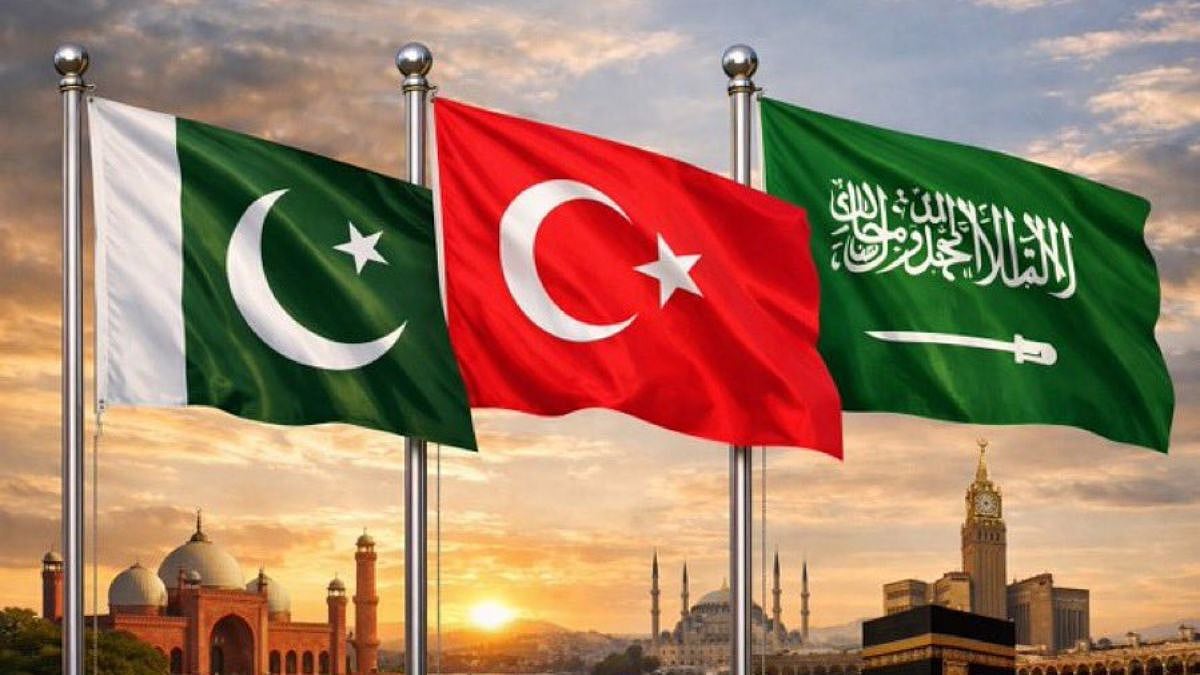
Saudi-Pakistan-Türkiye Defence Pact: New Security Challenge For India? | X
New Delhi: The recently signed Mecca Joint Defence Agreement between Saudi Arabia, Pakistan, and Türkiye has become the topic of much discussion in diplomatic circles. Some former diplomats say the pact constitutes a direct security threat for India, as it would mean Islamabad could now rely on both Riyadh and Ankara should a potential conflict erupt between India and Pakistan.
Former foreign secretary Kanwal Sibal holds this view. Sibal, who was also a former ambassador to Ankara, has voiced concern about the language used in the agreement, which includes a “NATO Article 5 type provision.” Such a provision, Sibal believes, has serious implications for India, as New Delhi now has to deal with a “higher political and security profile of Pakistan in the region where we have major interests and where Pakistan was losing ground earlier.”
ALSO READ
The implications of this will be that Islamabad will now “feel more emboldened to pursue its combative diplomacy against India and could take risks on the terrorism front,” where it could potentially rely on Saudi financing and Türkiye providing weaponry.
Sibal contends that if this indeed proves to be the case, India’s tensions with the Kingdom would rise and the quiet diplomatic role that Riyadh has played between India and Pakistan as was witnessed in the aftermath of the April 2025 Pahalgam attack would be over.
“Saudi Arabia has equities in India it cannot ignore. Türkiye will have to take into account its own vulnerabilities. We have cards to play,” said Sibal when asked about India’s potential response.
Other diplomats take a different view. Former ambassador and West Asia expert Talmiz Ahmad does not believe the defence pact is directed at India but is there to act as a deterrent towards Israel. “The pact is a product of the recent West Asia conflicts and emerges from the failure of the US as the regional security guarantor,” says Ahmad. “It is not directed at Iran; it is unlikely that Pakistan will join in any attack on Iran. The alignment is not directed at India – neither Saudi Arabia nor Türkiye will join Pakistan in a military confrontation. It is thus principally a West Asia-related agreement, which is mainly directed at Israel, which has emerged as the regional military hegemon; the agreement would act as a deterrent.”
Ahmad contends that while India will not have to worry on the security front, New Delhi cannot and should not ignore Pakistan’s expanding role in West Asia. “While India has excellent relations with all Gulf nations on a bilateral level, we have not done enough to engage them regionally.” While he noted External Affairs Minister S Jaishankar’s meeting with foreign ministers of the Gulf Cooperation Council (GCC) in September 2024, the first IndiaGCC Joint Ministerial Meeting, in New Delhi, he said such efforts were not enough in the face of Pakistan’s continuous engagement in the region
“The pact, if it holds, could have implications for India. Pakistan could closely partner with Türkiye in Central Asia, an area where India is seeking to create a sphere of influence,” he said. “We should also note that (Iranian foreign minister) Abbas Araghchi has praised the defence agreement ensuring that more countries could possibly join in the future. This gives Pakistan access to connectivity projects within the region, thereby increasing its influence there. This is clearly something that India will not want.”
While Indian diplomats have largely viewed the defence agreement as a coming together of Sunni Muslim nations to create what some have called a “Muslim Nato” Pakistani analysts have not seen it that way. Husain Haqqani, a Senior Fellow at the Hudson Institute and the Anwar Gargash Diplomatic Academy in Abu Dhabi, believes the “Saudi-Türkiye-Pakistan Mutual Defence Agreement is more symbolic than substantive. A shared enemy is the first element of a mutual defence agreement, and that is absent here.” Haqqani believes the better way to view the agreement is as a “defence cooperation agreement” that will “enhance intelligence sharing and joint munitions production.” It is too early, he feels, to attribute larger geopolitical motives to it.
Some senior diplomats privately agree with one pointing out that the full text of the defence agreement has yet to be shared. Another diplomat points out that comparing the alliance to Nato is simply absurd. “Nato has a secretariat, shared budget, a general and forces that can work under the organisation’s command. This is not the case here.”
The other point to note here is this experiment has been tried before. “Saudi Arabia set up the Islamic Military Counter Terrorism Coalition (IMCTC) in 2015, where 41 countries joined,” Ahmad said. “The coalition which was eventually headed by former Pakistani army chief Raheel Sharif in 2017 was meant to create a multinational pan-Islamic force which would oversee and tackle threats in the region but it failed. We have to wait and see if this effort works or meets with the same fate.”
RECENT STORIES
-
-
-
-
-