PM Modi Reviews West Asia Crisis, Directs Ministries To Secure India's Energy And Fertiliser Supplies
Prime Minister Narendra Modi chaired a CCS meeting to review the impact of the West Asia conflict on India's energy security, fertiliser supplies and trade routes. He directed ministries to ensure uninterrupted imports, protect Indian citizens abroad and strengthen coordination to minimise disruptions.

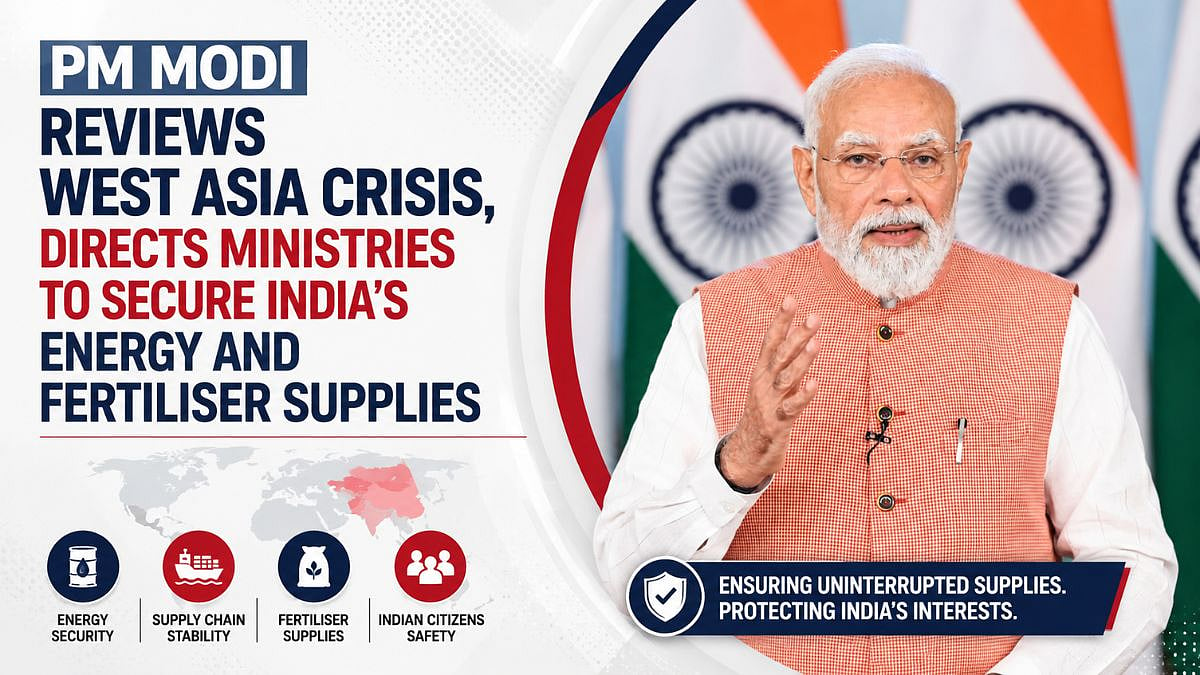
Prime Minister Narendra Modi chaired a high-level meeting to review the West Asia crisis and ensure uninterrupted energy and fertiliser supplies for India | AI Generated Image
New Delhi, July 30, 2026: Prime Minister Narendra Modi on Thursday chaired a special meeting of the Cabinet Committee on Security (CCS) to review the impact of the ongoing conflict in West Asia on India's energy security, supply chains and the safety of Indian citizens abroad.
The extended meeting was attended by Defence Minister Rajnath Singh, Home Minister Amit Shah, External Affairs Minister S. Jaishankar, Finance Minister Nirmala Sitharaman, Chemicals and Fertilisers Minister J.P. Nadda, Commerce Minister Piyush Goyal, Shipping Minister Sarbananda Sonowal and Petroleum Minister Hardeep Singh Puri. According to the Prime Minister's Office (PMO), this was the fourth special CCS meeting held on the issue.
Supply Chains Under Pressure
The discussions focused on the impact of conflicts around the Strait of Hormuz, the Black Sea, the Red Sea and the Gulf of Aden, all of which are crucial trade routes for India's imports. Officials reviewed the security situation and the disruptions affecting the movement of petroleum products, natural gas and fertilisers.
Cabinet Secretary T.V. Somanathan briefed the committee on measures taken to maintain uninterrupted supplies. The government said India has diversified its sources for liquefied petroleum gas (LPG), while stocks of major petroleum products remain adequate.
It also said sufficient crude oil supplies have enabled Central Public Sector Enterprise (CPSE) refineries to operate at more than 100 per cent capacity, ensuring continued production of petrol, diesel and other fuels.
Push For Long-Term Energy Security
The government also reviewed efforts to expand Piped Natural Gas (PNG) connections and reduce dependence on LPG. It said industrial use of LPG is being gradually replaced through the expansion of the National Gas Grid, liquefied natural gas (LNG) import and regasification infrastructure, City Gas Distribution networks, and faster approvals for pipeline and last-mile connectivity under the Pipeline Infrastructure Order, 2026, PTI reports.
The fertiliser situation ahead of the Rabi season was also assessed. The government discussed alternative sources of fertiliser imports, and Modi directed officials to ensure there is no disruption in supplies.
The meeting also reviewed the condition of Indian seafarers working on domestic and foreign-flagged ships in conflict zones. The Prime Minister asked ministers to create a mechanism to provide timely information, emergency assistance and counselling to seafarers and their families.
Safety Of Indians A Priority
Modi stressed that every effort must be made to protect Indian citizens and the Indian diaspora from the impact of the conflict. He also called for greater emphasis on renewable energy and other non-fossil fuel sources to strengthen India's long-term energy independence.
He asked ministries to adopt a whole-of-government approach and set up a coordinated mechanism to closely monitor developments and ensure quick implementation of measures to safeguard national interests.
Ministers also presented the steps taken by their respective ministries to ensure uninterrupted imports of petroleum products, natural gas and fertilisers. The Prime Minister is learnt to have directed them to protect India's economic interests and minimise disruptions to supply chains.
Multiple Global Flashpoints
The review comes at a time when India's energy supply routes are facing growing uncertainty. Before the US-Israel war with Iran, around 40 per cent of India's energy imports passed through the Strait of Hormuz. With the conflict continuing, supplies from West Asia have come under pressure.
The situation has worsened after Yemen's Houthi militia announced it would target Saudi Arabian oil tankers attempting to cross the Bab al-Mandab, a key shipping route connecting the Red Sea, the Gulf of Aden and the Arabian Sea.
According to available data, the average number of ships crossing the passage has dropped from 43 per day in the first half of July to 31 per day over the past three days.
Russian oil shipments through the Black Sea have also come under pressure as the Russia-Ukraine war has intensified, with several attacks reported on ships in recent days.
Also Watch:
ALSO READ
India imports more than 88 per cent of its energy needs and also relies heavily on imported fertilisers. Nearly one crore Indians live and work in West Asia, making the region strategically important for both the country's economy and its citizens overseas.
To get details on exclusive and budget-friendly property deals in Mumbai & surrounding regions, do visit: https://budgetproperties.in/
RECENT STORIES
-
-
-
-
-