Kunal Kamra Moves Supreme Court Over Legislative Privilege Row, Raises Free Speech Concerns
Comedian Kunal Kamra has approached the Supreme Court seeking intervention in a case examining the limits of legislative privilege and its relationship with fundamental rights. The move comes amid pending privilege proceedings against him in Maharashtra over a satirical performance. The seven-judge Bench will hear the constitutional issues from October 6.

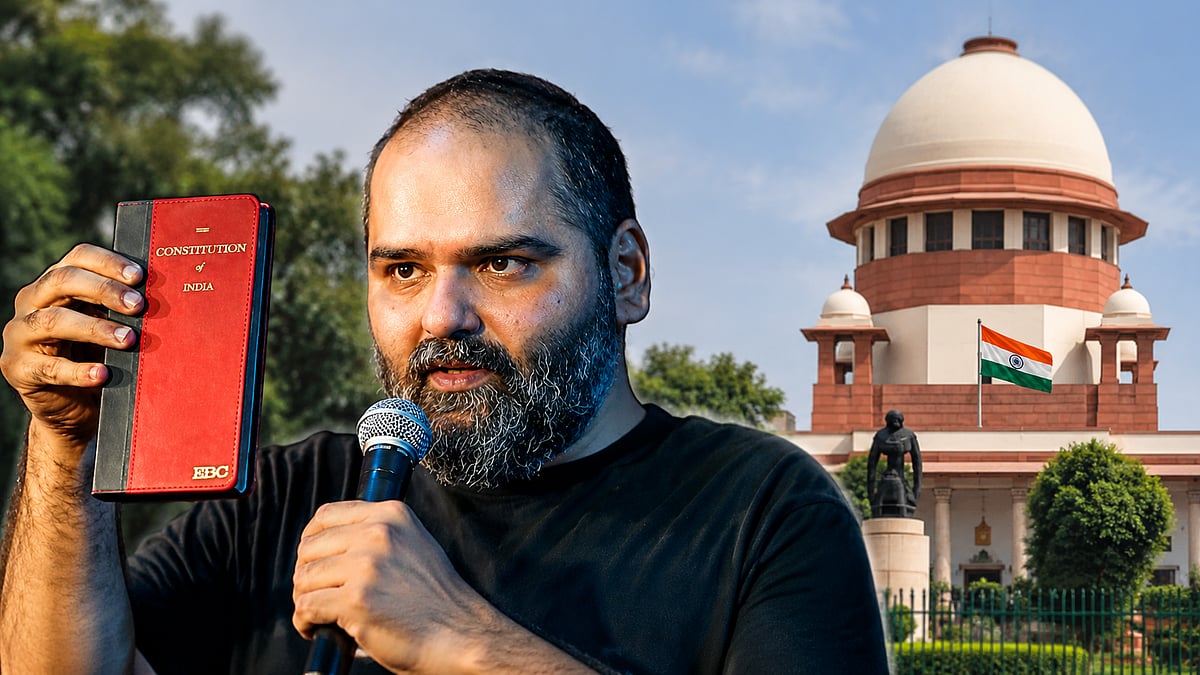
Kunal Kamra Moves Supreme Court Over Legislative Privilege Row, Raises Free Speech Concerns | AI Representational Image
Comedian Kunal Kamra has approached the Supreme Court seeking to intervene in a case before a seven-judge Bench that will examine the limits of legislative privilege and its relationship with a citizen’s fundamental rights, including freedom of speech and expression.
Kamra has sought permission to become a party in the N Ravi and others v Speaker, Legislative Assembly, Chennai case. The matter involves questions over the interplay between legislative privilege under Article 194(3) of the Constitution and the rights guaranteed under Articles 19(1)(a) and 21. The seven-judge Bench is scheduled to begin hearing the matter on October 6, Live Law and Bar & Bench report.
Why Kamra Wants To Join The Case
Kamra’s intervention comes against the backdrop of breach of privilege proceedings pending against him before the Maharashtra Legislature over his comedy show Naya Bharat.
The performance dealt with political developments in Maharashtra in 2022, including the split in the Shiv Sena, the resignation of then Chief Minister Uddhav Thackeray and the subsequent formation of a government led by Eknath Shinde. During a satirical song, Kamra also reportedly referred to Shinde as “Gaddar”, meaning traitor.
Privilege Proceedings Over Satirical Song
A breach of privilege motion was subsequently moved against Kamra. In July 2025, the Maharashtra Legislature Secretariat informed him that Legislative Council member Pravin Darekar had filed a breach of privilege and contempt case against him.
According to the notice, Kamra’s satirical song personally disrespected and belittled Shinde and thereby breached the privilege of the Deputy Chief Minister and the Assembly.
Kamra, however, told the Privileges Committee that his comedy show had not interfered with the functioning of the Maharashtra Legislature. He maintained that the performance was an exercise of his right to freedom of speech and expression under Article 19(1)(a).
Criminal Case Also Pending
Separately, MLA Murji Kanji Patel lodged a complaint at Khar Police Station after the video was uploaded, alleging that Kamra’s performance defamed Shinde. An FIR was registered under Sections 353(1)(b), 353(2) and 356(2) of the Bharatiya Nyaya Sanhita.
Kamra approached the Bombay High Court seeking to quash the criminal case. On April 25, 2025, the High Court directed that he should not be arrested while his petition remained pending. It also restrained the concerned court from proceeding in relation to the FIR if a chargesheet was filed. According to Kamra’s intervention application, no chargesheet has been filed and the High Court proceedings remain pending.
“Strikes At The Heart Of Democracy”
In his application before the Supreme Court, Kamra has argued that legislative privilege cannot be used to suppress citizens’ speech.
“The exercise of legislative privilege to stifle the speech of citizens strikes at the heart of democracy,” he submitted.
Kamra has argued that any conflict between legislative privilege and a citizen’s freedom of speech and expression should be harmoniously resolved in favour of free speech, which he described as the constitutionally and democratically compatible interpretation.
His case brings a significant question into focus: how far can a legislature go in protecting its privileges when a citizen comments on the conduct of an elected representative? Kamra’s argument places the emphasis on protecting citizens’ ability to scrutinise political figures, while the Supreme Court will have to consider how that freedom operates alongside the constitutional privileges granted to legislatures.
ALSO READ
Kamra Cites “Chilling Effect” On Speech
Kamra has said the privilege proceedings have affected him beyond the immediate legal dispute. He claimed they have made it difficult for him to secure venues for shows in Mumbai and have created the risk of similar proceedings if he comments on legislators in the future.
He argued that such proceedings could have a “chilling effect” on citizens who wish to comment on the conduct of elected representatives.
“The Applicant believes that his case demonstrates that the exercise of legislative privileges affects not only the freedom of speech and expression of members of the press, but also of any citizen who wishes to speak about the actions of members of the legislature,” his plea states.
“It is disquieting that provisions of the Constitution can be deployed to discourage speech and commentary that concerns the actions of elected representatives,” the application adds.
Privileges Committee Proceedings Remain Pending
According to the intervention application, Kamra appeared before the Privileges Committee on April 9, 2026, after several adjournments. He submitted written arguments and legal authorities before the committee.
The privilege proceedings remain pending. Kamra has now sought permission to place his arguments before the Supreme Court, contending that the questions being examined by the seven-judge Bench have a direct bearing on his case.
Case Goes Back To 2003
The N Ravi case has its roots in a 2003 resolution of the Tamil Nadu Legislative Assembly concerning senior journalists of The Hindu.
The privilege proceedings followed an editorial in the newspaper that criticised the “rising intolerance” of the State government, which was then led by AIADMK leader J Jayalalithaa.
The Assembly resolved to sentence editor N Ravi, executive editor Malini Parthasarthy, publisher S Rangarajan, chief of bureau V Jayant and special correspondent Radha Venkatesan to 15 days in prison for breach of legislative privilege and contempt.
Arrest warrants were issued, but the journalists were not ultimately arrested after the Supreme Court restrained such action.
Also Watch:
Constitutional Questions Before Supreme Court
In an order on December 8, 2003, the Supreme Court observed that the dispute raised substantial questions of law involving the interpretation of Article 194(3) and its interplay with Article 19(1)(a), which protects freedom of speech and expression, and Article 21, which protects life and personal liberty.
The matter was referred to a five-judge Bench. In 2004, it was referred to a seven-judge Bench after the Court noted an apparent conflict between earlier five-judge and seven-judge Bench rulings on related questions.
The Court also took note of a submission by Senior Advocate Harish Salve, who represented The Hindu journalists at the time, that the issue had wide ramifications and required an authoritative settlement.
The seven-judge Bench is scheduled to take up the case on October 6, with arguments proposed to conclude by October 15.
Kamra’s intervention application has been drawn by advocate Arti Raghavan and filed through advocate Mansi Binjarajka.
RECENT STORIES
-
-
-
-
-