ISRO Launches Heaviest Ever BlueBird Block-2 Satellite Aboard LVM3-M6 Rocket From Sriharikota; Video
ISRO launched the 6,100-kg BlueBird Block-2 communication satellite on Wednesday at 8:55 am aboard the LVM3 rocket from Sriharikota. It is the heaviest payload placed into LEO by LVM3. The launch time was adjusted slightly to avoid collision.

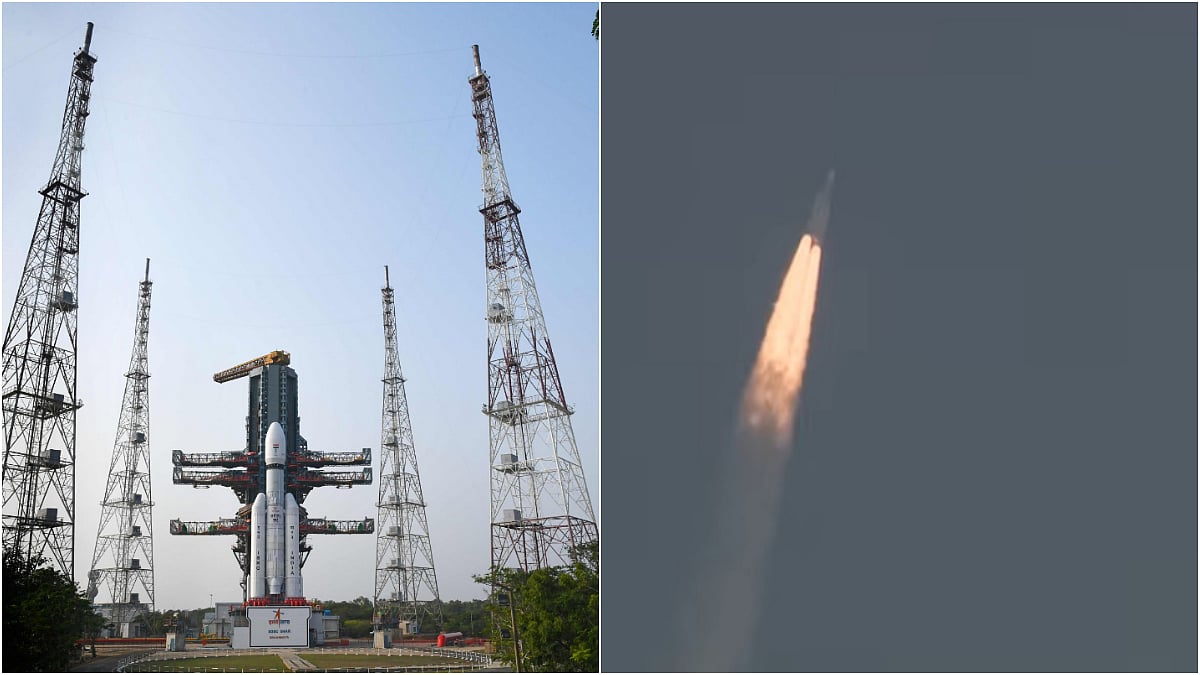
ISRO Launches BlueBird Block-2 Satellite Aboard LVM3-M6 Rocket From Sriharikota | X/@ISRO
Bengaluru: The Indian Space Research Organisation (ISRO) launched the BlueBird Block-2 satellite of the United States on Wednesday morning aboard its Launch Vehicle Mark-3 (LVM3) rocket from the Satish Dhawan Space Centre, Sriharikota. The rocket lifted off at 8:55 am.
Weighing 6,100 kg, the communication satellite would be the heaviest payload to be placed into Low Earth Orbit (LEO) in LVM3 launch history, ISRO said. Earlier, the launch was scheduled for lift-off at 8:54 am. However, the new time set for the launch was 8:55 am as there was reportedly a chance of a collision on the flight path of the Bahuballi rocket. It was ISRO's 101st launch.
The previous heaviest was the LVM3-M5 Communication Satellite 03, weighing about 4,400 kg, that was successfully launched by ISRO on November 2 in the Geosynchronous Transfer Orbit (GTO).
The BlueBird Block-2 mission is part of the commercial agreement signed between NewSpace India Ltd (NSIL) and US-based AST SpaceMobile (AST and Science, LLC). NewSpace India Ltd is the commercial arm of ISRO.
The mission would deploy the next-generation communication satellite designed to provide high-speed cellular broadband directly to smartphones worldwide. AST SpaceMobile is building the first and only space-based cellular broadband network, which is accessible directly by smartphones and designed for both commercial and government applications.
ALSO READ
According to ISRO, the 43.5-metre-tall LVM3 is also known as the Geosynchronous Satellite Launch Vehicle (GSLV) Mk III. It is a three-stage rocket with a cryogenic engine designed and developed by ISRO's Liquid Propulsion Systems Centre.
The vehicle uses two S200 solid rocket boosters to provide the huge amount of thrust required for lift-off. The booster has been developed by Vikram Sarabhai Space Centre, Thiruvananthapuram.
After 15 minutes of flight, the BlueBird Block-2 satellite is expected to get separated from the launch vehicle.
The BlueBird Block-2 mission is part of a global LEO constellation to provide direct-to-mobile connectivity through satellite.
This constellation would enable 4G and 5G voice and video calls, texts, streaming and data for everyone, everywhere, at all times. It features a 223 m² phased array, making it the largest commercial communications satellite ever deployed into Low Earth Orbit, about 600 km altitude.
RECENT STORIES
-
-
-
-
-