India, Germany Move To Deepen Defence Ties As Berlin Urges Reduced Reliance On Russian Arms
German Chancellor Friedrich Merz’s India visit focused on fast-tracking the India-EU FTA and deepening defence cooperation, including joint development and co-production. India stressed defence sourcing is guided by national interest. The two sides signed 27 MoUs, boosted trade ties, announced visa-free transit for Indians, and reaffirmed Indo-Pacific cooperation.

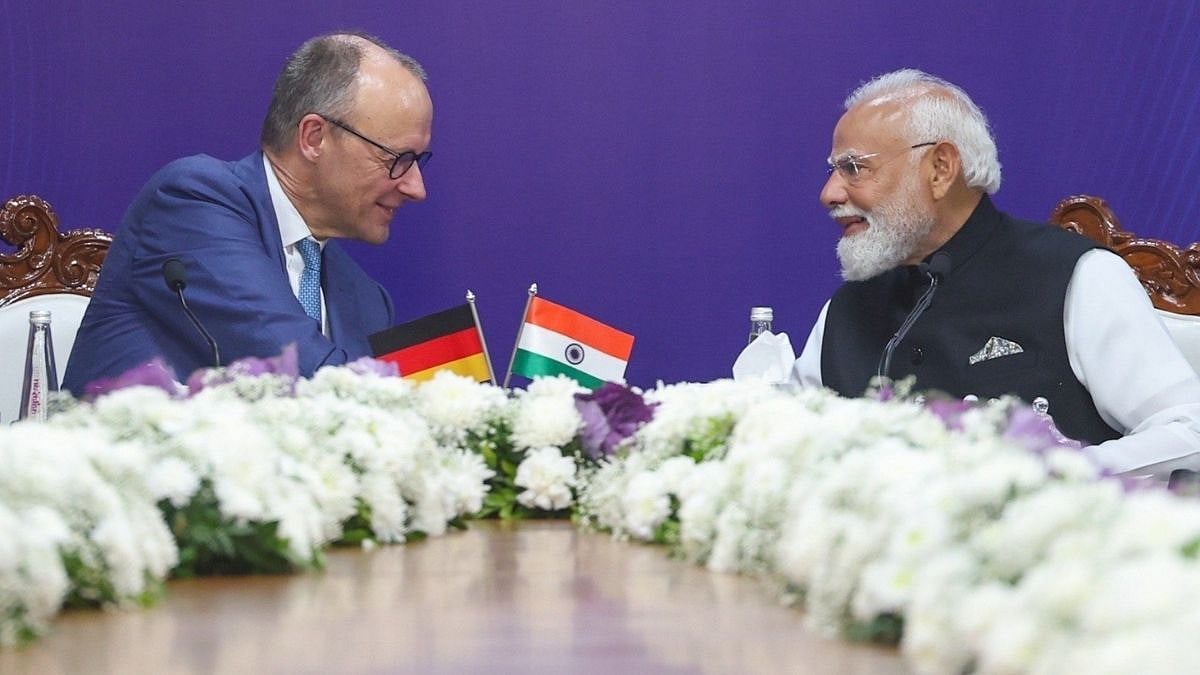
India, Germany Move To Deepen Defence Ties As Berlin Urges Reduced Reliance On Russian Arms | X @narendramodi
New Delhi: German Chancellor Friedrich Merz who arrived on Monday morning at Ahmedabad for an official two-day visit, stated that his priorities included finalising the long-negotiated India-EU FTA agreement and pulling India away from Russian arms and equipment. “We need to strengthen our defence industries and the cooperation of our defence industries. This has strategic significance, as this means India is less dependent on Russia,” the German Chancellor said in a joint address with Prime Minister Modi.
India and Germany released a joint statement after the meeting between Prime Minister Modi and Chancellor Merz. On the defence front, the statement said that both sides had agreed to a Joint Declaration of Intent to develop a Defence Industrial Cooperation Roadmap to promote long-term industry-level collaboration, which included “technology partnerships, co-development, and co-production of defence platforms and equipment.” At a special briefing post the leader press conference, Foreign Secretary Vikram Misri responded to Chancellor Merz’s remarks regarding Russian defence equipment, Misri said.
“The Chancellor was pointing to the change in approach that Germany has taken with regard to defence and security policy insofar as India is concerned.” He added. “Our approach to defence sourcing is driven entirely by our national interest. There are many factors involved, and it is not ideological. So I would not say that sourcing from one is linked to sourcing from the other.”
About German Chancellor Friedrich Merz’s India visit
Merz’s visit—his first to an Asian country since he took power last year—comes after President Trump has announced his desire to impose 500% tariffs on Indian exports to the US. The threatened tariffs, which have yet to be passed by the US Congress, have seen both India and the EU make new strides to finalise the long-negotiated FTA. Commerce Minister Piyush Goyal was in Brussels on January 6-7 to negotiate the FTA, and the EU’s top leadership is expected to be the Chief Guests for India’s Republic Day, following which the India-EU summit will be held on January 27.
ALSO READ
After visiting Sabarmati Ashram and taking part in the International Kite Festival, the German Chancellor met with Prime Minister Modi, following which 27 MoUs and Joint Declarations of Intent were formalised. Key among them were the Joint Declaration of Intent on Strengthening Bilateral Defence Industrial Cooperation, the Joint Declaration of Intent on Strengthening Bilateral Economic Cooperation, and the Joint Declaration of Intent on Cooperation in the Field of Critical Minerals. Germany also announced a visa-free transit facility, ensuring Indians no longer need an airport transit visa for layovers in Germany's international transit areas to catch a connecting international flight. However, Indian travellers cannot leave the airport.
Speaking at a joint press conference post the exchange of MoUs. Prime Minister Modi stated that India and Germany had deep historical and people-to-people ties. He pointed to the works of Rabindranath Tagore and Swami Vivekananda’s philosophy, which he said had given a “new perspective to the intellectual world” both in Germany and Europe. On the economic side, the prime minister said relations were at a high, as bilateral trade had reached its highest level ever by crossing the $50 billion mark.
ALSO READ
“More than two thousand German companies have been present in India for a long time. This reflects their unwavering confidence in India and the immense opportunities that exist here. This was evident at the India-Germany CEO Forum this morning.” The prime minister stated that the Indo-Pacific remained a “high priority for both nations. To enhance our cooperation in this region, we are going to launch a Consultation Mechanism.”
The joint statement said that both leaders condemned the terror attack in Pahalgam and the terror incident in Delhi on November 10 last year. Asked what steps India had taken to secure the release of Ariha Shah, an Indian baby who had been taken into foster care following allegations of abuse, Misri said that Prime Minister Modi had spoken to the German Chancellor about it and India was fully committed to bringing her home.
RECENT STORIES
-
-
-
-
-