‘Giving Dowry Is Also Punishable Under Law’: Allahabad HC Acquits Husband In Suicide Case
The Allahabad High Court acquitted a husband convicted of cruelty, abetment of suicide, and dowry offences, holding that he had no contact with his wife for more than five months before her suicide. The court also observed that Section 3 of the Dowry Prohibition Act punishes both giving and taking dowry, while finding the alleged ₹6 lakh payment was not proved.

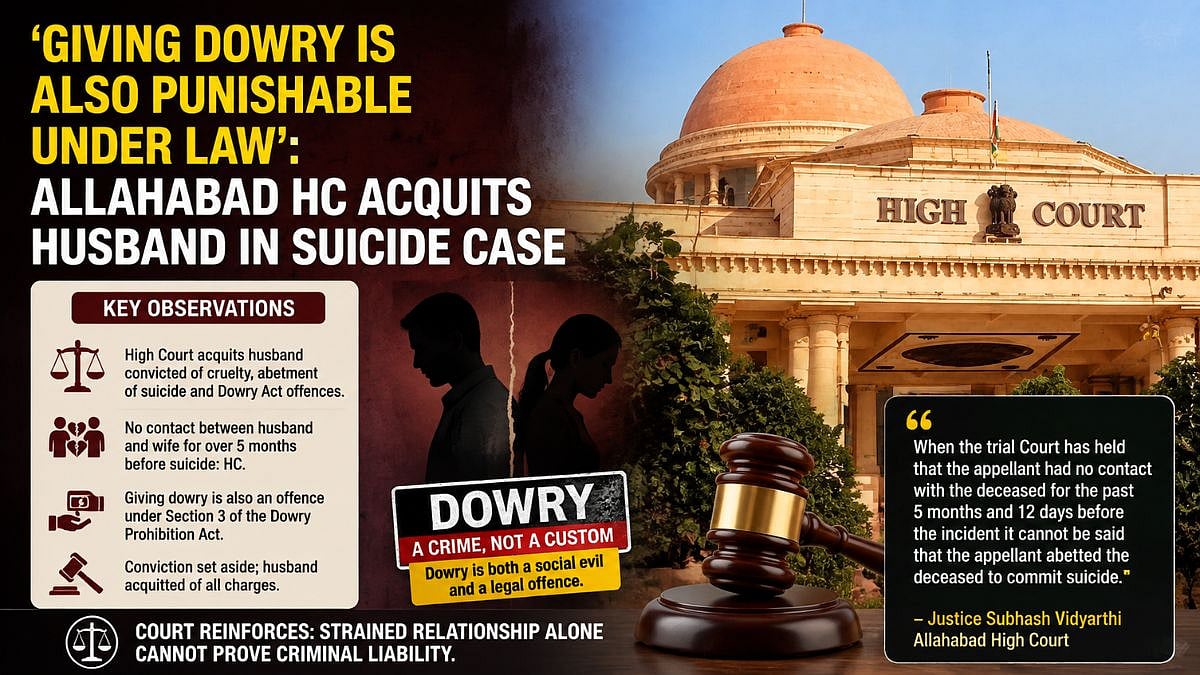
The Allahabad High Court acquitted a husband in a dowry and suicide case, citing lack of contact with his wife for more than five months before her death | AI Generated Image
Prayagraj, August 7, 2026: The Allahabad High Court has acquitted a husband convicted of subjecting his wife to cruelty, abetting her suicide, and offences under the Dowry Prohibition Act, noting that he had no contact or communication with her for more than five months before she died by suicide.
Allowing the husband’s criminal appeal, Justice Subhash Vidyarthi said that when the trial court itself had found that the husband and wife had not been in contact for five months and 12 days before the suicide, it could not be said that he had abetted the act. The High Court also pointed out that Section 3 of the Dowry Prohibition Act makes both giving and taking dowry punishable, Live Law reported.
Dowry Claims Under Scrutiny
The case arose from the husband’s appeal against a trial court judgment convicting him under Sections 498-A and 306 of the Indian Penal Code (IPC) and Sections 3 and 4 of the Dowry Prohibition Act. The trial court had acquitted him of the offence under Section 304-B of the IPC.
According to the prosecution, the woman married the appellant on December 14, 2004. It was alleged that after the marriage, the husband and his family demanded Rs 10 lakh as dowry to purchase a flat.
The woman’s father allegedly sold a plot of land and paid Rs 6 lakh in cash. The prosecution claimed that the husband continued to demand the remaining Rs 4 lakh and harassed his wife. She died by suicide on October 2, 2010.
The High Court, however, found serious discrepancies in the prosecution’s version regarding the alleged demand and payment of dowry. It noted that prosecution witnesses had given inconsistent accounts of the alleged Rs 6 lakh payment.
The court also noted that details of the alleged sale of the plot, including the date of sale and the consideration amount, had not been disclosed. It further found material inconsistencies between the allegations in the first information report (FIR) and the oral testimony of prosecution witnesses.
Giving Dowry Is An Offence Too
While examining the allegation that the woman’s father had paid Rs 6 lakh as dowry, the High Court said that if the claim were proved, it would amount to a confession regarding an offence under Section 3 of the Dowry Prohibition Act because the provision penalises both giving and taking dowry.
“Thus, not only taking dowry, but also giving dowry is an offence under Section 3 of the Dowry Prohibition Act. However, as I have come to a conclusion that the allegation that the father of the deceased had given Rs 6,00,000 to the appellant as dowry has not been proved...” the court observed.
The observation is significant because it underlines that the prohibition under the law applies to both sides of a dowry transaction. In this case, however, the prosecution’s inability to establish the alleged payment beyond reasonable doubt meant that the charge relating to the transaction could not stand.
The court concluded that the ingredients required to establish an offence under Section 498-A of the IPC and Section 4 of the Dowry Prohibition Act had not been proved beyond reasonable doubt.
Five-Month Gap Proves Crucial
On the husband’s conviction for abetment of suicide under Section 306 of the IPC, the High Court referred to several Supreme Court decisions and said abetment requires proof of instigation, incitement, or intentional aid. Mere allegations of harassment are insufficient unless there is a positive act by the person concerned that is proximate to the suicide.
The High Court noted that the trial court had acquitted the husband of the charge under Section 304-B of the IPC after finding that the couple had not been in contact since April 20, 2010, when an FIR was lodged by the woman.
She died by suicide on October 2, 2010. This meant there had been no contact between the spouses for five months and 12 days before her death.
“When the trial Court has held that the appellant had no contact with the deceased for the past 5 months and 12 days before the incident, it cannot be said that the appellant abetted the deceased to commit suicide even without there having been any contact or communication between them,” the High Court observed.
This finding became central to the appeal. In the court’s assessment, convicting the husband of abetment despite the prolonged absence of contact would not satisfy the legal requirement of establishing an act of instigation, incitement, or intentional assistance connected to the suicide.
Cruelty Cannot Simply Be Presumed
The High Court also held that the presumption under Section 113-A of the Evidence Act could not be invoked without cogent evidence establishing cruelty under Section 498-A of the IPC.
“In the absence of any cogent evidence as regards harassment or abetment in any form like aiding or instigating, the appellant cannot be convicted for the offence under Section 306 I.P.C. by straightway invoking Section 113-A so as to presume that he has abetted the commission of suicide,” the court observed.
The High Court said the trial court had convicted the husband “merely because the relations between the appellant and his wife had turned sour”, while overlooking the fact that they had no contact for more than five months before the suicide and that there was no act during this period amounting to instigation.
The ruling reinforces a key distinction in criminal law: a strained marital relationship by itself cannot substitute for evidence necessary to establish criminal liability. For an abetment conviction, the prosecution must prove the legal ingredients of the offence beyond reasonable doubt.
Also Watch:
Husband Acquitted Of All Charges
The High Court ultimately concluded that the prosecution had failed to prove the charge under Section 306 of the IPC and allowed the husband’s appeal.
It set aside the trial court’s judgment and order of conviction and sentence, acquitted the husband of all charges, and directed his release subject to compliance with Section 437-A of the Code of Criminal Procedure (CrPC).
The court also ordered that the fine deposited by the husband be refunded.
To get details on exclusive and budget-friendly property deals in Mumbai & surrounding regions, do visit: https://budgetproperties.in/
RECENT STORIES
-
-
-
-
-