FPJ Exclusive: Flight 171 Captain Had Both Hands On Steering Handle During Ahmedabad Air India Crash
New forensic witness accounts and autopsy details in Air India 171 crash challenge earlier claims of pilot Sumeet Sabharwal’s intent. Testimonies suggest he may have been handling controls in final moments after suspected dual-engine failure. Experts cite procedural ambiguity, RAT deployment inconsistencies and missing forensic details raising questions.

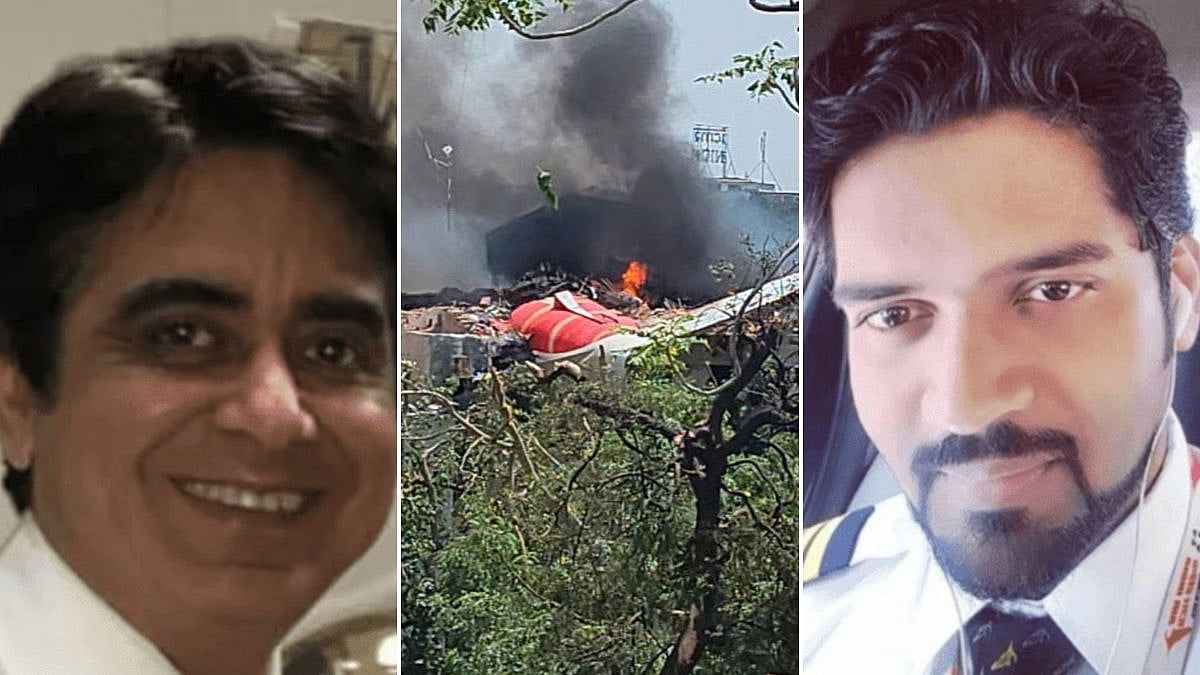
Ahmedabad Air India Crash: 'Flight 171 Captain Had Both Hands On Steering Handle' | file pic
Ahmedabad: For nearly a year, the world was told a devastatingly simple story about Air India 171: that veteran Boeing 787 Capt Sumeet Sabharwal may have intentionally crashed his aircraft a few seconds after take-off on June 12, 2025.
But now, confidential autopsy documents, eyewitness testimony from inside Ahmedabad’s BJ Medical College mortuary, and what appear to be unexplained omissions in the official forensic record raise a radically different possibility. That the captain died while physically fighting to save the doomed aircraft.
Multiple witnesses independently claim that Capt Sabharwal’s body arrived in a seated position, with his hands still fixed to what they described as the aircraft’s “steering handle” — the control yoke. If true, senior pilots say it would strongly suggest the captain was actively flying the aircraft during the final seconds of the emergency, attempting to recover the Boeing 787 after a catastrophic systems failure and not deliberately crashing it.
One of the key witnesses is a medical professional who was present at BJ Medical College Hospital after the crash and who signed about five forensic identification documents linked to crash victims. Romin Vahora, a family member of AI 171 crash victims, lost his brother, his three-year-old niece and his aunt in the crash. In an interview, he described seeing Capt. Sabharwal’s body shortly after it was brought into the hospital. “I saw Capt Sumeet’s body. I was only a few feet away when they brought him in,” he said.
He had been searching for the body of his niece, when Capt Sumeet's body was wheeled in. Romin had direct access to the hospital as well as the forensic processing area. “His body was in a seating position. With his hands on the handle; like a car steering handle. He had both hands on the handle," said the witness. There was a bit of the column of the yoke along with the handle, he recalled. The captain, identifiable in his pilot uniform, was partially burnt.
A second witness — a doctor at BJ Medical Hospital — independently described an almost identical scene. "Only his back and sides were burnt. His body was also kept in a separate room away from the other victims' bodies in in the mortuary." He described the captain’s body as "being in a seated posture, knees bent - feet in the air; shoes visible," with his hands still on what he described as the aircraft’s “steering handle.” “His back and sides were burnt, but his face was clearly identifiable,” the doctor said.
Family members of Capt Sumeet say they never saw his body. It was returned to them in a sealed casket. And they were told that the body was in an unsafe stage of decomposition and should not be opened. They were also puzzled about the size of the casket -- being much smaller than one would expect for a man as tall as Capt Sumeet at 6 feet 2 inches. But then the family was told: "Only half his body could be found." The statement does not match the autopsy report or the witnesses - all of whom talk about a full body recovery - with shoes to uniform with four stripes intact.
The autopsy report appears to corroborate several portions of the witness testimony. The postmortem report says, "the body was wearing remnants of an Air India pilot uniform with metallic insignia and four stripes. It also notes the presence of a shoe labelled “Clarks Active Air.” It confirms the body was confirmed as Capt Sumeet Sabharwal through DNA testing. The four stripes matter as they are usually reserved for someone of the Captain rank.
The report records that the body exhibited “pugilistic attitude” In forensic medicine, a pugilistic posture refers to the boxer-like flexed positioning. The report also documented extensive injuries, including burns, multiple fractures in upper and lower limbs, pelvic fractures, and a penetrating abdominal wound.
But one detail stands out sharply. The autopsy states that “upper part of head and face except lower jaw is missing.” Yet neither witness recalled anything as visually dramatic as a missing jaw.
Forensic experts, consulted by The Free Press Journal, say the omission of the yoke in the autopsy report is significant. "The absence of a foreign object - in this case a cockpit control column. Usually autopsy reports mention anything like splinters, a gun or even nails found in or around the dead person; anything near or inside a person's body would be mentioned - like bullets," said a doctor in Chennai General Hospital, who has handled more than a dozen autopsies.
If the captain died still holding the controls, it would directly challenge the narrative that Sabharwal intentionally caused the crash.
Capt. CS Randhawa, president of the Federation of Indian Pilots (FIP), told Free Press Journal, “If Captain Sumeet died with his hands on the controls, he was doing exactly what a captain is trained to do in an emergency — take over the aircraft and try to save it.”
The preliminary accident report states that First Officer Clive Kunder was the “pilot flying” during takeoff but doesn’t clarify who was physically flying the aircraft once the emergency began. Nor does it identify who made the final Mayday call.
Randhawa says those omissions matter. “This would also change our understanding of what happened in AI 171’s cockpit,” he said. “In a dual-engine shutdown, the memory items require the crew to recycle the fuel switches and start the RAT. If Captain Sumeet was physically on the controls, then the fuel-switch recycling would most likely have been done by First Officer Clive, not by him.”
On international media reports, that both Capt Sumeet and First Officer Clive had their hands on the controls, Capt S Sen, a commercial airline pilot with over 20 years of experience, says, "It’s possible they were trying to break a dead lock. Remember the loss of engines in a dual engine shutdown means three things - loss of thust, loss of electrical power and loss of hydraulic power. And hydraulic power is what is needed to control the plane's flight surfaces. And it's possible if Capt Sumeet saw his actions on the yoke weren't yielding results; he instructed the first officer to also try. It would be rare for two pilots to fly the plane at the same time."
ALSO READ
In agreement, Capt Randhawa says, "The protocol is one person is flying the plane; not both pilots on control. One person is Pilot Flying. The other person is Pilot Monitoring. There is a clear CRM protocols. Also both pilots will act in coordiantion with each other. If Capt Sumeet took over once emergency hit - he'd have said, "I've controls." First Officer Clive would have to confirm "You've controls."
Engineers in Air India say in the final moments it possible that Capt Sumeet's side of the cockpit faced a more severe power loss than the First Officer's because of underlying faults. They track this to the early deployment of emergency power or Ram Air Turbine (RAT) on AI 171. Federation of Indian Pilots, representing 6,000 pilots, recently released images showing RAT deploying whilst Flight 171 was still on the runway; contradicting AAIB report's CCTV photo that shows RAT deploying in air and statement, "The CCTV footage obtained from the airport showed Ram Air Turbine (RAT) getting deployed during the initial climb immediately after lift-off."
The RAT which is a small propeller housed in the belly of the aircraft, is like the last line of defence, indicating something has gone catastrophically wrong.
RECENT STORIES
-
-
-
-
-