Digital Arrest Scams: CBI Crackdown Widens As Supreme Court Keeps Up Pressure
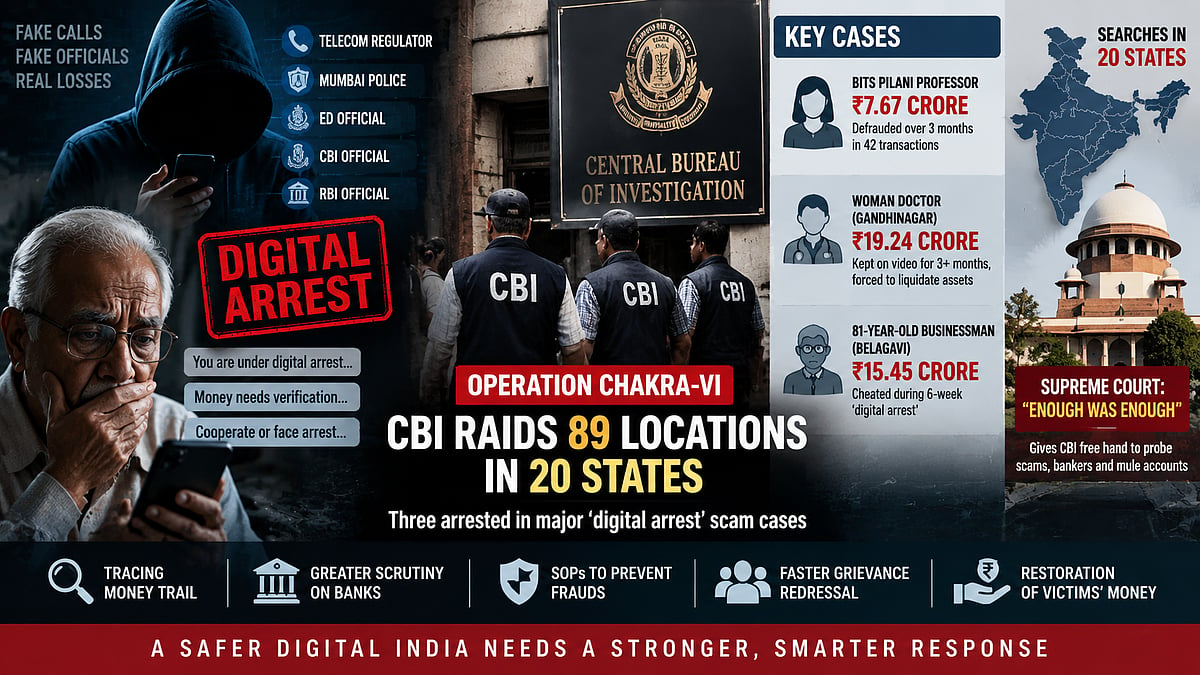
The CBI searched 89 locations across 20 states under Operation Chakra-VI to investigate digital arrest scams, officials said. The agency is probing three cases where victims allegedly lost crores after fraudsters posed as police and government officials. Three suspects have been arrested, while investigators are tracing bank accounts and digital trails used to move the defrauded money.

Digital Arrest Scams: CBI Crackdown Widens As Supreme Court Keeps Up Pressure | AI
The Central Bureau of Investigation (CBI) has intensified its nationwide crackdown on “digital arrest” scams, searching 89 locations across 20 states under Operation Chakra-VI. The latest action centres on three major cases in which victims were allegedly coerced into transferring crore of rupees after fraudsters falsely claimed they were under police custody through video calls.
Three suspects have been arrested so far. The CBI said the searches followed detailed scrutiny of bank records and digital account-access trails and were aimed at tracing the movement of the proceeds of crime and identifying those who ultimately benefited.
Money Trail Under Scanner
Among those arrested is Akash from Haryana, who allegedly received ₹1.95 crore of the defrauded money in an account he had opened himself and moved the funds onward the same day.
Raja Karmakar of Kolkata allegedly routed ₹1.5 crore through his firm’s account, while Jyoti Rani allegedly withdrew part of the money credited to her account in cash and transferred the remainder onward.
The cases underline why investigators are increasingly looking beyond the people making threatening video calls. Following the money trail and examining the accounts through which the funds move could prove crucial to disrupting the wider networks that make such fraud possible.
Professor Loses ₹7.67 Crore
One of the cases involves a BITS Pilani professor who was kept under a fabricated “digital arrest” for three months and defrauded of ₹7.67 crore.
In October 2023, she received a call from a person claiming to represent India’s telecom regulator, who told her that her mobile phone number was linked to a cybercrime complaint. People posing as Mumbai police, Enforcement Directorate and CBI officials subsequently contacted her through Skype and falsely linked her to the money-laundering case involving Jet Airways founder Naresh Goyal, The Hindu reports.
The fraudsters claimed a police warrant had been issued against her and threatened her with arrest unless she cooperated. For more than three months, she was made to report her daily movements.
Believing the fraudsters’ claim that her money required “digital verification”, she withdrew ₹7.67 crore through 42 transactions and deposited it into various accounts as directed. She had also taken bank loans totalling ₹80 lakh to make the payments.
Doctor Kept On Video For Months
In another case, a senior woman doctor in Gandhinagar, Gujarat, was targeted using a similar modus operandi. She was kept under “digital arrest” for more than three months, from March 15 to June 25.
The scammers posed as a telecom official, a police officer, public prosecutors and a notary official. Using forged documents purportedly linked to the Enforcement Directorate (ED), they convinced her that she was under investigation.
She was forced to remain in constant video contact and share her live location, including while travelling. The fraudsters told her that assets worth about ₹20 crore needed to be “parked” while the supposed investigation continued.
The doctor broke fixed deposits, took loans, sold gold and offloaded shares, eventually transferring ₹19.24 crore to about 30 accounts.
Police arrested Lalji Jayantibhai Baldaniya, whose account was allegedly used to receive money, and suspected a link to a Cambodia-based cybercrime syndicate.
81-Year-Old Loses ₹15.45 Crore
The third case involved 81-year-old Belagavi businessman Ajit Gopalkrishna Saraf, who was cheated of ₹15.45 crore during a six-week “digital arrest” scam between February and March 2026.
The fraud began on February 5 when a caller posing as a CBI official allegedly accused Saraf of having links with Goyal. Another caller, pretending to be a Reserve Bank of India (RBI) official, forced him to liquidate his fixed deposits and stock investments.
Saraf remained isolated in his room for days and continued transferring money on the scammers’ instructions. The fraud came to light only when his son visited during the Ugadi festival.
The three cases show how the same basic method can be adapted to different victims: create fear, impersonate authority, isolate the target and then keep demanding money. The prolonged nature of the scams also shows that stopping them requires more than simply warning people not to answer suspicious calls.
Supreme Court Steps In
Digital arrest scams have emerged as one of India’s most damaging categories of cyber fraud, with elderly citizens among those affected. A government submission to the Supreme Court had put total losses from such scams at roughly ₹3,000 crore.
Recognising the scale of the problem, the Supreme Court in December 2025 gave the CBI a free hand to investigate not only the scams but also bankers and mule-account networks that enable them, declaring that “enough was enough”.
Since then, the Supreme Court has issued a series of interim directions as part of suo motu proceedings concerning “digital arrest” victims, with the latest directions coming in August 2026.
Status reports from the Indian Cyber Crime Coordination Centre showed progress as well as continuing gaps. The Grievance Redressal Mechanism now covers more than 1.23 lakh bank branches across 69 banks.
A Money Restoration Mechanism covers 57 banks and all states and Union Territories and has restored about ₹18.05 crore across 36,290 cases so far.
Banks Face Greater Scrutiny
To address gaps in the system, the Supreme Court has directed the RBI to issue a standard procedure for banks to freeze accounts linked to mule activity, along with safeguards such as delayed-transaction mechanisms.
The direction is significant because money transferred during a digital arrest scam can move through multiple accounts. A faster and more coordinated response from banks could therefore be as important as identifying the fraudsters themselves.
The CBI has meanwhile registered several “digital arrest” cases, conducted multiple rounds of searches across states and made several arrests. In June 2026, the agency searched more than 80 locations across 16 states in connection with more than 200 cases.
ALSO READ
Court Says Vigilance Must Continue
The Supreme Court has made it clear that a decline in reported fraud is no reason to ease vigilance and has called for continued monitoring.
On August 4, 2026, the Court passed a detailed order directing the Centre, states, the RBI and telecom authorities to prepare a Standard Operating Procedure (SOP) to curb “digital arrest” scams.
The Court also sought mechanisms to address victims’ grievances, initiate criminal proceedings through zero FIRs and restore victims’ monetary losses within a fixed timeframe.
The nationwide searches and continuing judicial oversight indicate that the response to “digital arrest” fraud is moving beyond individual cases towards the networks and financial channels that allow such scams to operate. For the crackdown to have a lasting impact, however, enforcement, banking safeguards, telecom measures and speedy restoration of victims’ money will have to work together.
RECENT STORIES
-
-
-
-
-