BRICS Consensus On Joint Statement A Win-Win Situation For India: SJM's Ashwani Mahajan
SJM co-convener Ashwani Mahajan has called the BRICS consensus on a joint statement a “win-win situation” for India, saying New Delhi preserved its strategic autonomy while getting its concerns reflected in the declaration. He backed trade in domestic currencies, free and fair trade and interoperability between BRICS and global payment systems.

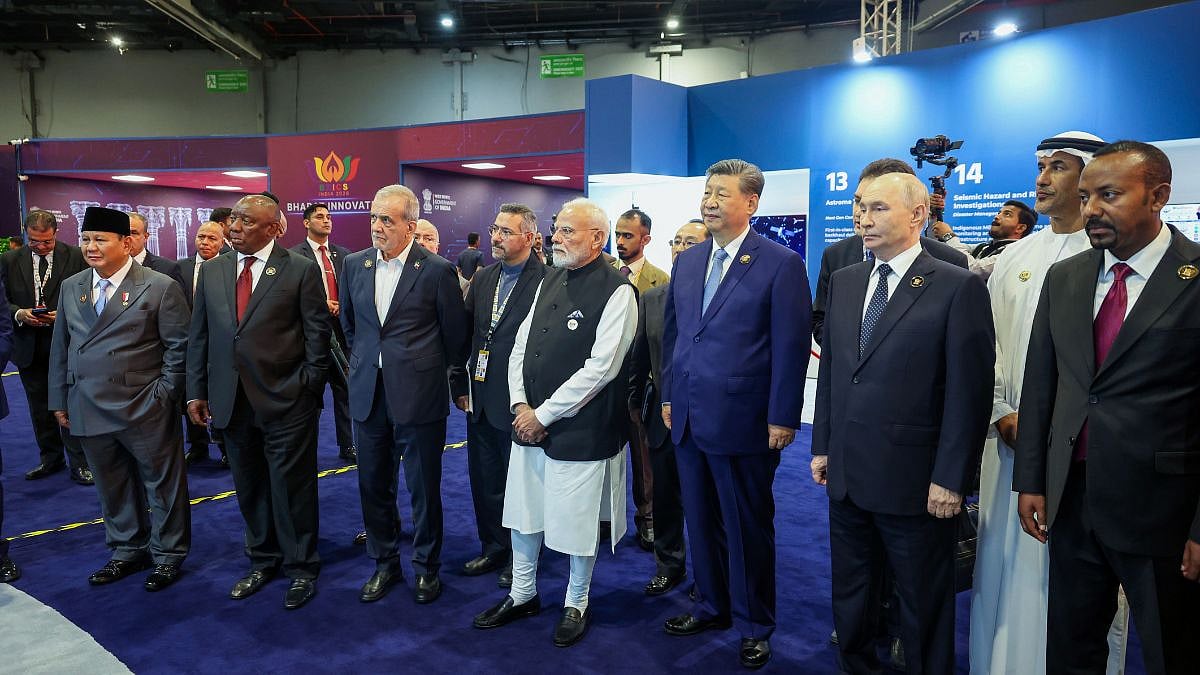
Prime Minister Narendra Modi, with Chinese President Xi Jinping, Russian President Vladimir Putin and Iranian President Masoud Pezeshkian, witnesses the Bharat Innovates exhibition at Bharat Mandapam, in New Delhi on Saturday. South African President Cyril Ramaphosa and other world leaders also present | ANI
New Delhi, September 12, 2026: A consensus on a joint statement at the BRICS summit is a "win-win situation" for India as it signifies that New Delhi has been able to preserve its strategic autonomy while ensuring that its key concerns are reflected in the document, Swadeshi Jagran Manch (SJM) co-convener Ashwani Mahajan said on Saturday.
BRICS Adopts New Delhi Declaration
BRICS leaders adopted the New Delhi Declaration at their 18th summit that sharply slammed Western trade barriers, explicitly naming carbon border adjustment mechanisms for the first time, and renewed demands for sweeping reform of the World Trade Organization.
The 11-nation grouping sought to present a unified front against what it casts as a fracturing global trading system.
The declaration links three strands of the BRICS economic agenda - opposition to unilateral tariffs, resistance to climate-linked trade barriers and reform of the WTO - into a broader demand for a trading system that gives emerging and developing economies a greater voice and more equitable access to global markets.
India's Strategic Autonomy
Mahajan said India's role in BRICS assumes greater significance as the country is chairing the bloc at a time when the world is facing uncertainties arising from wars, conflicts and trade wars.
"The importance of India's position in BRICS is more important, especially at a time when India is chairing this BRICS session," he told PTI.
He said that as BRICS members have been able to reach a consensus on a joint statement, India has maintained its strategic autonomy while ensuring that its key concerns are reflected in the document.
"As India has been able to persuade other members for a joint statement, then it is a win-win situation for India. We have been able to put forward our points," Mahajan said.
Push For Domestic Currency Trade
He said India was in favour of trade in domestic currencies and opposed the "weaponisation of trade" as well as the weaponisation of critical minerals and technology.
"Our point of view is absolutely clear. We are for trade in domestic currencies and at the same time we are against the weaponisation of trade, weaponisation of critical minerals and technology," he said.
Mahajan said these issues, along with free and fair trade, have been widely covered in the BRICS discussions and the joint statement agreed upon by the bloc.
Call For Payment System Interoperability
He also advocated greater interoperability between a BRICS payment system and the existing SWIFT network, saying such a mechanism could benefit the global trading system.
"If interoperability between other global payment systems and the BRICS system is ensured, then it will have a big benefit for the whole world," he said.
Such interoperability, he said, could also help put a check on the "monopoly" of SWIFT.
Mahajan said India has a clear position on the issues being debated within BRICS and should seek to advance its concerns without compromising its strategic autonomy.
Also Watch:
ALSO READ
He said the BRICS should move forward on trade in domestic currencies, free and fair trade and payment systems, while also addressing concerns over the use of critical minerals and technology as instruments of economic pressure.
(Disclaimer: Except for the headline, this article has not been edited by FPJ's editorial team and is auto-generated from an agency feed.)
RECENT STORIES
-
-
-
-
-