Bangladesh Votes Amid Fear And Apathy As Boat Symbol Missing, Tarique Rahman Poised For Return
Bangladesh’s general election saw low turnout and scattered violence as voters cast ballots amid heavy security. The Awami League’s boat symbol was absent for the first time in 30 years, leaving its supporters politically adrift. BNP’s Tarique Rahman emerged as frontrunner, while analysts said the absent Awami electorate could ultimately decide the outcome.

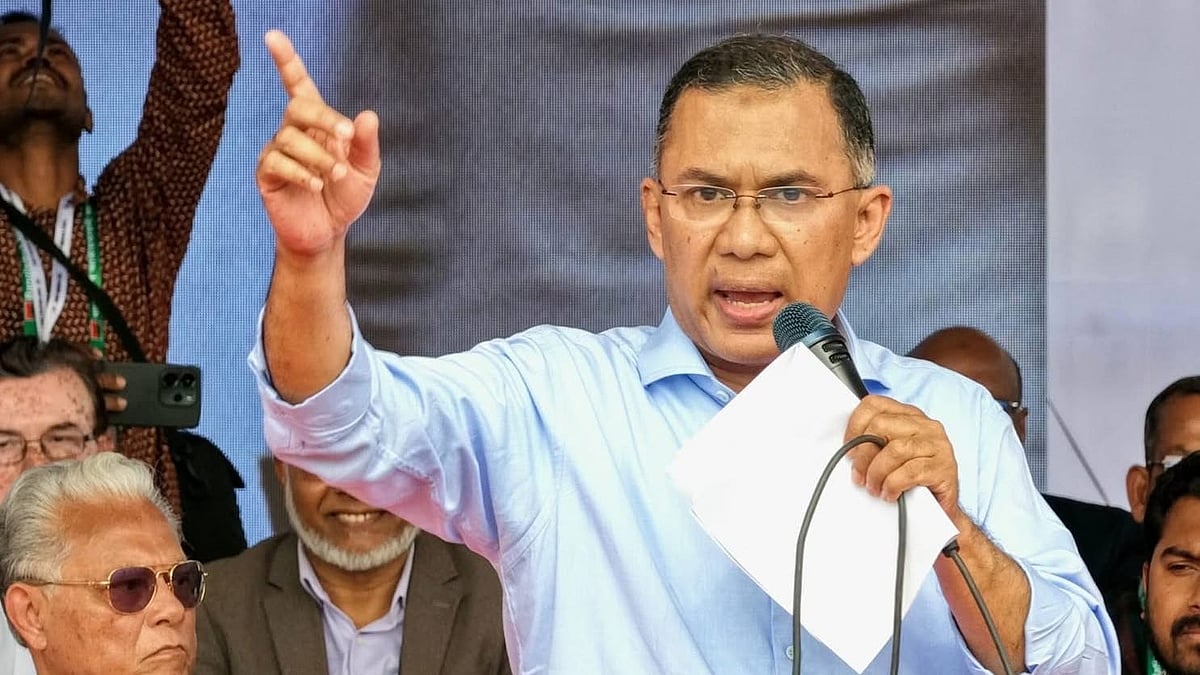
BNP Chairman Tarique Rahman |
Dhaka: As polling wound down at 4.30 pm on Thursday at a government residential college in Dhaka’s Mohammadpur, Nusrat Mahal was among the few voters still standing patiently in line. The sluggish pace told its own story. Voter turnout at the centre hovered below 50 per cent, a sharp drop from the usual 65–70 per cent recorded here in past elections.
Muted Mood Across Capital
Across the capital, and much of Bangladesh, the enthusiasm that typically accompanies election day was muted. Fear, fatigue and political disillusionment appeared to have replaced the frenzy of campaigning by the Bangladesh Nationalist Party and its orthodox rival, Jamaat-e-Islami, along with Jamaat’s ally, Hefajat-e-Islam. The Awami League's boat symbol was missing from ballot papers in Bangladesh's general election for the first time in 30 years.
“In the early hours there were hardly any voters,” Mahal said. “Those of us who live in Geneva Camp were worried. The army had been patrolling the streets all night, stopping vehicles. We thought there might be violence, so we waited to see how things unfolded.”
Mahal’s family history mirrors one of Bangladesh’s most unresolved human tragedies. She is an Urduspeaking descendant of refugees from Munger in India, who crossed into what was then Pakistan during the 1947 Partition. After Bangladesh’s 1971 Liberation War, Bihari Muslims were branded collaborators of the Pakistani army and became stateless once again.
Geneva Camp's Silent Suffering
Uprooted and vulnerable, many were herded into what came to be known as Geneva Camp, protected at the time by Indian soldiers from retaliatory violence by Bengali-speaking Bangladeshis who viewed them as complicit in the brutal repression that killed millions and left hundreds of thousands of women raped.
“We have no other home,” Mahal said quietly. “Pakistan will not take us. Bangladesh does not want us. We don’t even know Munger, except through my grandmother’s stories. All we want is a government that recognises us.”
Around 30,000 Urdu-speaking Muslims continue to live in squalid conditions in Geneva Camp, largely cut off from the rhythms of political change in Dhaka, voting when they can but rarely expecting outcomes to transform their lives.
Violence Mars Election Day
While voting in Dhaka remained largely peaceful, albeit thin, reports from other parts of the country were far grimmer. Bomb attacks, clashes between BNP and Jamaat supporters, allegations of ballot-box stuffing and intimidation punctuated election day.
Nearly a million police personnel and soldiers were deployed nationwide, a massive security presence intended to maintain order but also underscoring the fragility of that order.
After casting his vote, Muhammad Yunus declared that Bangladesh had “ended the nightmare and begun a new dream”, a carefully chosen phrase acknowledging months of unrest while gesturing towards renewal. Yunus voted in central Dhaka, as did the two principal political contenders: Tarique Rahman of the Bangladesh Nationalist Party and Shafiqur Rahman.
Tarique Rahman's Measured Pitch
In Gulshan, Dhaka’s diplomatic and commercial enclave, Tarique Rahman, widely seen as the frontrunner, addressed journalists from the BNP headquarters. His tone was measured, even conciliatory. “If the election is free, fair and without controversy, why would we not accept it?” he asked. “Of course we will. All parties will. But there is one condition: the election must be neutral and peaceful.”
Party workers streamed in and out of the office, congratulating one another, buoyed by early signs from several constituencies. Rahman acknowledged reports of irregularities, calling them “unwanted incidents”, and warned against attempts to mislead voters.
On the issue of delayed counting, a familiar anxiety as dusk falls on polling day, he was firm. There was no justification for prolonged delays, he said, recalling that in 1991, 1996 and 2001, results were declared within reasonable timeframes. “When people vote quickly, they expect results quickly,” he said.
Gopalganj's Defiant Silence
Yet 200 kilometres away, in Gopalganj, the birthplace of Sheikh Mujibur Rahman and the heartland of the Awami League, voter apathy took on a different meaning.
“People here are fiercely loyal to Awami League,” said Farid Riazi, a 50-year-old boat owner in the river-laced district. “You won’t see polling above 17 or 18 per cent. If they show more than that, it’s all chappa vote.”
Last year, tensions in Gopalganj erupted after the National Citizens Party, formed by students aligned with Muhammad Yunus, attempted a high-profile “March on Gopalganj”. Threats to desecrate Sheikh Mujib’s tomb were thwarted by locals, widely believed to be Awami League supporters. Violence followed.
Mobs led by Jamaat and NCP activists attacked homes and individuals, often with alleged support from security forces. The navy blockaded rivers, while the army conducted sweeping cordon-andsearch operations. Over 4,000 people were arrested, and at least 300 reportedly went missing.
'Whoever Wins, Awami League Voters Will Decide'
“Whoever wins will do so because Awami Leaguers voted for him,” Riazi said. “Forty per cent of voters still support the Boat.”
ALSO READ
While that figure may be inflated, few analysts doubt the centrality of the Awami League’s absent electorate. Though barred from contesting, its supporters remain politically decisive.
Surveys analysed by The New York Editorial, a US-based political Substack, point to sharply divergent outcomes. A poll by Innovision Consulting gives the BNP a commanding lead with 52.8 per cent support. Another by NarratiV/IILD shows BNP and Jamaat almost neck and neck, with a margin of just 1.1 per cent.
Both, however, agree on one thing: the election will be decided by voters once aligned with the Awami League. An estimated 40 million Bangladeshis now find themselves politically unmoored. If they consolidate behind BNP, Tarique Rahman’s return from 17 years in exile could culminate in a decisive victory. If they drift towards Jamaat-e-Islami, the balance of power could tilt dramatically.
For now, Bangladesh waits — and so does the Boat, refusing, despite all odds, to drift away.
RECENT STORIES
-
-
-
-
-