Ahmedabad, Nagpur And Madurai Among World's 10 Most Heat-Vulnerable Cities: Oxford Study
An Oxford University study has ranked Ahmedabad, Nagpur and Madurai among the world's 10 most heat-vulnerable cities. Assessing 205 urban centres, researchers found that heat risk depends not only on temperatures but also on poverty, infrastructure, demographics and access to cooling, underscoring the urgent need for climate adaptation measures.

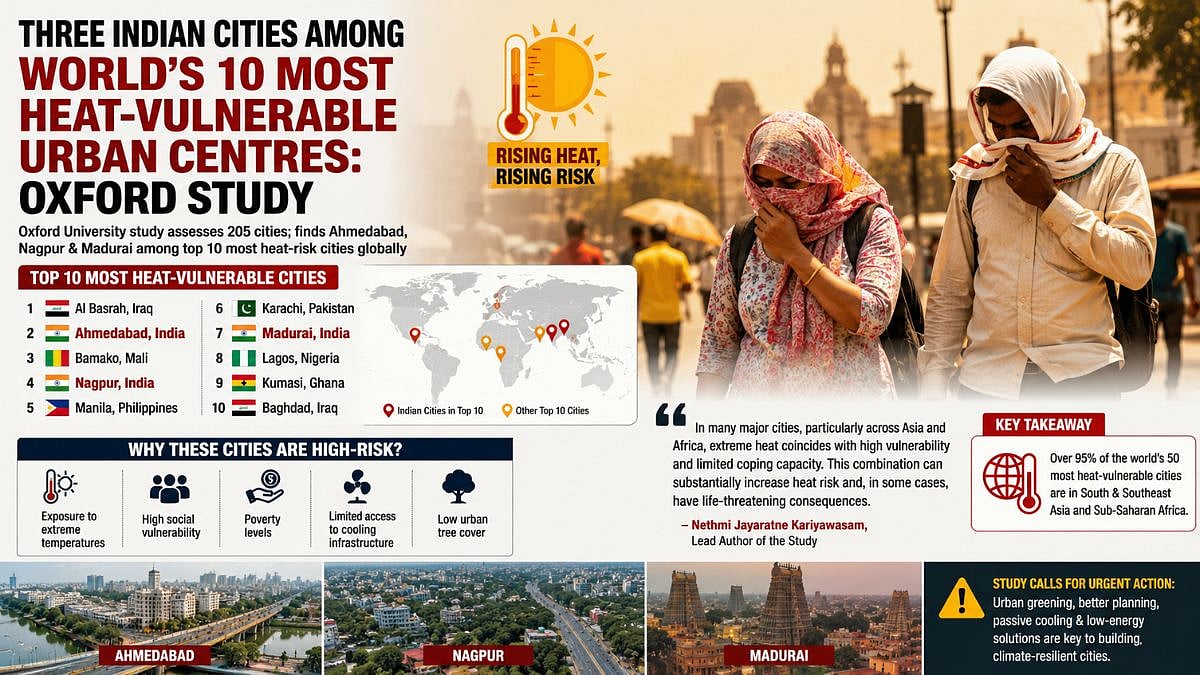
An Oxford study has flagged Ahmedabad, Nagpur and Madurai among the world's most heat-vulnerable urban centres amid rising climate risks | AI Generated Representational Image
Lucknow, June 4: Three Indian cities have been ranked among the world's 10 most heat-vulnerable urban centres, according to a new study by researchers at the University of Oxford that highlights the growing threat of extreme temperatures across South Asia.
The study, published in the journal Sustainable Cities and Societies, assessed 205 cities with populations of more than one million and found that Ahmedabad, Nagpur and Madurai are among the 10 cities facing the highest heat risk globally.
Ahmedabad ranked second globally
Ahmedabad was ranked second in the world, while Nagpur placed fourth and Madurai seventh. Only Iraq's Al Basrah and Mali's Bamako ranked above Nagpur. The top 10 list also includes cities in Iraq, the Philippines, Pakistan and Nigeria.
Researchers said India, Pakistan, Nigeria and Ghana account for the largest number of cities with high heat-risk scores. More than 95 per cent of the world's 50 most heat-vulnerable cities are located in South and Southeast Asia and Sub-Saharan Africa.
The study also identified Jaipur among the world's 50 most at-risk cities, placing another major Indian urban centre on the global heat-risk map.
Risk beyond rising temperatures
Unlike conventional rankings based solely on temperature, the Oxford analysis assessed heat risk through a combination of exposure to extreme temperatures, social vulnerability and coping capacity. Factors such as age demographics, poverty levels, access to cooling infrastructure and urban tree cover were taken into account.
Lead author Nethmi Jayaratne Kariyawasam said the findings demonstrate that urban heat risk is driven by multiple factors beyond rising temperatures.
"In many major cities, particularly across Asia and Africa, extreme heat coincides with high vulnerability and limited coping capacity. This combination can substantially increase heat risk and, in some cases, have life-threatening consequences," she said.
Researchers call for adaptation
The study comes amid increasing concern over the impact of climate change on India, where heatwaves have become more frequent, prolonged and intense in recent years.
Researchers warned that while demand for air conditioning is rising globally, millions of people remain unable to afford it. They argued that excessive reliance on energy-intensive cooling could further contribute to global warming and called for wider adoption of passive cooling measures, urban greening and low-energy technologies such as fans and coolers.
Also Watch:
The authors said the rankings provide one of the first globally comparable assessments of urban heat risk and could help governments identify cities where climate adaptation and resilience measures are most urgently required.
To get details on exclusive and budget-friendly property deals in Mumbai & surrounding regions, do visit: https://budgetproperties.in/
RECENT STORIES
-
-
-
-
-