The System Needs Teachers Who Are Effective And Not Merely Efficient
Management thinkers distinguish efficiency from effectiveness. In teaching efficiency covers syllabus tasks but effectiveness ensures real learning understanding and student growth

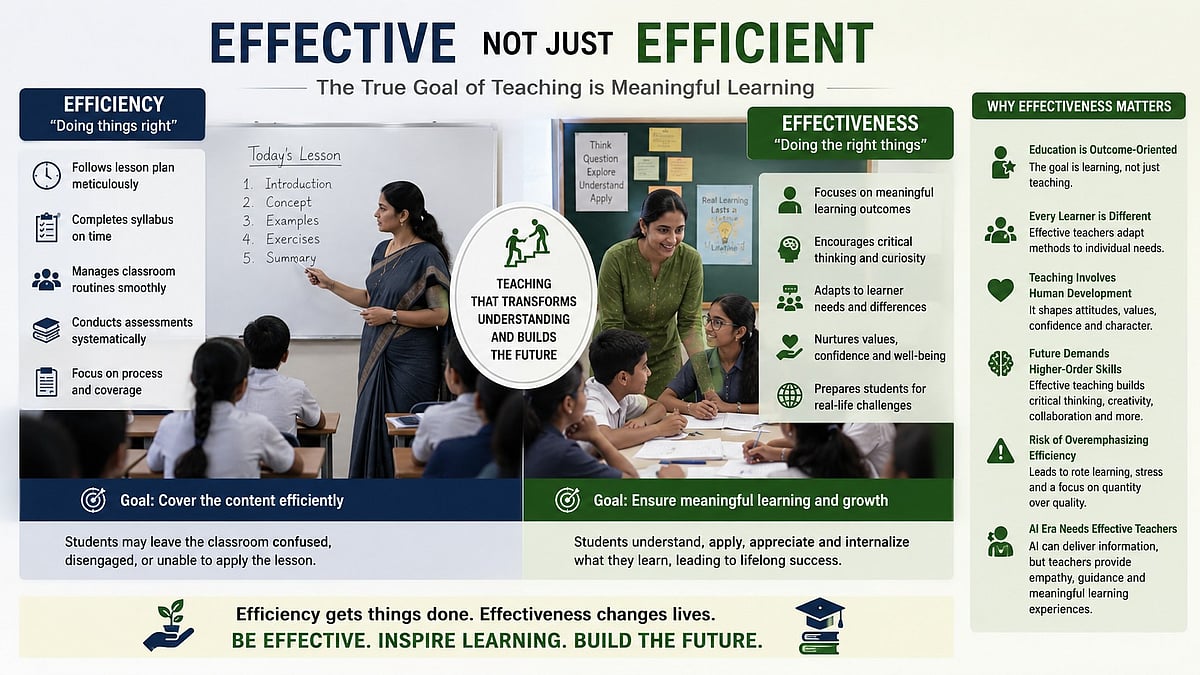
In the corporate world, management thinkers often distinguish between efficiency and effectiveness. Efficiency is commonly defined as “doing things right”, while effectiveness means “doing the right things”. An efficient manager ensures that resources are utilized optimally, processes are streamlined, and tasks are completed with minimal waste. An effective manager, however, focuses on selecting the right goals, priorities, and actions that lead to meaningful outcomes.
While both efficiency and effectiveness are important in any profession, the distinction becomes particularly significant in education. A teacher may be highly efficient in delivering content, completing the syllabus, grading assignments, and maintaining classroom discipline. Yet, if students fail to understand, apply, appreciate, or internalize what is being taught, the educational process falls short of its true purpose. Therefore, in the context of teaching, it can be argued that a teacher should strive to be “effective rather than merely efficient”.
Understanding Efficiency in Teaching:
Efficiency in teaching refers to the ability to perform instructional tasks with speed, organization, and economy of effort. An efficient teacher arrives prepared, follows a lesson plan meticulously, covers the prescribed curriculum within the stipulated time, manages classroom routines smoothly, and completes administrative responsibilities promptly.
Educational institutions often value such qualities because they contribute to orderliness and accountability. Efficient teachers ensure that classes begin and end on time, learning materials are ready, attendance records are maintained, and assessments are conducted systematically. These are undoubtedly important aspects of professional competence.
However, efficiency primarily focuses on the “process” rather than the “purpose”. A teacher may efficiently deliver a fifty-minute lecture without interruptions, yet students may leave the classroom confused, disengaged, or unable to connect the lesson to real-life situations. In such cases, efficiency has been achieved, but effectiveness remains questionable.
What Does Effectiveness Mean in Teaching?
Effectiveness in teaching goes beyond the mechanics of instruction. It concerns the extent to which teaching results in meaningful learning. An effective teacher asks not, “Did I teach the lesson?” but rather, “Did my students learn?”
Effective teaching involves selecting appropriate learning objectives, designing meaningful learning experiences, fostering curiosity, encouraging critical thinking, and ensuring that students achieve the desired outcomes. It is learner-centred rather than teacher-centred.
An effective teacher recognizes that education is not merely the “transmission of information” but the “transformation of understanding”. The ultimate measure of teaching success is not how much content has been delivered but how much learning has occurred.
Why Effectiveness Matters More Than Efficiency:
Education is Outcome-Oriented: The primary goal of education is learning. If students acquire knowledge, develop skills, cultivate values, and become capable of applying what they learn, education has succeeded. Therefore, the focus should be on outcomes rather than activities.
Every Learner is Different: Unlike machines in a factory, students do not learn at the same pace or in the same manner. Effective teachers acknowledge individual differences in learning styles, backgrounds, motivations, and abilities. Such teachers adapt their methods according to student needs. They may slow down when concepts are difficult, provide additional examples, facilitate discussions, or use alternative instructional strategies.
Teaching Involves Human Development: Education is concerned not only with academic achievement but also with the holistic development of learners. Teachers influence students’ attitudes, confidence, values, creativity, and character. These dimensions of learning cannot always be measured through efficiency indicators. Building trust, mentoring students, encouraging reflection, and nurturing emotional well-being require patience and personal engagement. Such efforts contribute profoundly to student growth and represent hallmarks of effective teaching.
Future Demands Higher-Order Skills: In the age of artificial intelligence and abundant information, memorization alone is insufficient. Students must develop critical thinking, problem-solving, collaboration, creativity, and ethical reasoning. Effective teachers design learning experiences that promote these competencies. They encourage inquiry, discussion, experimentation, and reflection. Such approaches may take more time than straightforward lecturing, but they prepare students for the complexities of the modern world.
Risk of Overemphasizing Efficiency:
Contemporary educational systems often emphasize measurable indicators such as syllabus completion, examination results, attendance rules, and administrative compliance. While these metrics are useful, an excessive focus on efficiency can produce unintended consequences.
Teachers may feel pressured to rush through content, prioritize coverage over comprehension, and teach for examinations rather than for understanding. Students may become passive recipients of information instead of active participants in learning. The classroom risks becoming a production line where quantity is valued more than quality.
When efficiency becomes the dominant goal, education may lose its humanistic and transformative character.
Need for Balancing Effectiveness and Efficiency:
Advocating effectiveness does not imply that efficiency is unimportant. In fact, effective teaching often requires a reasonable degree of efficiency. Poor organization, inadequate planning, and ineffective classroom management can hinder learning. The ideal teacher combines both qualities but places effectiveness at the centre. Efficiency should serve effectiveness, not replace it.
Effective Teacher in the AI Era:
The emergence of artificial intelligence further strengthens the case for effectiveness. AI systems can efficiently deliver information, generate lesson plans, create assessments, and provide instant explanations. However, they cannot fully replace the human dimensions of teaching such as empathy, inspiration, ethical guidance, and relationship building.
In an AI-driven educational landscape, the teacher’s value will increasingly lie not in delivering information efficiently but in facilitating meaningful learning experiences. Teachers will act as mentors, coaches, facilitators, and guides who help students navigate knowledge critically and responsibly.
Thus, the future of teaching belongs to educators who are effective in fostering understanding, wisdom, and human development.
Moving Ahead:
The distinction between efficiency and effectiveness offers a valuable lens through which to examine teaching. Efficiency focuses on doing things right, whereas effectiveness emphasizes doing the right things. In education, where the ultimate objective is meaningful learning and human development, effectiveness must take precedence.
A teacher's success should not be measured merely by amount of content delivered, speed of syllabus completion, or smooth execution of classroom routines. Rather, it should be judged by the extent to which students learn, grow, think critically, and become capable of contributing positively to society.
RECENT STORIES
-
-
-
-
-