NEP 2020 And Technology In Education: We Need To Move Faster
NEP 2020 stresses integrating AI, ML and other disruptive technologies into education. From school-level tech awareness to NEAT and online learning, India aims to strengthen digital adoption, though challenges in access, ethics and implementation remain.

AI
Developments of new and disruptive technologies are shaping the future of growth process. India is acknowledged among the leaders in technological revolution. In future too, technology and its applications must be given the front role as enablers of the education process. The challenge, however, lies in the rise of disruptive technologies like artificial intelligence (AI), machine learning (ML), block chain, etc. and how to integrate them in the education delivery system.
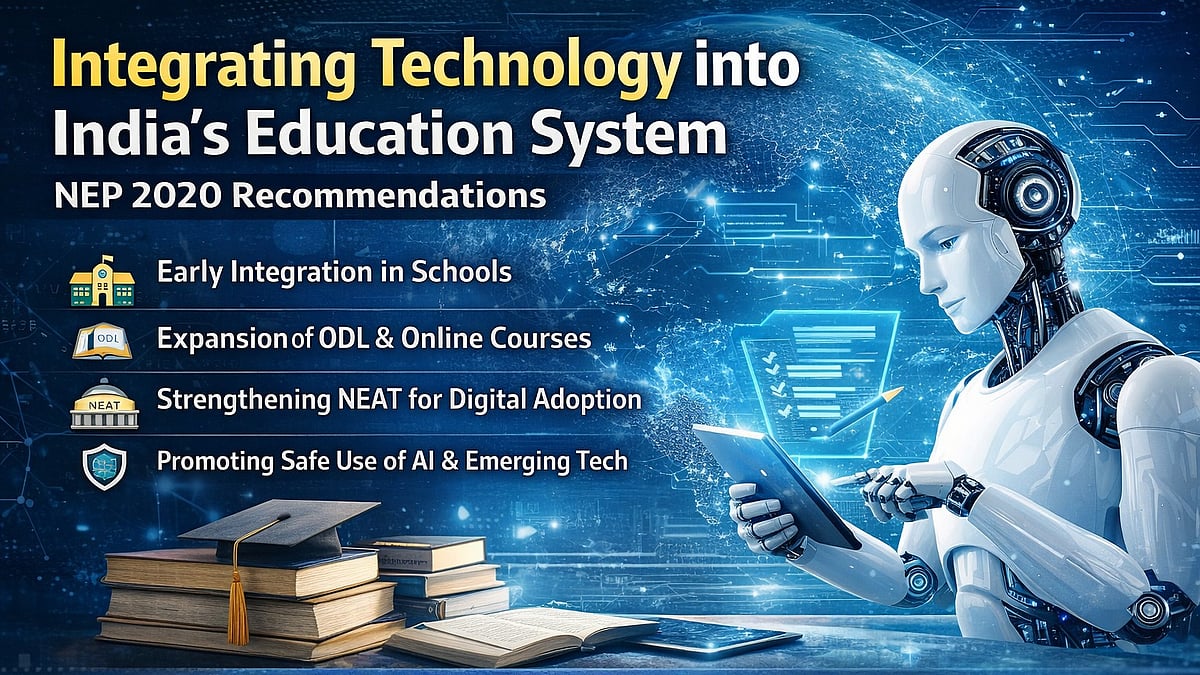
In the above context, the committee on NEP 2020 has made some important recommendations for integrating technology into education processes. Some major recommendations in this regard include the following:
School Level:
Integration of technology has to begin at school itself. Therefore, both students as well as teachers at school level need to be aware of the nuances of various technologies and their educational applications.
ODL and Online Courses:
The committee in its recommendations at various places has placed special emphasis on promotion of “open and distance learning (ODL)” by universities after getting prior accreditation. Distance learning is never possible without technical ingredients. The committee has also urged the introduction of value-added courses through online mode using various platforms like Swayam or NPTEL (National Program on Technology Enhanced Learning) at higher education level.
Establishment of NEAT:
One major recommendation of the committee has been to set up an independent body to be known as “National Educational Alliance for Technology (NEAT)” at the apex level as a policy entity. NEAT will be the body advising both the central as well as state government towards adoption of technology through empirical based research findings. It will also be a platform to exchange ideas regarding technology & its adoption among various stakeholders. It is expected that with the establishment of NEAT, there will be a unified and concerted focus on adoption of technology at different levels.
Improved Teaching-Learning Processes:
The committee has recommended that all higher educational institutions (HEIs) should try to develop new software and courses based on upcoming technologies; efforts should also be made to ensure that more innovative teaching pedagogies are developed through process of digitization. All these attempts are aimed at improving the ease and comfort of educational processes and delivery.
Tackling Disruptive Technologies:
The committee has paid specific attention to the emergence of disruptive technologies like artificial intelligence (AI). The committee has opined that special care should be made to anticipate such disruptions in future on a continuous basis so that proper feedback can be made to the authority like “Rashtriya Siksha Ayog (RSA)” so that proactive steps can be taken to anticipate effects of the same on future educational processes. Universities should constantly undertake research in various areas of technology including AI / ML, etc. so that the system is ahead. The committee also recommends that all higher educational institutions, including those running doctoral courses, should teach new technologies so that our education system is one of the best in the world. One unique recommendation of the committee is that technology should be developed in “Indian Languages” too so that all are benefited.
Current State of Implementation and Way Forward:
Core of the entire recommendation is that India should be among world leaders as far as adoption of technology is concerned in educational systems and processes. Some modest implementations have already taken place including the development of dedicated technology courses at graduate level in disruptive technologies like AI / ML both in Engineering and Science Disciplines.
NEAT has also been established in 2019 with AICTE being the lead coordinator. As per government report, around 12 lakh free course coupons have been distributed to disadvantaged students and MOUs have been signed with more than 50 Edtech Companies. However, the country is too big and much more needs to be done in this regard. All of us appreciate that adoption of technology with high speed is key to India’s progress and prosperity, which is not the case as of today.
Thanks to the epidemic of COVID that forced many teachers and students to adopt new online platforms and technologies. But the fact of matter remains that use of technology in classrooms is not to the extent it should be particularly in rural and urban places. The limitation of internet bandwidth is also creating issues.
Different stakeholders are blindly using AI: the actual progression of teaching knowledge enhancement through AI models is yet to stabilize in India. Many of the regulators are also grappling with the emerging issues of ethical use of AI and plagiarism. Barring a few entities like Zoho, there are hardly big Indian players in modern technologies.
It is high time that the Government sets up a “Think Tank” of serious academics and IT thinkers to come out with a comprehensive “IT Policy for the Future” so that educational system can really become technology enabled and driven. That will be a real driver for the economy.
The author is Founder and Convener, Higher Education Forum (HEF).
RECENT STORIES
-
-
-
-
-