JEE Advanced 2026 Concludes In Indore With IIT Roorkee’s High-Stakes Analytical Paper Designed To Trigger Cognitive Fatigue
JEE Advanced 2026 concluded amid heavy traffic, biometric screening and strict dress code enforcement at Indore examination centres on Sunday. According to mentor Atil Arora, the IIT Roorkee paper emphasised conceptual linkage, exhaustive option elimination and lengthy calculations over memorisation.

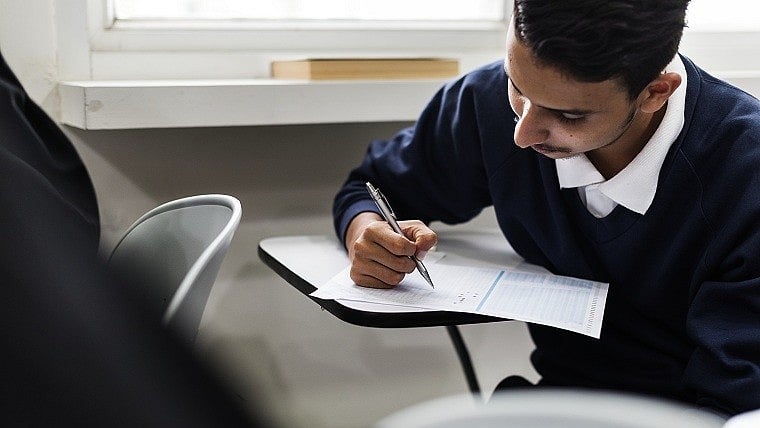
JEE Advanced 2026 Concludes In Indore With IIT Roorkee’s High-Stakes Analytical Paper Designed To Trigger Cognitive Fatigue | File Photo
Indore: The Joint Entrance Examination (JEE) Advanced 2026 concluded on Sunday as engineering aspirants across Indore completed the final assessment for selection into the Indian Institutes of Technology (IITs). Organized by IIT Roorkee, the national-level computer-based test required candidates to appear for two mandatory three-hour sessions, with Paper 1 running from 9:00 AM to 12:00 Noon and Paper 2 held from 2:30 PM to 5:30 PM. Local examination venues along the Bypass Road, Dewas Naka, and Scheme No. 54 encountered severe morning traffic congestion as candidates rushed to meet the strict 9:00 AM gate closure. Rigorous security screening, biometric verification, and strict dress code protocols were enforced across all centers, requiring candidates to leave footwear and personal items outside. Evaluating the structural design of the paper, Indore-based JEE mentor Atil Arora observed that the examination prioritized multi-layered analytical application over speed, purposefully triggering cognitive fatigue during the afternoon session.
Single-Correct MCQs Lacked Direct Formulas
Analyzing the option-based sections, Arora noted that the single-correct multiple-choice questions offered a structured entry point but entirely lacked direct formula substitution, forcing candidates to derive solutions by connecting fundamental principles rather than relying on rote memory. In contrast, the multiple-correct option questions carried substantial weightage and demanded exhaustive choice elimination to bypass structural traps. Arora emphasized that the options were calibrated to prevent guesswork, making the partial marking scheme highly decisive because candidates who exercised restraint by marking only verified choices would hold a distinct advantage over those risking negative marks. Meanwhile, the integer and numerical value questions across Physics and Mathematics involved lengthy, multi-step calculations that made absolute arithmetic precision critical. Even when the underlying theoretical framework was identified quickly, candidates had to navigate complex, time-consuming arithmetic to reach the correct value. Additionally, integrated paragraph and matrix-match questions in Physics and Chemistry demanded cross-topical synthesis, forcing candidates to link concepts from separate chapters to solve individual problem matrices.
ALSO READ
Interviews with Indore’s top-performing students from the JEE Main 2026 sessions highlighted these structural challenges. State topper Riddhesh Bendale stated that Paper 2 presented a significantly greater challenge, noting that multiple-correct Physics questions required deep analytical filtering where a minor calculation lapse could invalidate a student's entire conceptual approach. Girls' topper Anushka Agarwal remarked that the Chemistry section demanded immediate visualization of reaction mechanisms rather than textbook recall, adding that lengthy Physical Chemistry calculations heavily restricted time management in the second half of the day. Local high-scorer Lakshay Koushal noted that the mathematical steps in the integer-type questions were deliberately elongated, forcing him to slow down his calculation speed to avoid errors under pressure. According to data from the organizing institute, candidate response sheets will be released on May 21, 2026, followed by provisional answer keys on May 25, 2026, and the final results on June 1, 2026. Academic experts project that overall qualifying thresholds may remain moderate to low due to the calculated length of the papers and the penalizing nature of the marking scheme.
RECENT STORIES
-
-
-
-
-