Ethical Concerns In Research Rise As Publication Pressure Mounts In Indian Academia
Rising pressure to publish research in India has led to ethical concerns such as plagiarism and data fabrication. Experts stress the need for balanced academic policies that value both teaching and research, alongside stricter guidelines to maintain integrity and credibility in higher education.

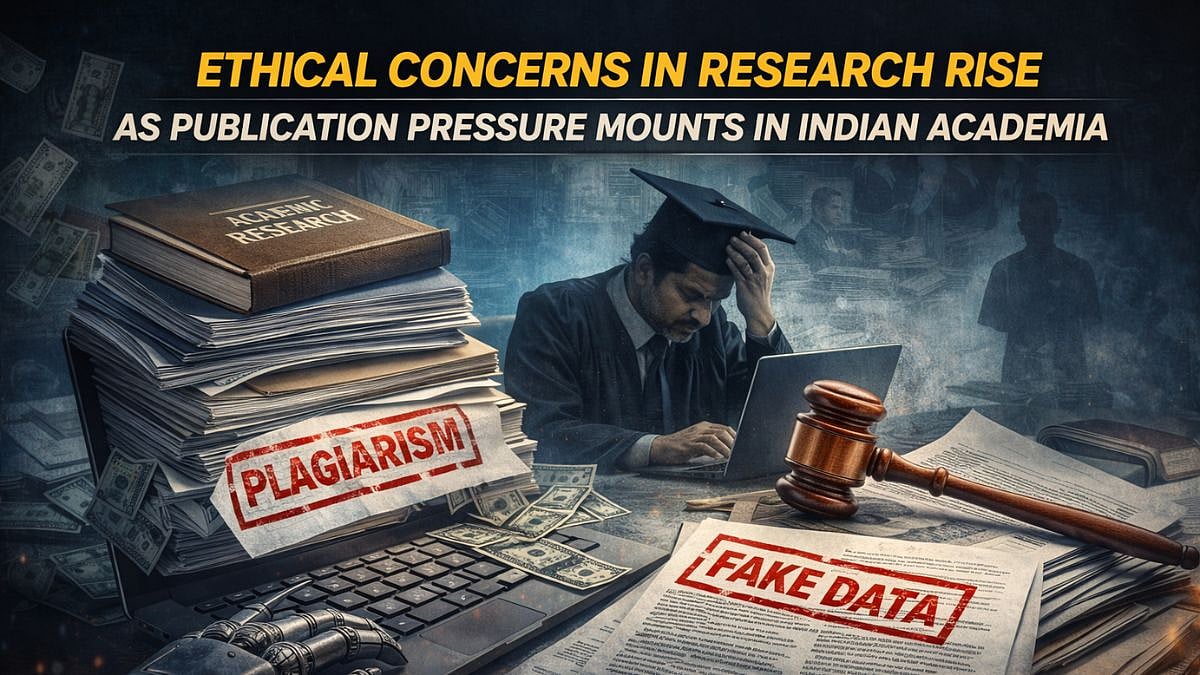
Rising pressure to publish research sparks ethical concerns in India’s higher education system | AI Generated Representational Image
Backdrop
Research has always been associated as a mandatory scholarship for a teaching professional, particularly at the higher education level. There are several reasons for the same. Firstly, creation of knowledge is equally important, if not more, than its dissemination.
Secondly, research is, in fact, a process of “learning” which a teaching faculty must practice himself/herself. And finally, research helps a faculty to bring in deeper insights into the classroom, enabling him/her to become a better teacher.
Therefore, both “theoretical” as well as “applied” research have always been considered an integral part of the teaching world, making PhD a mandatory qualification for entry-level jobs at colleges and universities all over the world.
Ethical fallouts
However, there has recently been severe fallout; an overdose of everything has a negative impact. The overemphasis on research in recent times has led to serious concerns related to ethics: plagiarism, ghostwriters, fabrication of data, wrong analysis, duplicate publication, among many others.
Academic institutions and the research fraternity all over the world are genuinely worried. India is no exception; the resultant effect is seen in the number of “retractions” that has substantially gone up in recent times. As per available statistics, the retractions of Indian papers used to be negligible in the later part of the 1990s or early part of the 2000s.
However, in recent times, particularly during the last five years or so, the retractions of journal articles by Indian authors have shown a steep increase. This is besides the “withdrawals,” i.e., the papers withdrawn by the authors during the process of publication due to adverse remarks by the reviewers.
This unfortunate development is casting a serious shadow on the ethical standards of Indian researchers and academicians. The advent of AI is only accentuating the problem, as everything appears to be so easy.
Possible reasons
The human mind sometimes looks for a quick and shortcut route to success, but that is not the only reason for the increase in ethical concerns. The main cause for this unfortunate trend primarily lies with the system itself, which has suddenly started placing “overemphasis” on research publications for any type of incentive: monetary, career progression, placement, among others.
We also see an unfortunate trend that even at the time of recruitment, interviewers are more particular about “research publications” rather than the “teaching acumen” of the applicant. There are universities in India that make the number of publications in Scopus/ABDC journals mandatory at a very high level, say ten or fifteen, for promotion from Assistant to Associate Professors, which forces faculty to resort to shortcut means for publication only to survive and grow.
The entry of indexed journals like Scopus, ABDC, IEEE, etc., and the compulsion to publish in the same has further complicated the situation. With too many authors chasing publication in too few “coveted and accepted journals,” the process takes a hit, with authors resorting to shortcuts and unethical practices. Cartels have started operating, resulting in a steep rise in article processing charges (APCs).
Now, there are new terms emerging like “clone journals” that are duplicate (and fraudulent) versions of the original journals, which many new researchers sometimes cannot distinguish. There is one more problem in India that needs to be addressed.
We have many instances where articles being published by PhD research scholars carry the name of the research guide as one of the authors, without any meaningful contribution. This, as a matter of practice, is not a healthy trend and sometimes amounts to “ghost authorship.” This aspect also needs to be seriously looked at.
Coping strategies
The solution mostly lies within the system. While a research-friendly ambience needs to be created within the system, the culture of “mandatory publication” might have to be revisited in the Indian context. India still has many “very good teachers” who are not necessarily “good researchers.”
The system needs to cater to these good exceptions as well and incentivise them properly towards “inspirational teaching.” Students, forever, remember good and motivated teachers and not researchers. Only incentivisation of research creates an asymmetric institution unless it is purely a “research institution.”
Every institution must have a well-defined research policy with “definition,” “acceptable levels of plagiarism” and “penalty clauses.” Existing UGC rules are good to start with. This policy should also be realistic (should not be too ambitious) in terms of incentivisation of research publications towards career progression of faculty members. For implementation of the policy, there must be a “research committee” comprising both internal as well as external experts.
Moving ahead
There is no denying that for creating an excellent institution, we need to focus on research, as that will determine ultimate credibility and admiration. However, the institution must create a conducive ecosystem for fostering collaborative and meaningful research in different impact areas.
The strategies of incentivisation need to be worked out accordingly; however, good teachers (who may not necessarily be good researchers) should be incentivised as well and simultaneously trained to become good researchers. It is the combination of “good teaching” and “impactful research” that makes a great institution.
By Dr A K Sen Gupta, Founder, Higher Education Forum (HEF). He may be contacted at aksengupta51@gmail.com and/or 98211 28103.
RECENT STORIES
-
-
-
-
-