Andhra Pradesh Revamps School Education With Gender-Neutral Textbooks, AI Learning, No Bag Days And Personalised Digital Education
Andhra Pradesh is reforming school education by removing gender stereotypes from textbooks, introducing AI and practical learning on No Bag Days, and using technology for personalised education. Minister Nara Lokesh also highlighted curriculum reforms, teacher recruitment and industry-linked skilling.

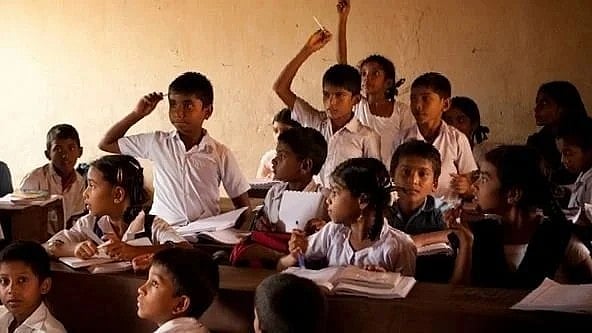
Andhra Pradesh Revamps School Education With Gender-Neutral Textbooks, AI Learning, No Bag Days And Personalised Digital Education | File Pic (Representative Image)
Amaravati: The Andhra Pradesh government has embarked on reforms in the school education sector, designing material aimed at ending gender stereotypes, such as men doing household chores, while focusing on technology to make learning interactive.
Also Watch:
State Education Minister Nara Lokesh said school textbooks in the state have been reformed to erase gender stereotypes and instill respect for women from an early age.
Textbooks for Classes 1 and 2 earlier depicted household chores as being performed entirely by women, which changed to men and women equally sharing the workload, aiming to avoid gender stereotyping from the first grade itself, he noted.
ALSO READ
"Andhra's textbooks reformed to erase gender stereotypes and instill respect for women from an early age. Focus on respect for women and eliminating gender stereotypes from an early age," Lokesh said in a recent meeting in New Delhi.
The southern state's ongoing reforms in school and higher education are focused on value-based education, gender sensitivity, technology-enabled learning, curriculum reform and industry-linked skilling.
Further, Lokesh noted that Saturday is observed as a "No Bag Day" in schools, providing an opportunity for value-based and practical learning.
ALSO READ
Activities include lessons on managing family budgets and agricultural budgets, field exposure visits and an introduction to Artificial Intelligence, he said.
Students are being introduced to both the positive and negative sides of AI so that they can understand the technology and use it effectively in their chosen fields.
On curriculum reform, Lokesh said the state has already undertaken two rounds of improvement, stressing that curriculum transformation cannot happen overnight and must instead be reformed incrementally and systematically with grade-wise improvements and continuous additions.
Further, Lokesh outlined his long-term goal of "gameifying" classrooms through technology.
Under this approach, after every 45-minute class, students would watch a 60 or 90-second video summarising the lesson, followed by four to five questions.
Using clicker technology, students would actively participate in answering the questions, turning the classroom into a more interactive learning environment.
The objective, Lokesh said, is to shift students from being passive learners to active learners.
The data would feed into the state's Learning Management System (LMS), enabling it to identify individual learning gaps and provide prescriptive homework and targeted learning content, the minister explained.
Lokesh cited the example of a student who may be strong in mathematics but weak in a particular concept such as probability.
In such a situation, he said the system would identify the specific gap and provide additional homework and learning material through the Learning Excellence in Andhra Pradesh (LEAP) app, which is accessible to parents and teachers as well.
He also linked school education reforms to higher education, underlining that the state is reviewing university curricula through discussions with academicians.
Lokesh said Andhra Pradesh is examining what courses, majors and minors are being offered, whether they remain relevant, and how closely curricula is aligned with market requirements.
He said these are among the key issues being discussed as part of the transformation of higher education.
Lokesh highlighted the progress made in ensuring 'one class, one teacher' concept, noting that when he took charge (2024) only three percent of the schools had achieved this standard while the figure has now increased to 33 percent.
ALSO READ
Lokesh underscored that the state recently completed a major teacher recruitment drive under which 16,000 teachers were recruited, with teacher recruitment being undertaken "every year."
He said value-based education is one of the key areas the state wants to strengthen further.
Referring to the vision of Viksit Bharat (developed India), the education minister said development without values would be incomplete and stressed that there is "no shortcut to success."
On technical education, Lokesh emphasised that the industry adoption of Industrial Training Institutes (ITIs).
He said Suzlon has adopted four ITIs while Royal Enfield has adopted one, leading to companies bringing in their equipment and industry-specific curriculum based on their operational requirements.
The state will continue to provide trainers while aligning training with the needs of industry, he said.
Lokesh added that these initiatives are aimed at creating an education ecosystem that combines values, practical exposure, technology, personalised learning and industry-relevant skills from school education through higher and technical education.
(Except for the headline, this article has not been edited by FPJ's editorial team and is auto-generated from an agency feed.)
RECENT STORIES
-
-
-
-
-