13% Employees Report High Burnout As Gen Z Nearly Doubles Its Share Of India’s Workforce To 26%: Study
India’s workforce is getting younger, with Gen Z now making up 26% of employees, nearly double its 2023 share. Meanwhile, 13% of employees remain in the high-burnout category, while AI and changing expectations reshape workplaces.

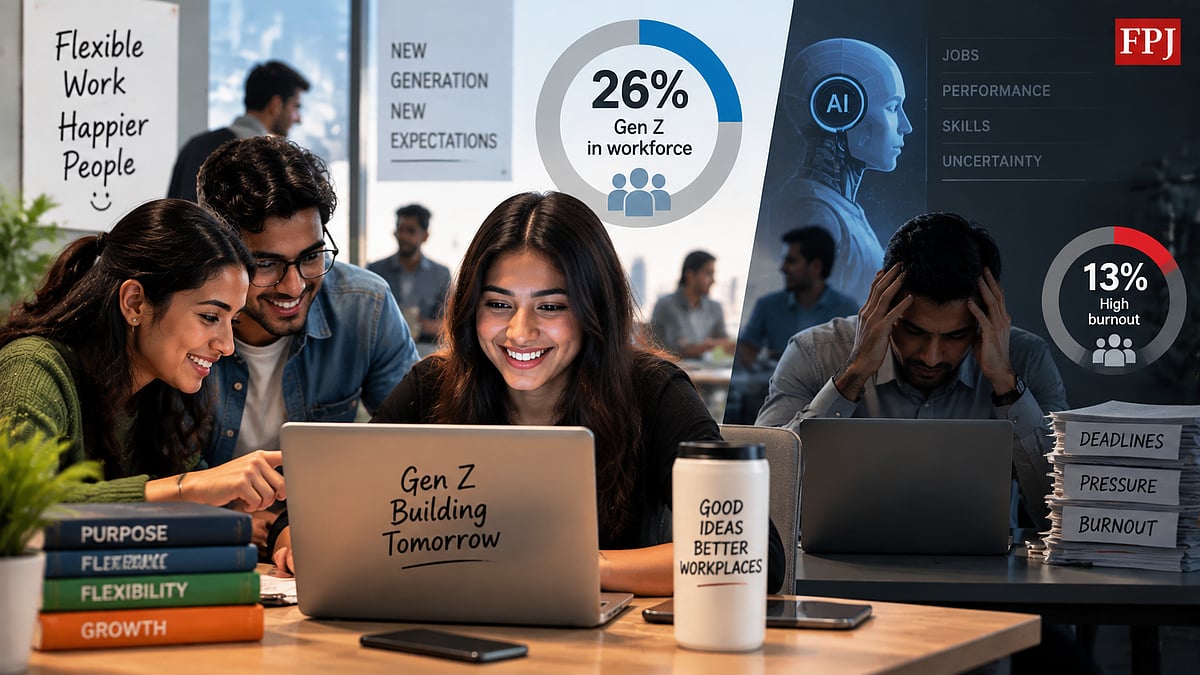
India's workforce is getting younger even as employee burnout remains a persistent concern, with Gen Z now accounting for 26 per cent of the workforce, nearly double its share in 2023. At the same time, around 13 per cent of employees continue to fall in the high-burnout category, according to a new study of Great Place To Work India.
The findings point to a workplace undergoing several changes at once, with younger employees bringing different expectations around flexibility and purpose, while organisations grapple with the impact of artificial intelligence (AI) on jobs, performance and workplace culture.
The study also found that discretionary effort has declined by 4 per cent since 2023, suggesting that while employees continue to perform their core responsibilities, fewer are willing to go beyond what is expected of them.
Gen Z's growing presence reshapes workplace expectations
The growing share of Gen Z employees is emerging as one of the key shifts for Indian organisations.
Gen Z now makes up 26 per cent of the workforce, compared with a significantly smaller share in 2023. Their expectations around how and where they work are also markedly different from those of older generations.
According to the study, 81 per cent of CHROs identify workplace flexibility as the top priority for Gen Z. By comparison, only 8 per cent of CHROs identify flexibility as the corresponding priority for Gen X and older generations.
The growing generational divide is adding another layer to the challenges companies are already facing as they adapt to rapid technological changes.
Balbir Singh, CEO of Great Place To Work India, said organisations are dealing with the combined impact of workforce transformation, AI adoption and changing employee expectations.
High burnout remains a concern
Despite greater attention to employee well-being, burnout has not disappeared from Indian workplaces.
The study found that 72 per cent of employees are currently in the low-burnout category, while the proportion reporting medium burnout has declined from 21 per cent in 2019 to around 15 per cent currently.
However, progress appears to have levelled off. Burnout levels have remained broadly stable between 2022 and 2026, with around 13 per cent of employees still reporting high burnout.
The findings suggest that while the overall picture has not deteriorated sharply, organisations have yet to make significant further progress in reducing higher levels of employee exhaustion.
AI adds to concerns around jobs and performance
The workplace transformation is also being driven by AI, which companies are increasingly deploying across teams and functions.
However, its adoption is creating new concerns around job security and employee performance. Around 44 per cent of CHROs said one of their major concerns is that high-performing employees are using AI to advance further while others struggle to keep pace.
This is creating a new workplace divide based not only on existing skills but also on employees' ability to effectively use AI tools.
Trust in AI-generated work is another challenge. Around 32 per cent of CHROs said employees remain uncertain about which AI-generated outputs need to be verified and which can be trusted.
The potential impact on employment is also becoming a concern. Nearly 25 per cent of CHROs expect AI to reduce workforce headcount by 1-20 per cent over the next two years.
At the same time, the longer-term impact remains uncertain, with nearly 45 per cent of CHROs saying it is still too early to estimate how AI will affect workforce size.
Managers also struggle with AI-enabled workplaces
The uncertainty is not limited to employees. Around 21 per cent of managers said they are unsure how to evaluate performance in an AI-enabled workplace. Meanwhile, 26 per cent of employees feel that leadership is not clearly addressing concerns around job security.
For organisations, this means AI adoption is becoming as much a people and communication challenge as a technology challenge. Employees need greater clarity on how the technology will affect their roles, career progression and performance expectations.
Employees are less willing to go the extra mile
The study also highlights a decline in discretionary effort, the additional effort employees voluntarily put into their work beyond their basic responsibilities.
Discretionary effort has dropped 4 per cent since 2023, with six in 10 organisations reporting a year-on-year decline.
The trend suggests a growing gap between employees completing their assigned work and their willingness to contribute beyond it.
Nearly 58 per cent of CHROs said they are dealing with AI-related and generational challenges at the same time.
According to Balbir Singh, the organisations that navigate the changing workplace successfully will be those that can combine faster technology adoption with trust, clarity and meaningful work.
With Gen Z's share of the workforce continuing to grow and AI reshaping jobs and performance expectations, companies are now being pushed to rethink not just how work gets done, but also what employees expect in return.
RECENT STORIES
-
-
-
-
-