The Greatest Economic Battle Lies Inside Every Human Mind
This week's column argues that economies are ultimately shaped by human behaviour, trust and judgement rather than numbers alone. It connects psychology with markets, examines key economic developments, and explains why ethical leadership and resilient institutions remain essential for sustainable prosperity amid global uncertainty.

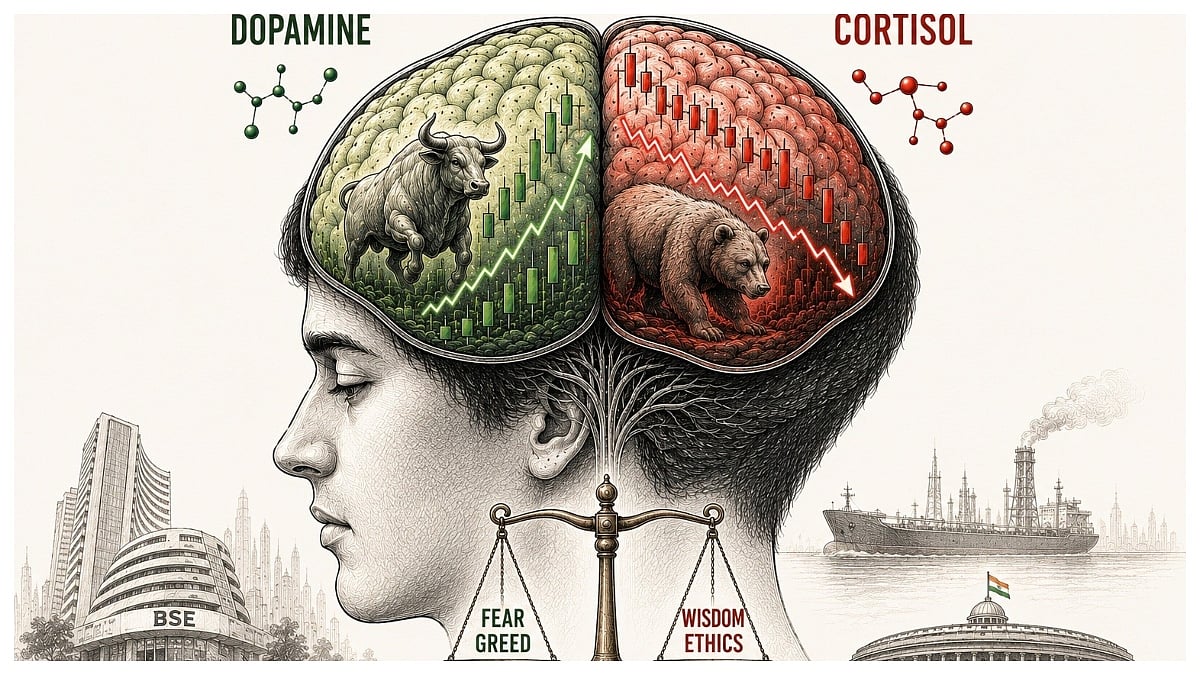
Invisible chemistry shapes visible choices, mkts and civilisations. |
Mumbai: “Every individual is fighting an invisible battle. Every family carries silent burdens. Every business confronts uncertainty. Every government balances competing pressures. Every nation pursues security, prosperity and influence.”
As markets reopen today (July 13), India begins another week carrying unanswered questions from the last one. The monsoon remains uncertain. Investors continue weighing risk against opportunity. Employers hesitate before committing fresh capital. Policymakers are still navigating American reciprocal tariffs, an unfinished India–US trade agreement and an increasingly fragile geopolitical landscape stretching from West Asia to global energy markets. Confidence has not disappeared; it is simply waiting for clarity.
Yet beneath these familiar headlines lies a deeper question that economics alone cannot answer.
Why do intelligent societies, blessed with unprecedented scientific knowledge, technological progress and accumulated wealth, continue to generate uncertainty, conflict and mistrust? The answer may begin within the human mind.
Before every market rally or crash, every election victory or defeat, every diplomatic breakthrough or military confrontation, billions of human brains process hope, fear, ambition and expectation.
Physics provides the electrical impulses that power the brain. Chemistry carries messages through molecules. Biology has refined these systems over millions of years to help humanity survive, compete and cooperate. Psychology transforms them into judgement and emotion. Economics becomes the sum of billions of individual decisions. Politics organises collective power. History records the consequences.
Scientists have identified several natural chemical messengers that quietly influence behaviour. Dopamine rewards achievement and fuels ambition. Cortisol prepares the body for uncertainty and danger. Testosterone strengthens confidence and competitiveness. Oxytocin nurtures trust and social bonds. None is inherently good or bad. Together they form part of the remarkable biology that makes us human.
Yet hormones do not start wars. They do not crash markets. They do not topple governments. Those outcomes emerge when natural human instincts collide with poor judgement, misinformation, intolerance, weak institutions, unchecked ambition and the absence of ethical leadership.
Markets reflect more than earnings; they reflect expectations. Governments depend upon more than policies; they depend upon trust.
Nations prosper not by eliminating fear, but by governing it wisely. The past week illustrated this reality. Tariff uncertainty delayed investment. Oil prices responded to conflict. Businesses postponed decisions while awaiting policy clarity. Financial markets oscillated between optimism and caution. None of this was purely economic. It was the visible expression of millions of invisible human decisions interacting simultaneously.
So who is to blame? Not physics. Not chemistry. Not biology. Nature provides the impulses. Humanity chooses the response.
Money is essential. Profit is legitimate. Enterprise creates employment, innovation and prosperity. But when disciplined investment gives way to reckless speculation, when long-term value is sacrificed for immediate gain, and when fear and greed overpower judgement, markets become fragile and societies pay the price.
Education refines judgement. Ethics restrains greed. Laws limit power. Independent institutions preserve confidence. Responsible leadership transforms uncertainty into stability. Compassion tempers ambition. These remain the true foundations of resilient economies and peaceful societies.
Perhaps the greatest investment India—and indeed the world—can make is not merely in infrastructure, artificial intelligence or military strength. It is in nurturing thoughtful citizens, trustworthy institutions and leaders who understand that lasting prosperity begins with understanding human nature itself.
Every civilisation is built twice. First in the human mind. Then in markets, governments and history. If humanity wishes to transform the second, it must first transform the first. Next Monday (July 20): Another week. Another lens. Another perspective.
DEFINING DEVELOPMENTS (JULY 6–12)
On July 8, the International Monetary Fund lowered India's FY2026–27 GDP growth forecast to 6.4%, while retaining India as the world's fastest-growing major economy. Global growth was cut to 3.0%.
The ADB also trimmed growth projections for developing Asia, citing elevated energy prices, trade uncertainty and persistent geopolitical risks.
Renewed US–Iran tensions returned West Asia to the centre of the global economic agenda, reinforcing geopolitical risks across financial markets.
Brent crude climbed to $80.50 a barrel on July 8 before easing to around $77–78, although markets continued pricing a geopolitical risk premium.
India's forex reserves rose by $7.26 billion to $674.19 billion in the week ended July 3. Foreign-currency assets increased by $4.5 billion to $545.5 billion, while gold reserves rose by $2.6 billion to $105.2 billion, reinforcing the country's external resilience.
FPIs turned net buyers in July, investing ₹15,156 crore until July 10, supported by improving macroeconomic stability, rising debt inflows and a resilient rupee.
Reciprocal tariffs and unresolved India–US trade negotiations prolonged uncertainty for exporters, while the USTR's Section 301 process remained under global scrutiny.
India hosted fresh ASEAN–India trade negotiations and strengthened partnerships in clean energy, digital payments, critical minerals and resilient supply chains.
The Sensex settled at 77,569.39, while the Nifty 50 closed at 24,206.90, recovering a significant part of the week's earlier losses.
The rupee recovered after early pressure from higher crude prices. It settled 9 paise higher at ₹95.38 per US dollar, supported by RBI intervention and easing market sentiment.
ALSO READ
India's Q1 FY27 earnings season began on a positive note, led by TCS, as investors shifted attention towards corporate profitability and AI-driven business demand.
Equity mutual fund inflows surged 26.5% to ₹28,973 cr, extending India's strong retail investment momentum, while SEBI approved intraday borrowing for mutual funds to strengthen liquidity management.
SBI Funds Management reduced its IPO size to ₹9,812.9 cr after a pre-IPO placement, while retaining the ₹545–574 price band. The issue opens on July 14 and closes on July 16, making it one of India's largest public offerings of 2026.
TRAI moved to tighten oversight of caller-identification platforms and clarify rules for 1400 and 1600-series numbers, aiming to strengthen consumer protection, curb fraudulent calls and improve confidence in India's telecom ecosystem.
ONGC proposed expanding strategic petroleum reserves, reinforcing the country's long-term energy security strategy.
Office leasing across India's top nine cities reached a record 45.5 million sq ft, led by strong demand from GCCs.
AI, semiconductor manufacturing, private credit, E20 fuel, an above-normal monsoon and improving kharif sowing emerged as the defining structural themes shaping the medium-term economic outlook.
ALSO READ
On July 10, former RBI Governor Raghuram Rajan, Harvard economist Raj Chetty and Microsoft executive Asha Sharma were appointed to US Federal Reserve task forces reviewing future monetary policy.
India enters the new week with confidence, but not certainty. Yet resilient savings, strong corporate earnings, healthy foreign-exchange reserves and a deep capital-market pipeline underpin long-term growth. Uncertainty remains the world's most expensive economic variable.
RECENT STORIES
-
-
-
-
-