Kharif Sowing Drops 23% As Weak Monsoon, El Niño Conditions Hit Farm Activity
Kharif sowing in India has fallen 23% year-on-year to 18.27 million hectares due to a weak and delayed monsoon. Major crops including rice, pulses, oilseeds, cotton, and coarse cereals have seen sharp declines. El Niño conditions and low reservoir levels are further adding pressure on agricultural output

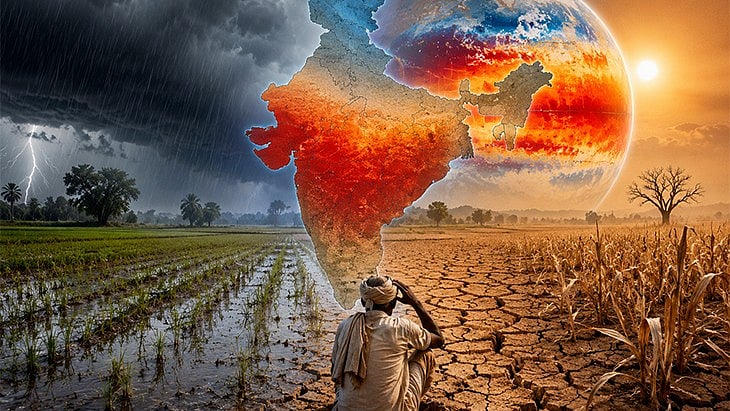
Sowing of kharif crops across India has declined significantly this season, with total acreage falling to 18.272 million hectares as of June, compared to 23.646 million hectares in the same period last year, according to data from the agriculture ministry.
The decline of nearly 23% has been largely attributed to the delayed and sluggish progress of the southwest monsoon.
The impact is visible across all major crops. Paddy, the primary kharif crop, recorded a sharp drop of 25.17%, with acreage falling to 2.575 million hectares from 3.441 million hectares a year earlier.
Pulses have also seen a steep decline, with tur/arhar sowing down to 356,000 hectares from 845,000 hectares.
Oilseeds have been significantly affected, with groundnut acreage falling to 887,000 hectares from 1.529 million hectares, while soybean dropped to 692,000 hectares from 1.997 million hectares.
Coarse cereals also registered a decline, with acreage reducing to 3.184 million hectares from 3.607 million hectares in the same period last year.
Cotton sowing has witnessed one of the sharpest declines, falling 34.61% to 2.966 million hectares compared to 4.536 million hectares last year.
However, not all crops have declined—sugarcane acreage has marginally increased to 5.731 million hectares, while jute and mesta have also seen a slight rise to 625,000 hectares.
The slowdown in sowing activity is closely linked to deficient monsoon rainfall. As per the India Meteorological Department (IMD), rainfall has been 42% below normal as of June 24.
Central India has recorded the highest deficit at 59%, followed by East and Northeast India at 41%, the South Peninsula at 28%, and Northwest India at 22%.
Adding to concerns, El Niño conditions are currently active over the equatorial Pacific and are expected to strengthen during the June–September monsoon period, potentially affecting rainfall patterns further.
Water availability is also under pressure. Live storage in 166 major reservoirs monitored by the Central Water Commission stood at 48.405 billion cubic metres, or 26.37% of full capacity as of June 25.
This is significantly lower than last year’s levels, though slightly above normal. While 111 reservoirs are above 80% of normal storage, 55 remain below that level, with 29 at 50% or less.
Overall, weak monsoon conditions and water stress are weighing heavily on India’s kharif agricultural outlook.
RECENT STORIES
-
-
-
-
-