Indian IT Nears AI-Led Revival, Deployment Spending Could Drive Next Growth Cycle
Indian IT could benefit as AI spending shifts from infrastructure towards deployment, integration and governance, although near-term pricing risks remain.

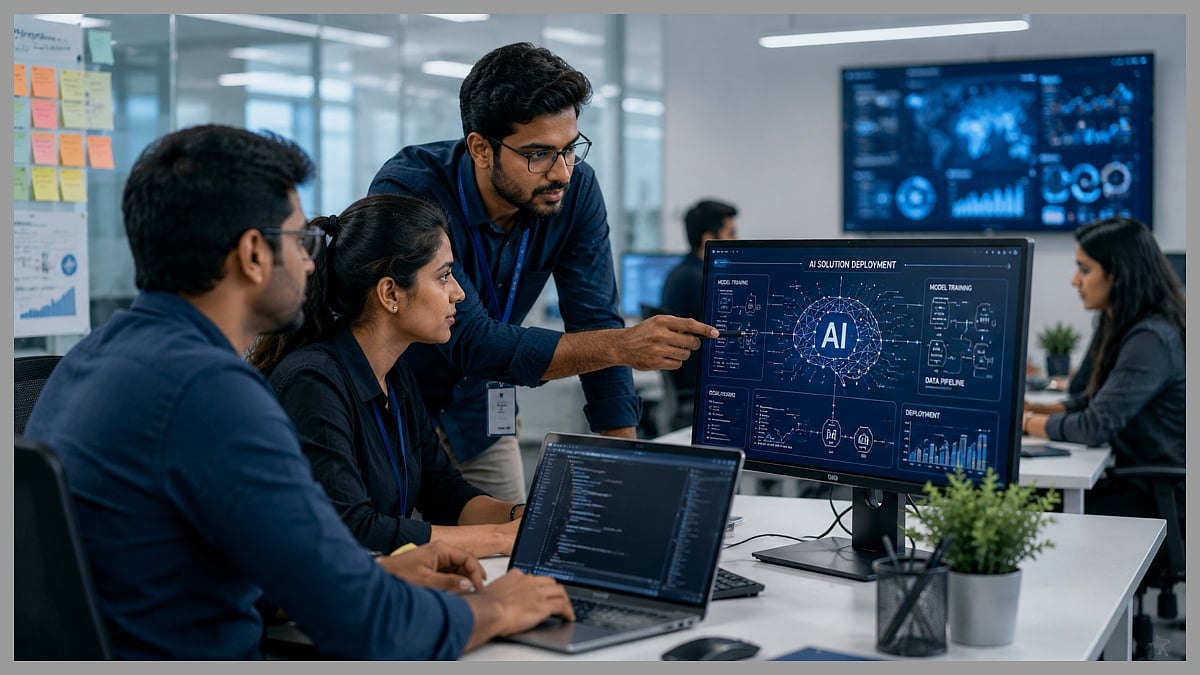
Indian IT could benefit as AI spending shifts from infrastructure towards deployment. |
Mumbai: Indian IT has endured an almost three-year spending slowdown, marked by weak discretionary budgets, longer deal cycles, H-1B pressures and AI-led revenue deflation. The February 2026 sell-off intensified concerns that agentic tools, including Claude Cowork and COBOL modernisation solutions, could directly automate legacy technology systems.
However, this fear may overlook the sector’s emerging opportunity. The AI investment cycle is shifting from “building capacity” to “proving payback”, a transition that requires extensive services support. Indian IT companies are well placed to benefit through deployment, integration, governance and legacy modernisation.
Value is gradually moving from businesses financing AI infrastructure towards companies deploying it. Enterprise software platforms are likely to benefit first, particularly Systems of Record and Systems of Action that control corporate data, permissions and approvals. Services companies could follow as they integrate, manage and operate these platforms.
This resembles the cloud investment cycle, where infrastructure spending came first and returns later flowed to different participants. Similar patterns were seen in railways, fibre networks and the cloud adoption J-curve between 2015 and 2019.
Funding pressures emerge
Several indicators suggest this transition has started. Combined capital expenditure by the five largest hyperscalers is projected to approach $825 billion in calendar year 2026, nearly double the 2025 level, while absorbing close to their entire operating cash flow.
Alphabet reported its first negative free-cash-flow quarter and paused share buybacks. Oracle was downgraded to BBB–, while its five-year credit default swap reached a two-decade high. Its roughly $638 billion order book is estimated to have nearly 50% exposure to OpenAI.
CoreWeave and OpenAI are also linked through circular, off-balance-sheet financing arrangements, with Nvidia emerging as a key financial backstop. Memory companies delivered record profits and gross margins of 83%, but investors remained cautious about earnings dependent on externally funded infrastructure expansion.
Deployment becomes critical
Meanwhile, AI models are no longer scarce assets. Open-weight models are increasingly challenging closed frontier systems. Chinese open models reportedly account for around 58% of US tokens processed through OpenRouter, while token prices have fallen sharply even as overall corporate AI expenditure continues rising.
Frontier laboratories are also acknowledging the importance of implementation. OpenAI’s DeployCo, Anthropic’s services joint venture and tiered partner networks represent more than $9 billion committed towards placing engineers within customer organisations.
Spending is already reaching the application layer. ServiceNow has crossed $1 billion in AI annual contract value, while SAP’s cloud backlog has risen 26%. EXL and Cognizant indicate that contract design and delivery capability, rather than model performance alone, increasingly determine success in AI-led engagements.
Near-term challenges nevertheless remain. AI-related pricing pressure and geopolitical uncertainty could restrain growth. Enterprise software monetisation may arrive first during FY27, with IT services benefiting more meaningfully as deployment expands into FY28.
AI could ultimately enlarge the total addressable market through AI FinOps, governance, managed-agent operations, legacy upgrades, sovereign AI and small-language-model pools. Indian IT offers exposure to these opportunities without the funding and balance-sheet risks carried by infrastructure providers, strengthening its appeal as a “safe AI” trade.
The preferred large-cap stocks are Tech Mahindra, LTIMindtree and Infosys, while Persistent Systems and Mphasis are the favoured mid-cap selections.
Disclaimer: This article is based on market analysis and available data; investors should consult independent financial advisers before making investment decisions.
(Anand Rathi Research Report)
RECENT STORIES
-
-
-
-
-