India May See Poverty Drop To 12.1% By 2028, Here's What The World Bank Report Reveals
India's poverty rate may fall to 12.1 percent by 2028 from 14.2 percent in 2026, says World Bank. Job growth and welfare schemes support progress, but rural poverty and unemployment remain concerns.

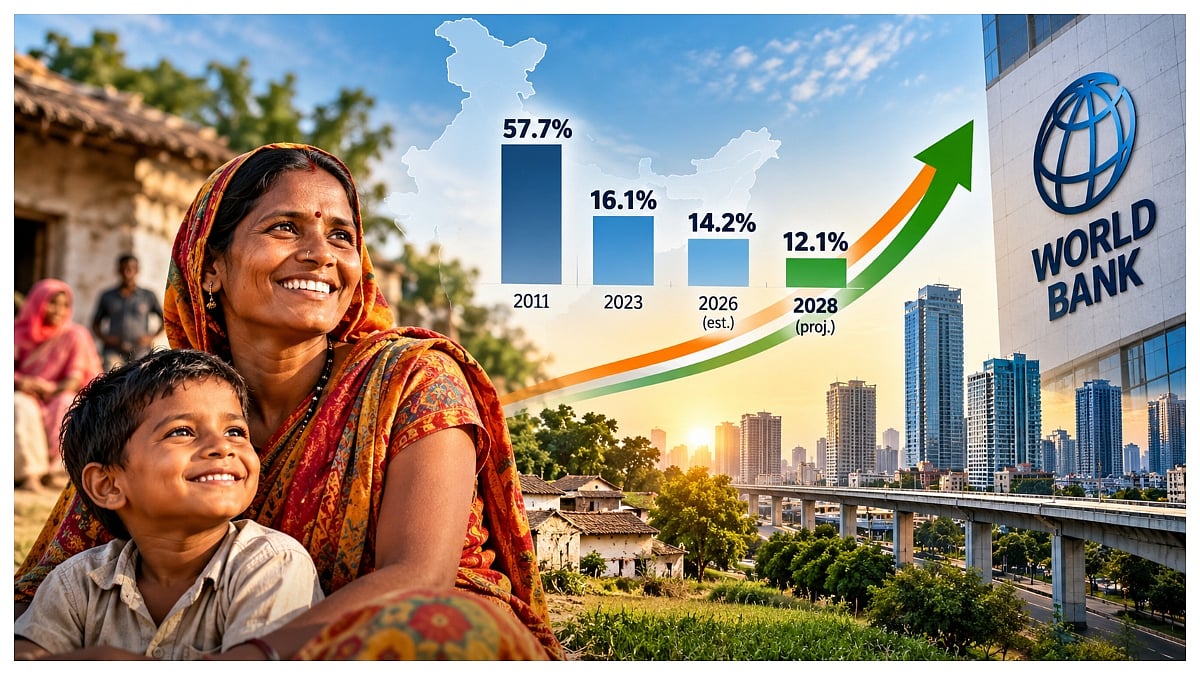
India's poverty rate may fall to 12.1 percent by 2028 from 14.2 percent in 2026. |
New Delhi: India's poverty rate is projected to decline from 14.2 percent in 2026 to 12.1 percent by 2028, according to the World Bank, although the pace of poverty reduction is expected to slow.
The projection, based on the USD 4.2-a-day poverty threshold, reflects improvements in household consumption, employment opportunities and government welfare support.
Nearly 50 Crore People Escape Poverty
According to the World Bank's October 2026 Poverty and Equity Brief, India's poverty rate fell from 57.7 percent in 2011 to 16.1 percent in 2023 under the lower-middle-income poverty threshold.
This improvement helped approximately 49.6 crore people move out of poverty during the period.
Extreme poverty, measured at USD 3 per day, also declined sharply from 27.1 percent to 2.6 percent.
However, nearly 80 percent of Indians remained below the upper-middle-income poverty threshold of USD 8.3 per day in 2023.
Rural Poverty Remains A Challenge
Poverty continues to be concentrated in rural India, where the rate stood at 19.3 percent in 2023, compared with 8.6 percent in urban areas.
States stretching from Uttar Pradesh to West Bengal accounted for approximately 57 percent of India's poor population.
The findings highlight persistent regional differences despite improvements in overall living standards.
Employment Growth Supports Consumption
India added approximately 13.4 crore jobs between 2017 and 2023, nearly twice the increase in its working-age population.
ALSO READ
Rising employment among rural women contributed significantly to this expansion, increasing household earnings and supporting consumption.
Government food subsidies, social transfers and expanding ecommerce-related employment also helped improve household spending capacity.
However, much of the employment growth occurred in low-productivity activities, limiting improvements in real wages.
Youth Unemployment Raises Concerns
Youth unemployment increased from 14.6 percent in April-June 2025 to 15.9 percent during the corresponding quarter of 2026.
The increase was particularly pronounced among young rural women, highlighting continuing challenges in creating productive employment.
ALSO READ
Sustained poverty reduction will depend on better-paying jobs, stronger productivity and continued economic opportunities.
The World Bank also cautioned that changes in survey methodology could influence poverty estimates, while consumption surveys may understate inequality by inadequately capturing spending among wealthier households.
RECENT STORIES
-
-
-
-
-