GST Council May Scrap Officers' Arrest Powers, Raise Prosecution Threshold From ₹1 Crore To ₹5 Crore
The GST Council will consider scrapping pre-prosecution arrest powers of GST officers at its October 8 meeting. The proposal, based on “trust the taxpayer”, would retain arrests after criminality is established and raise the prosecution threshold from Rs 1 crore to Rs 5 crore.

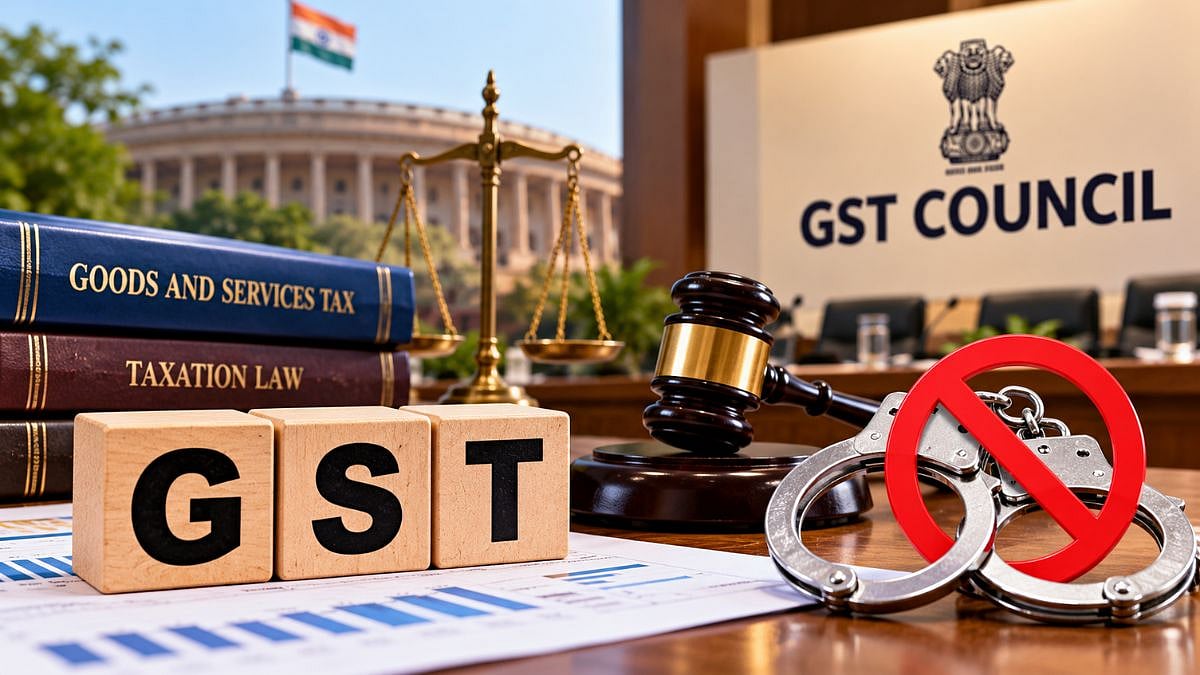
The GST Council is set to consider changes that would restrict tax officers from making arrests before criminality is established | AI Generated Representational Image
New Delhi, October 6, 2026: The proposal before the GST Council to do away with the arrest powers of GST officers is based on the principle of 'trust the taxpayer' and states too would see virtue in scrapping this power -- which was never there in any other tax law, except excise, Finance Ministry sources said on Tuesday.
"One or two states may feel very sensitive about the proposal of GST officers losing the power to arrest. The proposal does not remove the arrest provision completely under GST law. The proposal states that only after criminality is proven, that a law enforcement officer can arrest an offender," a source said.
GST Council To Discuss Changes
The 57th meeting of the GST Council, to be chaired by Union Finance Minister Nirmala Sitharaman and comprising state finance ministers, will on October 8 deliberate significant changes to the GST enforcement framework, including removing the arrest powers of GST officers.
As part of the decriminalisation exercise, the threshold for prosecution is proposed to be raised from Rs 1 crore to Rs 5 crore.
The changes in the GST law are likely to be implemented in early 2027.
Arrest Powers Traced To Excise Act
A GST officer's power to arrest came from the Excise Act, which was subsumed in Goods and Services Tax at the time of its rollout in 2017. Tax officers did not have arrest powers under VAT, service tax or other taxation laws.
When the GST was implemented, the power to arrest was one of the few tools available against fake invoicing because the means to detect it were limited as invoices could not be matched. Deterrence had to do the work that detection could not yet do.
"GST officers' arrest power was therefore, written in the law. However, today, invoice matching is possible with technology stability. The safeguard that arrest was meant to provide is now being provided by the system," another source said.
Tax Collection And Law Enforcement
Sources said a tax officer's main job should be to collect taxes, while letting law enforcement agencies to go after criminals. The proposal before the GST Council entails removal of pre-prosecution arrests.
"If there is a tax due, the effort should be to recover it. If there is criminality involved, and prosecution launched, arrests can be made based on court order," a source said.
Also Watch:
Proposal Seeks To Protect Honest Businesses
The changes would ensure that honest businesses can carry on their work without worrying about the threat of an arrest by a GST officer, a criticism which comes to the revenue department, another source said.
"The proposal underlines the tax department's principle of trust the taxpayer. One or two states want arrest powers to stay, but we hope they will come around," a source said.
(Disclaimer: Except for the headline, this article has not been edited by FPJ's editorial team and is auto-generated from an agency feed.)
RECENT STORIES
-
-
-
-
-