EU CEOs Crown India Top Strategic Priority For Trade, Tech And Supply Chains Over US & China, New Report Shows
Driven by internal economic pessimism and long-term caution over China, a new report reveals that the heads of Europe's largest companies are now prioritising their commercial relationship with India across vital sectors like trade, technology and resilient global supply chains

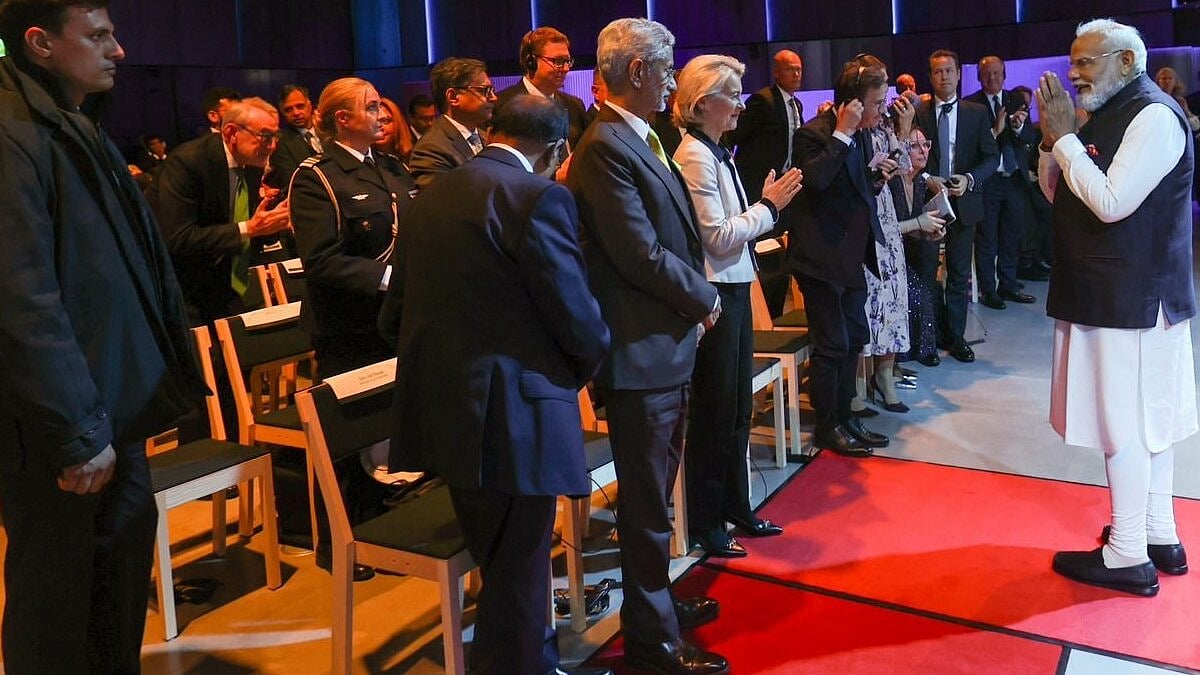
Prime Minister Narendra Modi addressed the European Round Table for Industry (ERT) in Gothenburg on May 17, 2026 | X handle of @narendramodi
In a major shift in global corporate strategy, European chief executives are exhibiting immense enthusiasm for India, increasingly prioritising it over China and other major global markets.
A new joint report published by The Conference Board and the European Round Table for Industry reveals that 63 per cent of surveyed leaders hold a positive view of India's long-term business scenario, with an additional 7 per cent declaring themselves very positive, while a mere 4 per cent view the market negatively. This wave of optimism has directly altered geopolitical and commercial priorities for European industry.
The data highlights that 58 per cent of respondents believe the European Union should award its relationship with India a very high priority across vital sectors including trade, investment, supply chain management, technology, security and climate energy.
According to report in the South China Morning Post, this high positioning places India at the top of Europe's external strategy, outpacing the 53 per cent priority rating assigned to the United States and the 42 per cent priority rating given to China.
High-level diplomatic momentum
This structural shift toward Indian markets was heavily on display during a high-profile diplomatic and industrial gathering in Gothenburg on May 17, 2026. Prime Minister Narendra Modi addressed the European Round Table for Industry at an event hosted by the Volvo Group, which featured top-tier leadership including Swedish Prime Minister Ulf Kristersson, European Commission President Ursula von der Leyen and prominent corporate executives from both European and Indian firms.
During his keynote address, Prime Minister Modi focused heavily on the successful conclusion of negotiations for the landmark India-EU Free Trade Agreement.
This agreement is being framed by both political and industrial circles as a transformative economic partnership designed to unlock unprecedented opportunities in trade, technology transfer, manufacturing expansion, services and the creation of resilient supply chains.
Beyond policy frameworks, physical connectivity projects such as the India-Middle East-Europe Economic Corridor are adding tangible value to this changing corporate alignment.
Domestic reforms driving India's manufacturing appeal
The core of India's pitch to anxious European CEOs relies on its rapid domestic economic growth and next-generation economic reforms. The Indian government has placed a massive emphasis on governance centred around the ease of doing business, an expanding digital public infrastructure, a vibrant manufacturing ecosystem and a rapidly transforming infrastructure sector.
By pushing the operational vision of designing for India, making in India and exporting from India, the country is positioning itself as a highly stable, alternative global manufacturing hub.
European companies are being actively invited to deepen their industrial engagement, leveraging India’s vast domestic market as well as its infrastructure capabilities to buffer against regulatory uncertainties and supply chain vulnerabilities felt elsewhere in the global market.
Collaborative frontiers
As European industry seeks to diversify, the scope of the India-Europe partnership is expanding into highly technical and sustainable sectors. European industry leaders are actively exploring large-scale investments in Indian transport, logistics, renewable energy, green hydrogen and nuclear power.
There is also a concerted push for joint operations in deep tech and advanced digital industries, including telecommunications, artificial intelligence, semiconductor fabrication, electronics and healthcare life sciences.
The long-term sustainability of this economic shift is tightly linked to human capital, education and skill partnerships. India's young and highly skilled workforce is increasingly viewed as a vital asset for future global economic growth, offering European companies a sustainable pipeline of talent.
To ensure that this corporate and strategic momentum does not fade, forward-looking measures have been proposed, including a proposal to hold the India-Europe CEOs Round-table on an annual basis and the creation of a dedicated India Desk within the European Round Table for Industry.
European corporate caution and long-term China outlook
This surge in India's prominence comes at a time when European corporate leaders are maintaining a highly cautious approach toward China's long-term business prospects.
When assessing the Chinese business environment more than three years into the future—specifically focusing on regulatory stability, systemic simplicity, openness and overall investment attractiveness—corporate sentiment is distinctly fragmented. The survey shows that 34 per cent of respondents view China's future positively, while an equal 34 per cent remain neutral and 23 per cent express a negative outlook.
While these figures reflect an undercurrent of ongoing hesitation, they actually represent an improvement over medium-term sentiments recorded in the previous year.
Economists point out that a prior report indicated only 8 per cent of European corporate heads planned to increase their investments in China. The latest data suggests that while immediacy brings scepticism, long-term views beyond the three-year horizon are gradually becoming more favourable, even as European leaders wade through challenging global macroeconomic conditions.
Economic pessimism within European market
The strong eagerness to explore external markets like India is heavily driven by deep anxieties regarding the short-term global economy and widespread pessimism about business conditions within Europe itself.
A significant majority of corporate heads doubt the structural progress of their home market, with three-quarters of respondents stating they do not believe the European single market will be completed by the European Commission's target year of 2028. Furthermore, 65 per cent express serious doubts that it will even be finished by 2030.
This internal scepticism extends into the broader, long-term commercial environment of the continent. More than 60 per cent of the surveyed executives deem Europe’s long-term business conditions to be outright negative, while a strikingly low 11 per cent anticipate any positive development, forcing major corporations to look abroad to safeguard their future growth.
RECENT STORIES
-
-
-
-
-