China's Economic Slowdown Deepens Despite Cheap Loans And Bank Liquidity
China is showing signs of a possible liquidity trap as record-low interest rates and rising bank liquidity fail to revive consumer spending and investment. Despite credit expansion and monetary easing, weak demand, falling property prices and high household savings are weighing on economic growth.

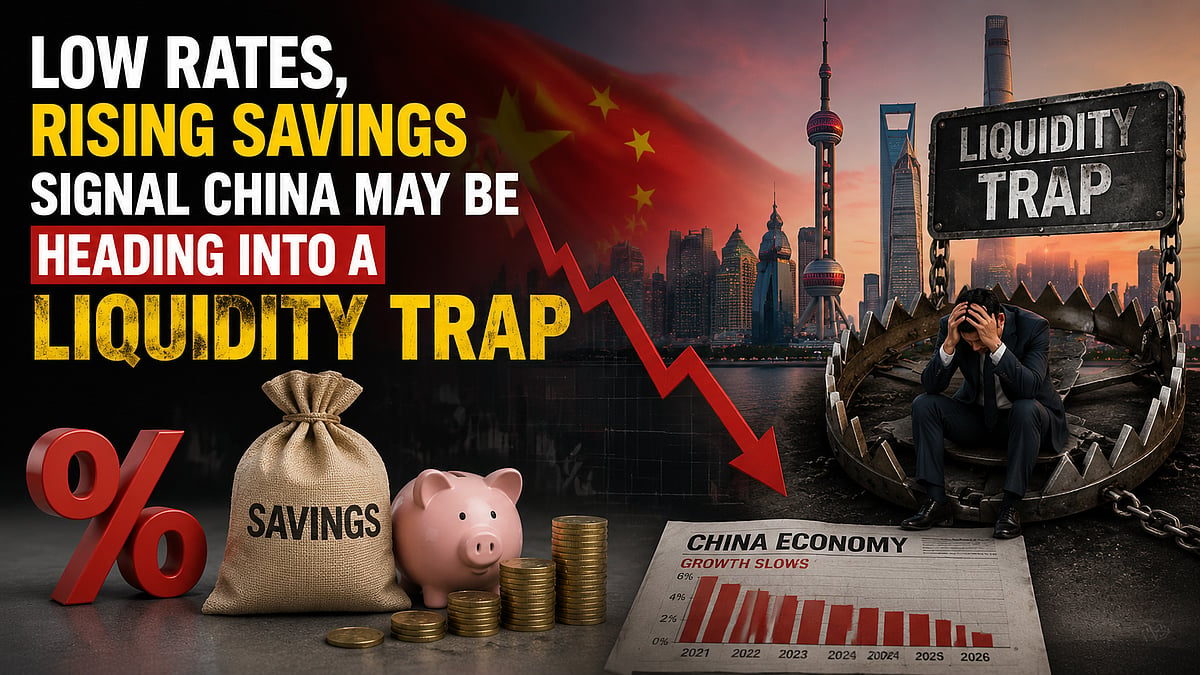
China's Economic Slowdown Deepens Despite Cheap Loans And Bank Liquidity | AI Representational Image
New Delhi, July 19: China is showing increasing signs of slipping into a liquidity trap, with record-low interest rates, abundant bank liquidity and aggressive credit expansion failing to revive consumer spending, business investment or economic growth, according to recent economic data.
The world's second-largest economy grew 4.3 per cent in the second quarter of 2026, falling short of Beijing's annual growth target of around 5 per cent and marking its weakest quarterly expansion in nearly three-and-a-half years, as per Dunham report.
The slowdown comes despite years of monetary easing by the People's Bank of China (PBOC), which has kept borrowing costs at historic lows while encouraging banks to extend fresh credit.
Signs of liquidity trap emerge
A liquidity trap occurs when interest rates are already very low and financial institutions have ample funds to lend, but households and businesses remain reluctant to borrow, invest or spend.
In such a situation, monetary policy loses much of its effectiveness as additional liquidity fails to stimulate economic activity, the report stated.
China's latest economic indicators suggest that this pattern may be emerging. The country's broad money supply (M2) expanded 8.6 per cent year-on-year at the end of May, while banks issued 10.72 trillion yuan in new loans during the first six months of 2026.
Savings rise amid weak demand
However, domestic demand has remained subdued, with consumers preferring to save rather than spend despite cheaper borrowing costs.
Recent surveys indicate that more than 80 per cent of respondents would rather increase savings than consumption, highlighting weak consumer confidence even as benchmark lending rates remain near record lows.
The one-year loan prime rate stands at 3 per cent, while the five-year mortgage-linked rate is 3.5 per cent.
Property crisis weighs on confidence
The prolonged downturn in China's property market has further weighed on household sentiment.
New home prices declined 3.3 per cent year-on-year in June, marking the 36th consecutive month of falling prices.
With nearly 70 per cent of household wealth linked to real estate, the sustained correction has eroded consumer confidence and curtailed discretionary spending, the report mentioned.
(Except for the headline, this article has not been edited by FPJ's editorial team and is auto-generated from an agency feed.)
RECENT STORIES
-
-
-
-
-