45.9% Individual Donations Go To Religious Bodies, 41.8% Given Directly to Beggars: How India Gives Report
A new report shows 45.9 percent of individual donations in India go to religious organisations and 41.8 percent to beggars. India’s household giving is estimated at Rs 54,000 crore annually. In-kind donations lead, followed by cash. Giving cuts across income levels, reflecting India’s strong culture of generosity.

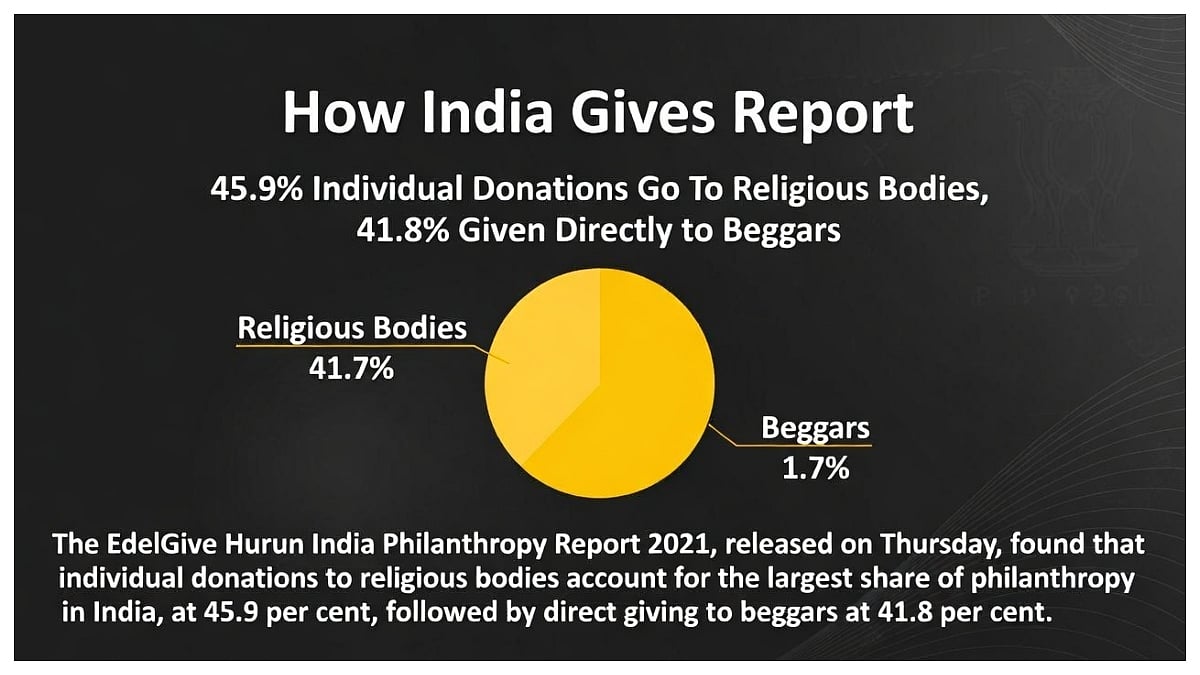
A new report shows 45.9 percent of individual donations in India go to religious organisations and 41.8 percent to beggars. | Image by Grok |
New Delhi: A new report shows that most individual donations in India go to religious organisations and beggars. According to the third edition of the How India Gives report, 45.9 per cent of donations are made to religious bodies, while 41.8 per cent are given directly to beggars.
Only 14.9 per cent of donations go to non-religious organisations.
The report was released by the Centre for Social Impact & Philanthropy (CSIP) at Ashoka University.
ALSO READ
Size of India’s Giving Economy
The study estimates that everyday household giving in India is worth about Rs 540 billion (Rs 54,000 crore) every year.
The report is based on 7,225 surveys conducted across 20 states. It also uses National Sample Survey (NSS) consumption data to understand how and why people give.
Researchers say this shows that Indians are among the most generous people globally. However, much of this giving is informal and often not recognised in official data.
How Indians Prefer to Give?
The report highlights that in-kind donations, such as food, clothes or other items, make up the largest share at 46 per cent. Cash donations are close behind at 44 per cent.
Around 30 per cent of people also volunteer their time, showing that giving in India is not only about money but also about personal involvement.
When it comes to learning about donation opportunities, 25 per cent of people prefer in-person requests. Social media comes next at around 15 per cent. This shows that trust and personal connection remain important.
Giving Across Income Groups
The report says everyday giving happens across all income levels. Even among households earning Rs 4,000–5,000 per month, about half report donating.
As income increases, participation also rises. Among higher-income households, 70–80 per cent report giving.
ALSO READ
The study also identifies four types of donors: Grassroot, Aspirational, Practical and Well-off givers. Each group has different reasons and styles of giving.
Overall, the report says there is strong potential to connect everyday generosity with organised social causes.
RECENT STORIES
-
-
-
-
-