Everyone Has AI. Now What? Goafest Spotlights What Creates Real Value
The conversation is no longer about whether artificial intelligence will transform advertising. That debate is over. The sharper, more uncomfortable question dominating Day 2 was this: when everyone claims to be using AI, who is actually creating value—and who is simply washing old ideas in new technology?

The first half of Day 2 opened with urgency, curiosity, and a healthy dose of scepticism. Across packed sessions and keynote stages, leaders from media, technology, advertising, and consumer brands confronted a changing reality: AI is moving from experiment to infrastructure, consumer attention is fragmenting faster than ever, and data itself is becoming one of the most contested assets in business.
The opening panel, ‘AI Washing: The Truth About AI’, challenged the industry’s growing obsession with AI labels. The central argument was simple but powerful—adopting AI tools does not automatically make an organisation AI-first.
The session featured industry leaders, including Gulrez Alam, Chief Revenue Officer, Affle; Niraj Ruparel, Creative Technology Lead, WPP & WPP Media; and Smriti Mehra, CEO, English and business news, Network18. The discussion was moderated by Shubhranshu Singh, Member of the Board of Directors, Effie LIONS Foundation & Forbes Most Influential Global CMO 2025.
Industry voices pushed back against surface-level transformation and redirected attention toward measurable outcomes. AI, speakers argued, matters only when it improves speed, efficiency, relevance, or business performance. Data quality emerged as the defining factor. In an age of automation, poor inputs still lead to poor outcomes—but increasingly, businesses are expected to move from simply analysing the past to predicting and shaping future decisions.
There was also a broader vision of what AI-enabled experiences may become. Beyond phones and screens, speakers pointed to a future shaped by wearables, spatial computing, AI-powered glasses, emotion recognition, and systems capable of understanding intent in real time. Yet this future comes with a paradox: as bots increasingly populate the digital ecosystem, brands may soon need to identify not only human audiences—but also engage with AI agents acting on behalf of people.
That idea echoed through Google’s keynote, ‘There’s an Agent for That – Excelling in the AI Era’, which introduced what many described as advertising’s next major shift: the move from generative AI to agentic AI.
The message was clear: consumers no longer move through neat marketing funnels. They search, stream, scroll, compare, and purchase simultaneously. AI agents—digital systems that act on behalf of users—are becoming participants across the customer journey. Shopping agents, media agents, optimisation agents, and recommendation engines are beginning to interact with one another in increasingly autonomous ecosystems.
But rather than replacing people, the emerging vision suggested that AI’s real value lies in removing repetitive work and allowing humans to focus on higher-order creativity and decision-making.
If technology dominated the morning’s first conversations, culture quickly took centre stage.
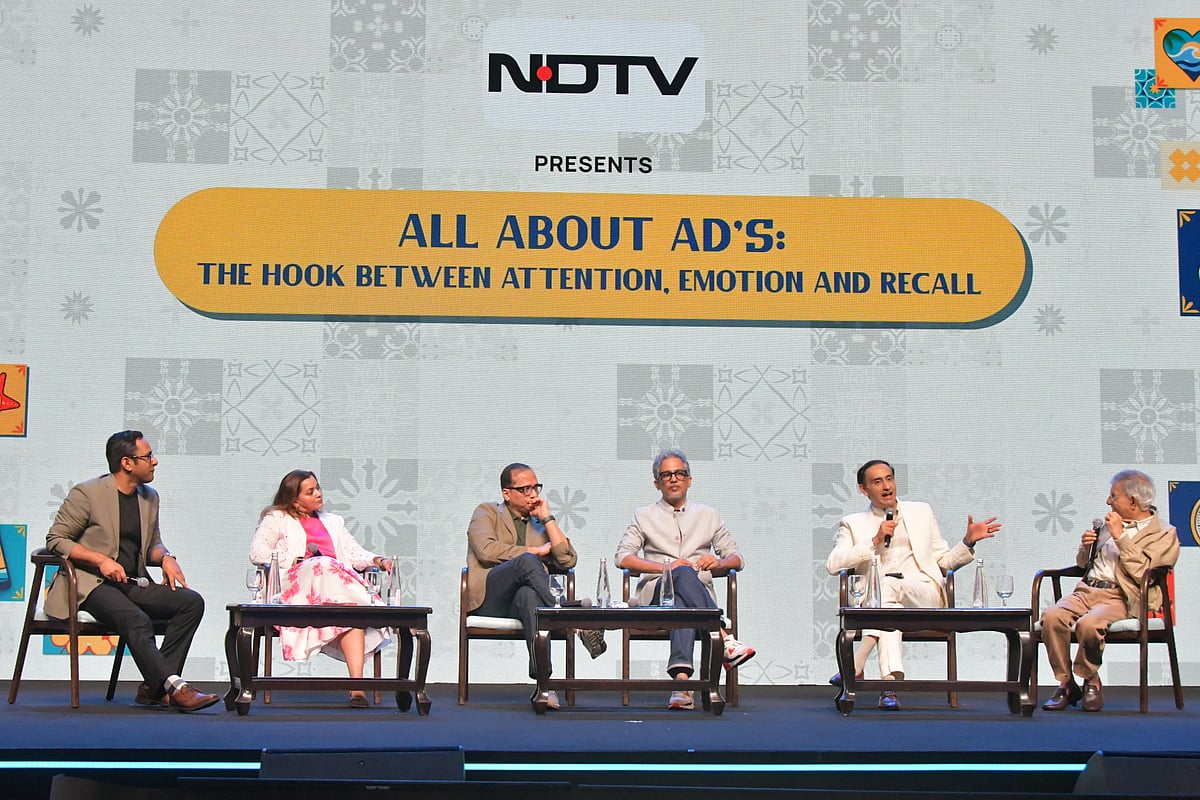
In ‘The Hook: The Craft, The Culture, The Conversation’, marketers and media leaders explored how brand-building itself is being rewritten. Traditional campaign cycles are giving way to always-on engagement, where relevance is measured in moments and attention is won—or lost—within seconds.
The session featured Darshana Shah, Chief Marketing Officer, Aditya Birla Capital; Rahul Kanwal, CEO & Editor in Chief, NDTV; Rana Barua, Group Chief Executive Officer, Havas India; Rohit Kapoor, Chief Executive Officer, Swiggy; and Sam Balsara, Chairman, Madison World. The session was moderated by Alex Matthew, Associate Executive Editor, NDTV Profit.
The panel reflected a growing industry reality: brands no longer compete only with competitors. They compete with feeds, creators, trends, and the endless stream of content consumers encounter daily.
Speakers highlighted how virality now emerges unexpectedly and spreads instantly. Yet despite the speed of culture, long-term brand building remains irreplaceable. Trends may explode overnight, but trust, memory, and brand equity still take years to create.
This tension between immediacy and consistency surfaced repeatedly throughout the day. While AI can accelerate execution and reduce production costs, speakers repeatedly returned to the same conclusion: machines may generate content, but meaningful ideas still come from human understanding of culture, emotion, and context.
The conversation became even more analytical during sessions focused on data and audience measurement.
As consumers increasingly rely on AI to recommend, filter, and decide, marketers face a new challenge: understanding audiences across fragmented platforms while maintaining transparency and trust. Discovery is becoming conversational rather than search-led, and influence increasingly flows through creators, communities, and ecosystems rather than traditional placements.
That evolution led naturally into one of the morning’s strongest themes—ownership.
In ‘The War on Data – Who Owns The Signal?’, leaders examined how brands, publishers, and platforms are adapting to a world shaped by privacy regulations, first-party data, and consent-driven ecosystems.
The session featured Mayank Shah, Vice President at Parle Products; Anjali Madan, Director, Consumer Experience, Global Marketing, Mondelez International; Sanjay Sindhwani, CEO, Indian Express Online; and Saikat Sinha, Director, Consumer Experiences, The Coca Cola Company. The session was moderated by Gowthaman Ragothaman, Founding Chief Executive Officer, Saptharushi.
The consensus was unmistakable: future advantage will belong not to those with the most data, but to those who earn the right to use it.
As Day 2’s first half wrapped, one takeaway stood above the rest.
Goafest 2026 wasn’t celebrating AI as a magic solution. Instead, it framed AI as a force multiplier—powerful, inevitable, and transformative, but only when guided by creativity, trust, cultural intelligence, and human judgment.
The future of advertising, it seems, won’t belong to the fastest algorithm.
It will belong to those who know what to do with it.
RECENT STORIES
-
-
-
-
-