Women Talking, Women Writing: The Daughters of Independence Through the Ages
This review of 'The Miranda Chronicles' explores how one women’s college became a quiet witness to generations of independence, dissent, and self-discovery. Through memories, conversations, and everyday campus life, the book pieces together a living history of women shaping their own spaces after Independence.

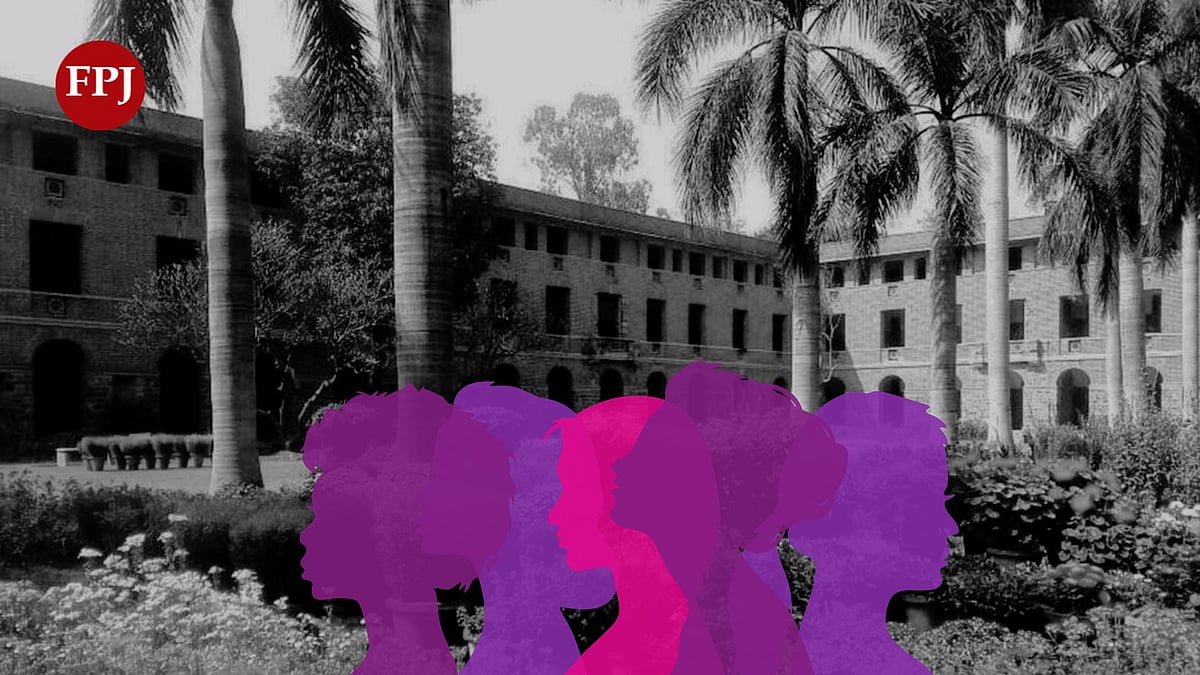
Women Talking, Women Writing: The Daughters of Independence Through the Ages | X/Altered by FPJ
Why should one read The Miranda Chronicles? Why must one know the MH story? For an answer, one might take into account the fact MH was one of the first women’s colleges of its kind. Or, maybe even how newspaper matrimonial columns once firmly appealed, “Miranda and LSR girls need not apply”. Larger than life though these make MH, these big histories somehow do not suffice as reason. There must be something more, then, something at the base of these occurrences that makes a perusal of this volume a liberating experience, something that makes it worthwhile even for a non-Mirandian to pick up this compendium.
The Miranda Chronicles reads like a microcosm of India as women experienced it after independence. In her introductory note to the volume, the editor envisions it as an everyday Miranda classroom, one, I might add, from where the lecturer has stepped out, leaving the students to their conversations.
The readers are only passersby, pausing and eavesdropping at the classroom window, becoming unseen listeners to their stories. Standing at the window and listening in, the reader gradually becomes a part of the conversations that unfold.
Why is it important for the reader to pause at this window? For the simple and yet meritorious reason that these are women talking, for themselves and among themselves. They talk without external censorship or editorial interruption. Dr. Ray neither footnotes their speech, nor adds on to or takes away from what their memories produce. Their opinions, arising out of their own accord, takes the form of both dissent and praise, and just as the praise is given ample space, the criticism too is placed alongside without comment. Their speech is free, and recounts personal anecdotes, private struggles, buried griefs, and fondly remembered joys. It also reproduces political scenes — while some confess to being too sheltered from the turmoil outside the gates of MH, some others forward accounts of how the turmoil seeped in through the walls, and still others of how they, in turn, slipped out through them to navigate, correct, and revise the upended politics of the violent decades that followed Independence. Ideologies and perspectives both complement and clash. In the same space of the book as of the college, Mrs. V. Krishna makes it rain on stage for the first time, and Anuradha Kapur rewrites Gorky in Hindi; Ruth Vanita forms a feminist circle that would later grow into Manushi, and Sudha Sarin begins “Thursday Night” where accomplished women, yet again, talk to their still budding counterparts.
In important feminist scholarship on the relationship between women and the spaces they inhabit, the latter is seen as shaping the former, writing the stories of their days as they are lived. More often than not, the house overrides the woman and closes off her space within four determining walls. Miranda House, on the other hand, houses women to liberate them. Most of the contributors to the volume mention the Miranda lawns, libraries, and hostels with the telling words “room” and “space”. They all had space and room, they write, to be who they were, and grow. MH thus emerges for these women as the much coveted room of one’s own. It is a place-turned-space, formed out of women’s independent negotiations with freedom, liberty, and power. It is a space that the women chart independently, for themselves and the generations to come. The book, in its turn, reproduces this space as a polyphonous history, refracted through the stories of women.
Neither is Miranda House above reproducing the social fractures and divisions that exist beyond its gates. The book has its writers talk about the divide between the “pseudos” and the “snoot” (Pamela Nangia witnessed and recorded this even as far back as 1958), the derision of BA Programme students as behenjis, and the class divides that emerge as some women jostle for space in the U-specials, and others zoom in in second hand cars, purchased specially for their college travel. While these fault lines are criticised in acerbic tones, hope for reform is also voiced. Seamlessly, a severe critique of the snobbery of Miranda House follows hard upon a narrative that claims that an MH classroom never saw race, class. Or religion, and the book allows these experiences to exist side by side, leaving it to the reader to discover the complete picture. A complete picture itself is revealed as non-existent, as the book busts the myth of a homogenous Miranda House, or a typical Miranda Girl. Writers recount both friendship and loneliness, boldness and reserve, academic brilliance and classroom struggles, and most importantly, political action and political complacency. All these women together form Miranda House, and as each invents their own way of tasting and testing freedom, a feminist history is written and solidified for the generations to come.
The passage of historical time is charted through lived memories as students migrate from chaat outside the gates to chai samosa in the canteen as the years run on. Gradually, tastes give way to DePaul’s eclairs and Nirula’s cold coffee. Drinking coffee from Oberoi becomes a demonstration of resolve, and a horde of women marching into the cafe and occupying a table after hours becomes yet another instance of that charting out of space for themselves and their presence. Acceptable clothing changes from saris to the shalwar kameez or the churidar, slowly giving way to bell bottoms, until Ruth Vanita decides to wear jeans to class. The clothes of Mirandians can make a statement, but can also be inconspicuous; they can be an experiment in fashion, while also being regular. Quotidian accounts of eateries accessed, food relished, and clothes worn and discarded, all emerge as testimony to the workings of these women's minds in and against their times. These everyday accounts both build and are built by bigger histories. They are the history of self-expression and self-fashioning, recounted through the age-old method of telling histories: women talking.
At the same time, Miranda House is never just its women. The space that forms them is never formed just by them. In the memories of its inhabitants arise the familiar calls of Munshiramji — Bhijitor for you! — and the smiling care of Sujan Singh — Gudidea, aaj paneer ki sabzi bani hai! The men who sneaked the women in when they broke curfew, or who sneaked them a dessert when dinner was particularly drab, together hammered at the space that is MH to make it expandable. Their stories from within the gates, so often lost under the glimmer of the women who went out of the gates to do great things, are found again so that this history of Miranda House does not exclude the labour of those on whose foundation this history rests.
So, why should one read The Miranda Chronicles? It is a history of women, by women. It is the history of women as walked and made by women, and of education as lived by women. It is an archive of conversations, dialogues, revolutions, and conflicts that shape an institution, and by extension a society, a country, and gradually the world. Which reader shall not find a piece of themselves in the squealing terror of a latecomer tearing through roads to reach a hostel before curfew? Which reader has not lived a bleary-eyed exam morning with skirts pulled over their shorts? The solidarities forged in a women’s hostel is an experience common to most women scholars, and The Miranda Chronicles serves to highlight how these quotidian events of women’s existence together serve to build and make, to create history, and chart pathways. The compendium is valuable as both history and archive, as women’s testimony of the changing world, and thus worth preserving through constant perusal and mention. At the same time, more reconstructions, as Dr. Ray calls the book, of “institutional memory”, are necessary, as more women’s colleges and other spaces record the memories and conversations of their women. It is thus that memory shakes hands with history, and history is lived, experienced, and made.
The Miranda Chronicles: Daughters of Independence
Edited by: Devjani Ray
Publisher: Har Anand Publications, Delhi
RECENT STORIES
-
-
-
-
-