Tome And Plume: Bhopal Remains Bathed In Bappa’s Blessings Since The Days Of Yore
Bhopal’s bond with Lord Ganesha stretches far beyond its first public Ganesh Puja in 1947. From ancient rock-cut shrines and the nearby Udayagiri Ganesha to the iconic ‘Bhopal Ke Raja’, the city carries a rich legacy of faith. Its distinctive tradition includes idol immersions on both Dol Gyaras and Anant Chaturdashi.

Tome And Plume: Bhopal Remains Bathed In Bappa’s Blessings Since The Days Of Yore | FP photo
Bhopal (Madhya Pradesh): Unlike in other cities, the immersion ceremony of the idols of the Lord takes place twice in Bhopal: on Dol Gyaras and on Anant Chaturdashi.
The City of Lakes has remained bathed in the blessings of Bappa since the days of yore, though it witnessed the first public Ganesh Puja 80 years ago on September 18, 1947.
If we include the Chintamani Ganesha temple in Sehore within the periphery of the city, its association with the Lord exists for nearly two millennia.
The legend has it that the idol in the Sehore temple manifested itself, and King Vikramaditya built the temple. The mysterious idol remains half-buried in the ground.
Whenever devotees visit there for the first time with a wish, they draw an upside-down Swastika, and after Bappa fulfils their wishes, they return to the temple and sketch a regular Swastika in gratitude.
But the oldest datable Ganesha idol in Madhya Pradesh, and arguably all of India, exists in Cave Number Six of the Udayagiri hills in Vidisha, 57 km away from Bhopal.
Carved directly into the rock face during the Gupta Empire, an inscription at the cave’s entrance dates the site to 401 CE during the reign of King Chandragupta II. The idol dates back 1600 years. Jitendra Nath Bannerjea has referred to the statue of Ganapati in his book, The Development of Hindu Iconography.
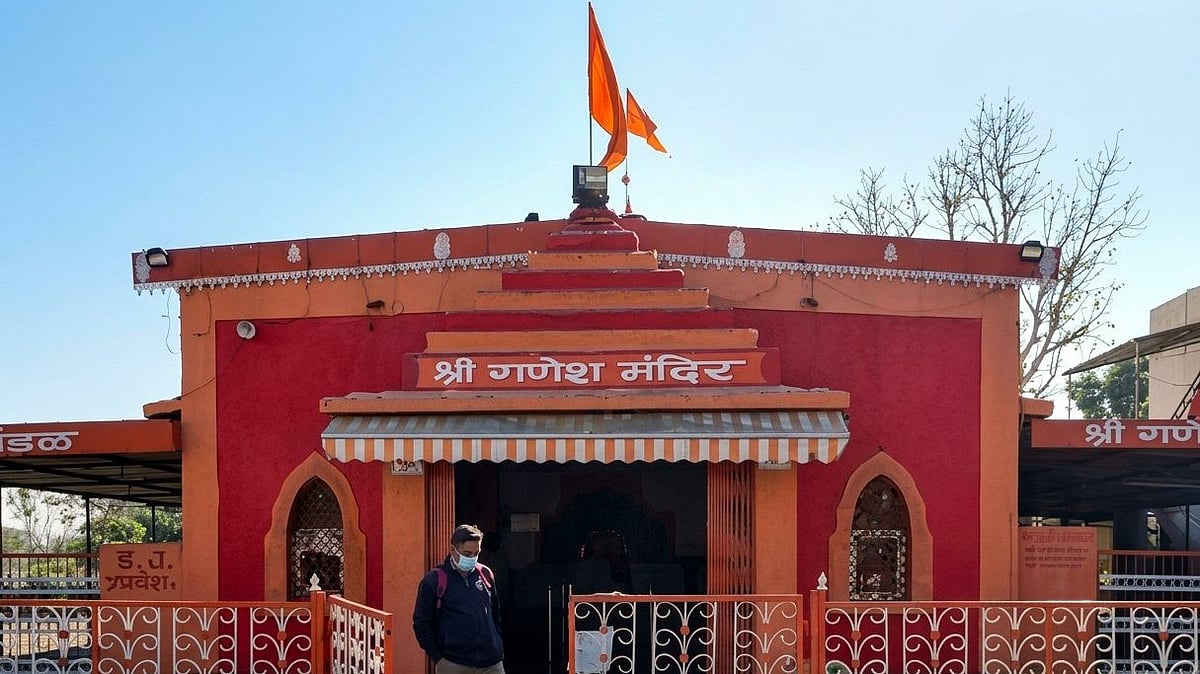
The state capital has another ancient temple in Bhadbhada close to the Upper Lake, which locals say belongs to the Parmar era. But the history of the temple lacks evidence. It has a rock-cut ancient idol, but vermillion coats cover the idol, hiding it from view.
The innermost sanctum sanctorum (garbhagriha) of the temple consists of natural rock-cut cave features. Devotees believe the ancient artisans carved the original deity directly out of the existing lakeside rock face. However modern the city may have been, the Bhadbhada Ganesh temple continues to preserve its aura.
People worship the Lord as the Vighnaharta (remover of obstacles) and the guardian of Bhopal’s waters. Generations of locals believe that Lord Ganesha’s placement near the Upper Lake keeps the city safe from natural calamities.
The site remained the place of quiet worship. Nevertheless, the first public Ganesh festival in its present form took place at Peepal Chowk (Chowk Bazar) in Bhopal on September 18, 1947.
India gained independence the same year in August, but the city remained a princely state under Nawab Hamidullah Khan until its formal merger with the Indian Union in June 1949.
Thus, the initial public celebrations of Ganesh Chaturthi in the city correspond with the final years of the Nawabi era. In the tumultuous atmosphere of 1947, marked by widespread riots across the country, Bhopal Ke Raja emerged as the city's most iconic cultural symbol. But before 1947, Ganesh Chaturthi remained a private family affair.
A group of local traders, inspired by Lokmanya Tilak, who turned the Ganesh festival into a public affair to encourage the people to join the freedom struggle in 1893, organised the first public worship of the Lord in the city.
Initially, it remained a low-key affair, but Mohan Lal Singhal, a freedom fighter, and a few merchants of the old Chowk Bazar in Bhopal, set up Shri Dol Gyaras Samaroh. They installed Bhopal’s first public Ganapati idol at Peepul Chowk.
Today, residents of the state capital call the idol ‘Bhopal Ke Raja’ and worship Him at the city’s richest pandal. Ganapati stays dolled up with over 100 kg of silver ornaments during the festival. The transition of the festival from private courtyards to open public squares made it possible for the common man to participate in the celebrations, breaking social barriers.
The Bhadbhada area, a site of the ancient rock-cut shrine, has become a primary hub for local artisans who make hundreds of idols for celebrations.
Unlike in other cities, the immersion ceremony of the idols of Ganesh in Bhopal takes place twice: on Dol Gyaras and on Anant Chaturdashi. Lively processions with the idols of the Lord pass through the thoroughfares. Thousands of people gather on the banks of the Upper Lake for the immersion rituals, bringing the modern city back to the lake where Bhopal’s Ganesha worship began nearly 1,000 years ago.
RECENT STORIES
-
-
-
-
-