Summer Solstice: MP Experiences Longest Day Of The Year With A 32-Minute East-To-West Disparity
On June 21st, the Summer Solstice brings the year's longest day as Earth’s North Pole tilts 23.5° toward the Sun. Science communicators clarified that "Zero Shadow Day" only occurs on the Tropic of Cancer. Additionally, the MP's geographic expanse creates a 32-minute daylight disparity from east to west.

Summer Solstice: MP Experiences Longest Day Of The Year with A 32-Minute East-To-West Disparity |
Bhopal (Madhya Pradesh): On June 21st, the Summer Solstice brings the year's longest day as Earth’s North Pole tilts 23.5° toward the Sun.
Additionally, the Madhya Pradesh's geographic expanse creates a 32-minute daylight disparity from east to west.
On this day, the Northern Hemisphere will experience the longest day and the shortest night of the year.
Explaining the scientific basis of the Summer Solstice using a model, scientists said that on this day, the Earth's North Pole is tilted towards the Sun at an angle of approximately 23.5 degrees.
Scientifically, this phenomenon is known as the Summer Solstice. During this time, the Sun's rays fall vertically on the Tropic of Cancer, resulting in the longest day of the year.
Onset of Dakshinayan - Sun's southward journey and shorter days
The scientist explained that after June 21, the Sun's position begins to shift southward, a phase known as 'Dakshinayan'. Consequently, days gradually become shorter and nights longer, signalling a change in the season.
Clarifying misconceptions about 'Zero Shadow Day'
During the program, the scientist also addressed a common misconception. It was clarified that 'Zero Shadow Day' occurs only at locations situated on the Tropic of Cancer.
In regions south of the Tropic of Cancer, including parts of Madhya Pradesh, this event takes place in April or May, whereas it never occurs in cities like Delhi and Jammu.
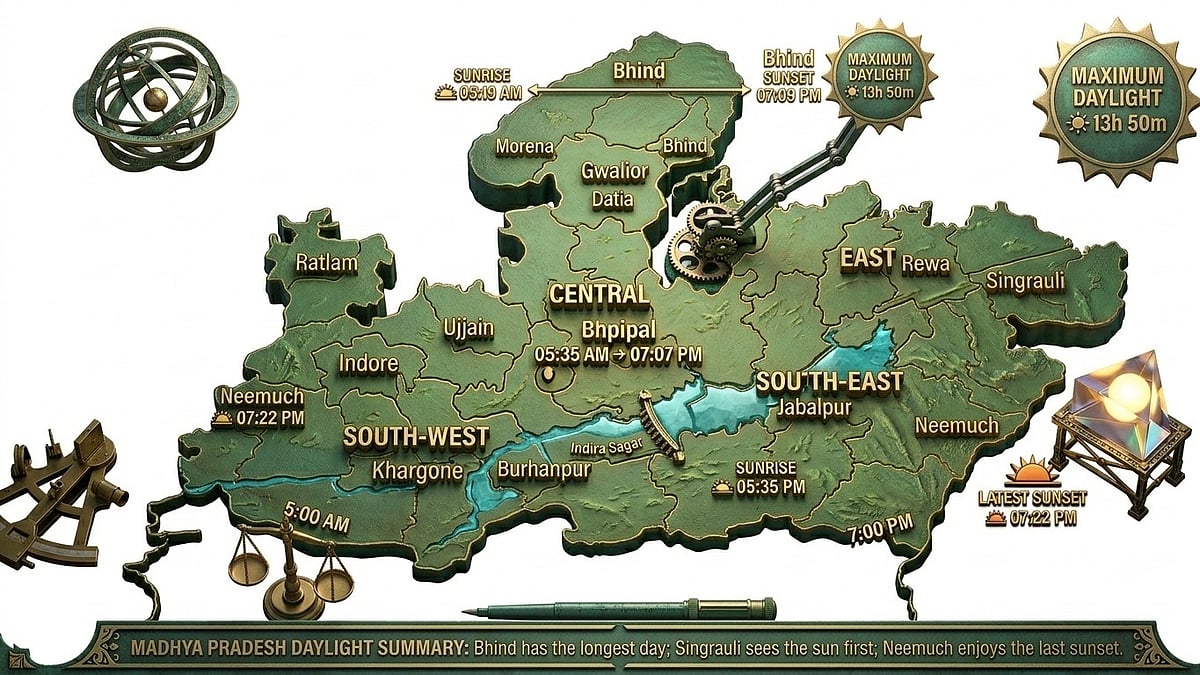
A 32-minute difference from East to West
The impact of Madhya Pradesh's geographical expanse was clearly evident in the sunrise and sunset timings.
The earliest sunrise occurred in Singrauli at 5:12 am, while the latest sunset was recorded in Neemuch at 7:22 pm.
Thus, there was a difference of approximately 32 minutes between the state's eastern and western extremities.
ALSO READ
RECENT STORIES
-
-
-
-
-