Forest Cover: State Battles Shrinking Forests, Rising Wildlife Threats In Bhopal, Other Districts
However, habitat fragmentation, infrastructure development, climate impacts and rising wildlife intersections threaten long-term ecological stability. Vision 2047 adopts an integrated approach for conserving biodiversity, securing wildlife corridors and embedding coexistence mechanisms within landscape management.

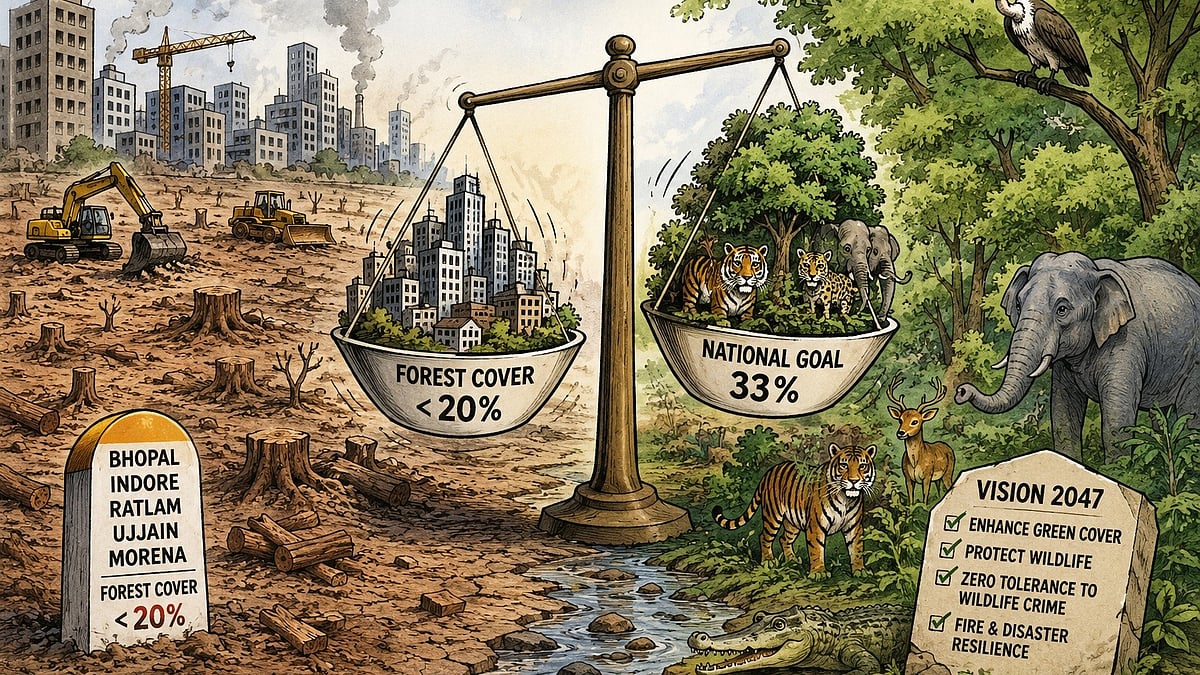
Forest Cover: State Battles Shrinking Forests, Rising Wildlife Threats In Bhopal, Other Districts | File pic
Bhopal (Madhya Pradesh): Madhya Pradesh faces significant intra-state disparities in green cover. Nearly one-third of its districts, including Bhopal, Indore, Ratlam, Ujjain and Morena, have forest cover below 20% due to urban growth and land use change.
Bridging this gap through Trees Outside Forests (TOFs) is central to achieving the national objective of 33% green cover of the National Forest Policy 1988 and fulfilling climate goals under the Paris Agreement.
The objective is to achieve 33% forest and tree cover in the state by planting TOF in low forest cover areas and reducing grazing pressure.
This has been stated in the forest department’s Vision 2047. In the chapter on Forest and Wildlife Protection, the vision document says that 25% area of the state is under forest cover.
However, these forests face increasing pressure from organised forest and wildlife crime and from recurring forest fires aggravated by climate change, extended dry periods and anthropogenic activities.
Illegal felling, poaching, encroachment and wildlife trafficking erode both ecological integrity and governance credibility.
Often, fires are deliberately set to conceal illicit activities, creating an intertwined challenge of crime, fire and climate risk.
To deal with such challenges, the vision document envisages establishing zero tolerance, full deterrence and total transparency in forest and wildlife crime prevention, integrating data, digital forensics, cyber intelligence and inter-agency coordination and total resilience against fire and disaster.
Under key challenges, the vision highlights low conviction rates due to poor documentation and weak chain of custody, absence of integrated data sharing among forest, police, prosecution and judiciary.
It also highlights limited digital forensic and cybercrime capabilities, no real-time detection of fire, and inadequate field infrastructure like watch towers, water points and so on.
Biodiversity conservation
The state is home to 785 tigers followed by 3,907 leopards, 12,710 vultures, 2,456 gharials and 772 wolves along with 50,000 plant and animal species.
However, habitat fragmentation, infrastructure development, climate impacts and rising wildlife intersections threaten long-term ecological stability.
Vision 2047 adopts an integrated approach for conserving biodiversity, securing wildlife corridors and embedding coexistence mechanisms within landscape management.
The vision document speaks of challenges related to the population of tigers in and around Bhopal. It adds that over the past decade, wild elephants, once locally extirpated from most of the state, have recolonised parts of the state.
RECENT STORIES
-
-
-
-
-