The SCO’s Civilisational Moment: Can Delhi Turn Shared Heritage Into Strategic Dialogue?
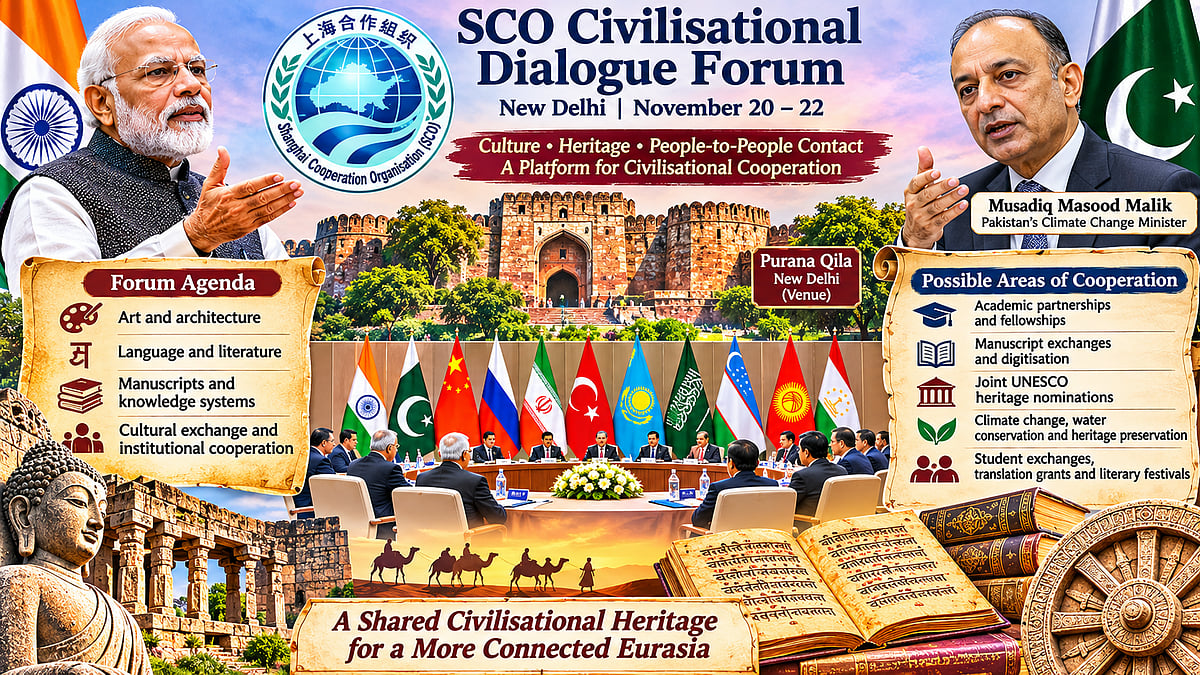
Pakistan plans to send Climate Change Minister Musadiq Masood Malik to the SCO Civilisational Dialogue Forum in Delhi from November 20 to 22, according to the article. It would mark the first Pakistani ministerial visit in over three years. The forum will focus on shared cultural heritage amid strained ties following the 2025 Pahalgam attack and Operation Sindoor.

The SCO’s Civilisational Moment: Can Delhi Turn Shared Heritage Into Strategic Dialogue? | AI
When nations find it difficult to agree on the present, they can sometimes discover common ground in the past. The Shanghai Cooperation Organisation’s (SCO) Civilisational Dialogue Forum, scheduled in New Delhi from November 20 to 22, seeks to build such a bridge. Pakistan’s decision to send its climate change minister Musadiq Masood Malik adds significance. It will be the first visit by a Pakistani minister to India in more than three years, following the freeze in relations after the Pahalgam terror attack and Operation Sindoor in May 2025.
By bringing Eurasian representatives to Purana Qila, India is placing culture alongside the SCO’s conversations on security, trade, and connectivity. Pakistan’s participation does not signal a revival of bilateral dialogue but offers an opportunity to keep a channel open.
Islamabad initially considered sending its federal minister for national heritage and culture, Aurangzeb Khan Khichi, but nominated Malik instead. The choice of a climate minister rather than the culture minister matters. Pakistan has, nevertheless, said it remains committed to dialogue among civilisations and people-to-people contact within the SCO framework.
Agenda: From Cultural Exchange to Institutional Cooperation
The forum will address art, architecture, language, literature, and manuscripts. Four sessions are planned after Prime Minister Narendra Modi inaugurates it on November 20. Modi proposed the initiative at the SCO Summit in Tianjin in September 2025 to add a cultural dimension to the organisation’s security and economic agenda.
Despite different political systems and strategic ambitions, SCO societies have long been connected through trade, migration, religion, languages, and intellectual exchange. The forum can remind governments that the region’s history is larger than its disputes.
Manuscript exchanges, digitised collections, exhibitions, academic partnerships, and joint UNESCO heritage nominations could turn goodwill into cooperation, provided countries invest in scholarship and institutional coordination.
Pakistan’s Participation and the Diplomatic Opportunity
Relations deteriorated sharply after the April 22, 2025, Pahalgam attack, which killed 26 people. India launched Operation Sindoor on May 7, targeting terrorist infrastructure in Pakistan and Pakistan-occupied Kashmir. The confrontation ended with a ceasefire on May 10.
India’s suspension of the Indus Waters Treaty and restrictions on travel and diplomatic engagement, alongside Pakistan’s suspension of bilateral trade and closure of its airspace to Indian aircraft, further strained ties. Direct political engagement remains limited. The SCO is, consequently, among the few multilateral platforms where both countries continue official interaction.
The debate also has an ideological dimension. In May 2026, senior RSS functionary Dattatreya Hosabale advocated keeping dialogue open through people-to-people contact. He stressed that India’s security must be protected and terrorism dealt with firmly, but dialogue should not be abandoned.
RSS chief Mohan Bhagwat clarified that Hosabale’s remarks referred principally to the people of Pakistan, rather than its political establishment. He said the RSS would follow the government’s policy towards the Pakistani state while emphasising historical and cultural connections between the two peoples.
The RSS position thus combines firmness against terrorism with support for contact between people. The SCO offers a limited setting to explore this approach without confusing cultural engagement with political normalisation.
India’s Opportunity and the Challenges
India invited 25 countries; 15 had confirmed before Pakistan’s announcement, including China, Saudi Arabia, Iran, Türkiye, and the Central Asian states. Their traditions are interconnected: Buddhism and trade linked China with the region, Persian influence shaped its languages and architecture, and historic routes carried merchants and scholars across borders.
For India, the gathering is an opportunity to present itself as a civilisation whose influence has travelled across Asia. Culture minister Gajendra Singh Shekhawat has urged a focus on cultural links, noting that India and Pakistan followed parallel civilisational trajectories despite Partition. The main question is whether a shared heritage creates a space for dialogue amid deep political rivalries.
Obstacles remain substantial. India and China face border issues and strategic competition; India and Pakistan have a deeper trust deficit, intensified by terrorism. Competing historical narratives also complicate matters. The Indus Valley Civilisation, for instance, has entered political discourse amid the Indus Waters Treaty dispute. Yet ancient civilisations predate modern states and cross borders.
India must ensure the agenda is inclusive, giving every country space to contribute. Continuity requires a clear framework, responsible institutions, and periodic reviews; otherwise, the forum risks remaining ceremonial.
Future Projections: From Dialogue to Partnership
Fellowships, student exchanges, translation grants, archaeological research, and literary festivals could extend the forum’s impact. Climate change, water conservation, and heritage preservation offer areas for cooperation despite political disagreements.
Pakistan’s participation matters because it is scheduled to host the SCO Heads of State Summit in Islamabad in August 2027. Both countries have maintained multilateral engagement, including Pakistan’s 2023 ministerial meeting in Goa and India’s 2024 participation in Islamabad. Regional cooperation must not become hostage to bilateral disputes; lasting normalisation, however, requires action against terrorism and restored trust.
The forum should be judged by sustained partnerships, not ceremony. Pakistan’s presence cannot resolve differences or erase the wounds of conflict, but cultural and academic engagement can preserve possibilities that formal diplomacy may find difficult to pursue.
The SCO cannot escape geopolitics, but it need not remain imprisoned by it. If Delhi combines scholarship with openness, institutional follow-through and respect for plural identities, the Civilisational Dialogue Forum could become an instrument of soft power and regional confidence-building. The past cannot settle every dispute; it can remind the region that cooperation has deeper roots than confrontation.
The writer is a strategic affairs columnist and senior political analyst based in Shimla.
RECENT STORIES
-
-
-
-
-